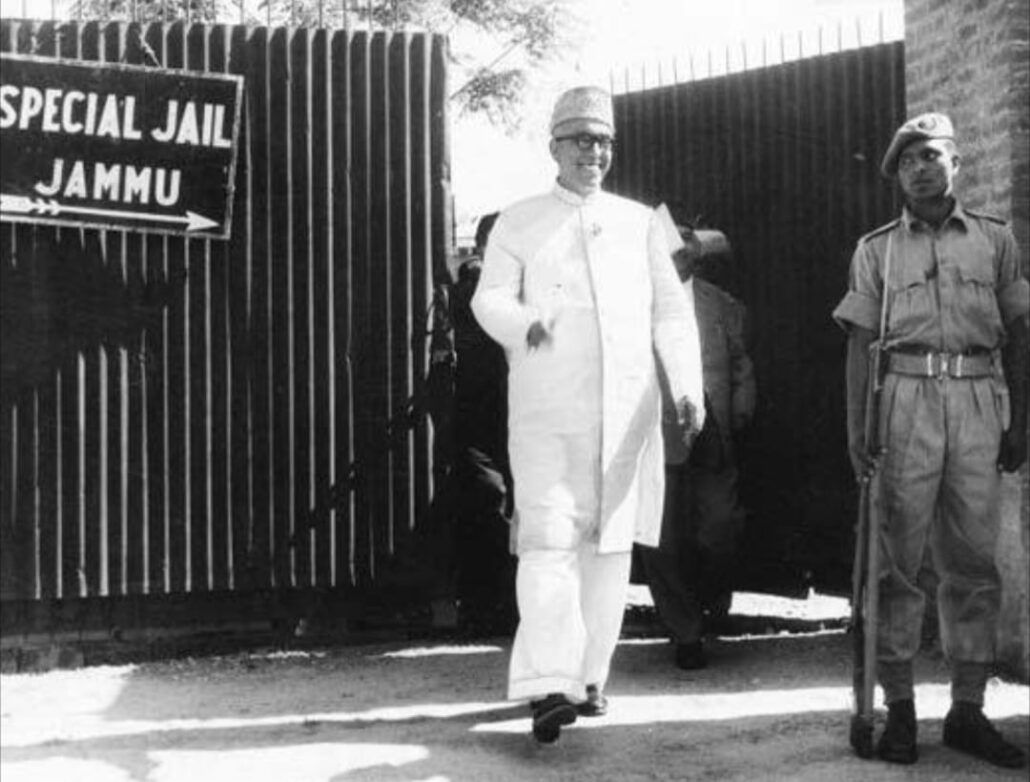
On the night of 8–9 August 1953, the political architecture of Jammu Kashmir and with it, the Indian Union’s compact with the state shifted decisively.
Dr. Karan Singh, the Sadr-i-Riyasat (constitutional head of state), dismissed Sheikh Mohammad Abdullah as Prime Minister and swore in Bakshi Ghulam Mohammad. The dismissal order is typically dated 8 August, with Abdullah’s arrest in the early hours of 9 August, a sequencing borne out by contemporary accounts and document collections.
ALSO READ: The Indira-Sheikh Accord: A step-by-step historical breakdown
The text of Karan Singh’s order read:
“Whereas I am satisfied that Shri Sheikh Mohammad Abdullah, the Prime Minister of Jammu and Kashmir, has lost the confidence of his colleagues in the Cabinet;
Now, therefore, in exercise of the powers vested in me under the Constitution of Jammu and Kashmir, I hereby dismiss Shri Sheikh Mohammad Abdullah from his office of Prime Minister with immediate effect.”
(Signed)
Karan Singh
Sadr-i-Riyasat, Jammu and Kashmir
9 August 1953
For many historians, this moment inaugurated a long phase of tutelary governance in Srinagar and marked a rupture in India’s federal promise to its only Muslim-majority state.
Setting the stage: From revolution to friction (1947–1953)
Sheikh Abdullah became the central figure of Kashmiri politics through the National Conference and Kashmiri nationalism, which promised land reforms and social justice. After Hari Singh acceded to India in October 1947 and an interim government was formed, Abdullah rose to head the administration, and from March 1948 formally as Prime Minister under the Kashmir’s constitution-making process [Schofield 2000].
India’s constitutional settlement with J-K culminated in Article 370, a bespoke arrangement recognizing the state’s autonomy, symbolized by its own constitution, prime minister, president (Sadr-i-Riyasat), and control over residuary powers [Noorani 2011].
Two currents soon strained the relationship with New Delhi. First, the Delhi Agreement of 1952 tried to codify a working division of powers and symbols (e.g., separate flag, Sadr-i-Riyasat elected from the state legislature), while integrating citizenship and the Supreme Court’s appellate jurisdiction. The agreement’s ambiguities left ample room for competing readings of autonomy and integration [Noorani 2011; Bose 2003]. Second, politics on the ground became polarized: the Praja Parishad in Jammu mobilized against special status and demanded “Ek Pradhan, Ek Nishan” (one head, one flag), while Abdullah in Kashmir became more vocal about Kashmiri distinctiveness and, at times, self-determination [Bose 2003].
By mid-1953, Abdullah’s rhetoric had sharpened. His Hazratbal and other speeches worried Prime Minister Jawaharlal Nehru, who had been Abdullah’s ally since the 1930s. Nehru now faced a two-front pressure: Hindu nationalist agitation in Jammu, and Western (especially Anglo-American) scrutiny of Kashmir at the UN, where a plebiscite remained on paper [Schofield 2000; Lamb 1991]. In April–July 1953, Abdullah shuffled his cabinet, clashed with key colleagues (notably Bakshi), and postponed confronting a legislative confidence test, exacerbating Delhi’s concerns that he might pull away from the Union or bargain for a quasi-sovereign status [Bose 2003; Lamb 1991].
The constitutional mechanism—and the missing floor test
In his autobiography Ātish-e-Chinar (Flames of the Chinar), Sheikh Mohammad Abdullah gives a vivid and emotional account of the events of August 1953, when he was dismissed from office and arrested. Abdullah describes how he immediately demanded to know on what grounds he had been removed. He writes that he confronted Dr. Karan Singh, the Sadr-i-Riyasat, and argued that if there was indeed any question of confidence, it ought to have been tested in the Assembly.
“Yeh faisla na to Assembly mein hua, na awaam se poocha gaya” (“This decision was not taken in the Assembly, nor were the people consulted”), he protested, underscoring that his dismissal was arbitrary and unconstitutional. For Abdullah, this was not only a personal slight but a violation of democratic principle.
The Sheikh portrays the episode as a carefully staged “conspiracy” orchestrated from Delhi. In his telling, Bakshi Ghulam Mohammad, along with a few other colleagues, had already aligned with New Delhi to engineer his downfall. He writes bitterly that Nehru, despite their long association, had allowed himself to be swayed by “afsaron aur chand saathi jo pehle se gathjod mein the” (“officials and a few colleagues who were already in league”). Intelligence officials had painted him as unreliable, and Nehru, instead of questioning this narrative, acquiesced.
What pained Abdullah most deeply, however, was not only the machination itself but Nehru’s silence. He believed Nehru could have intervened to stop the dismissal but chose not to. “Yeh faisla doston ki khamoshi ke saaye mein hua” (“This decision took place under the shadow of friends’ silence”), he lamented, hinting at the personal betrayal he felt.
The formal ground for removal was the assertion that Abdullah had “lost the confidence of his cabinet,” which the Sadr-i-Riyasat treated as sufficient to withdraw his commission as Prime Minister. Crucially, Abdullah was not allowed to demonstrate his majority on the floor of the Assembly, an omission that later commentators and scholars saw as politically decisive and constitutionally dubious. Karan Singh, who has offered first-person glances in memoiristic writings, recalls the fraught nighttime scene of 8 August and Abdullah’s fury at being dismissed by the “boy” he had helped install as Sadr-i-Riyasat [Karan Singh, memoir extracts].
Document compilations published by Oxford University Press include orders and correspondence from 9 August 1953, detailing the arrest and the swift administrative transition, which together suggest a coordinated plan executed with Delhi’s knowledge and assent [OUP docs, “Sheikh Abdullah’s Arrest: 9 August 1953”; Noorani 2011].
Tariq Ali characterizes the episode bluntly as “effectively a coup,” capturing the view among many contemporaries that New Delhi engineered the change and then retrofitted legal justifications [Ali 2001].
Alastair Lamb, writing from a diplomatic history perspective, argues the dismissal damaged India’s moral case internationally: Nehru had long presented Abdullah as the authentic voice of Kashmiris; removing him undermined that claim [Lamb 1991].
Installing Bakshi Ghulam Mohammad and the new order (1953–1963)
Bakshi Ghulam Mohammad, until then Abdullah’s powerful deputy and rival, was sworn in promptly and secured a vote of confidence later that year.
His government pressed ahead with development schemes and land reforms, while also tightening political controls, banning adversaries, and benefiting from a steady flow of central funds, what some scholars call a “patronage state” that blended welfare with surveillance. The infamous “Kashmir Conspiracy Case” (1958) targeted Abdullah and associates, alleging clandestine links with Pakistan and sedition; it dragged on for years, reinforcing the sense that the post-1953 order derived legitimacy more from Delhi’s backing than from uncoerced consent in the Valley [Schofield 2000; Noorani 2011].
Sumantra Bose situates 1953 as the foundational breach: a central intervention that normalized extraordinary methods, managed elections, cultivated client elites, and periodic detentions, to keep Kashmir within a tightening constitutional and security embrace [Bose 2003]. Political scientists have repeatedly returned to 1953 as a “first break” in India’s federal bargain, after which subsequent central actions (1984, 1987) were easier to justify in a narrative of “national security” [Mahadevan 2009; Bose 2003].
Was Nehru’s acceptance of Abdullah’s ouster a reluctant necessity or a strategic choice? The record hints at both. Nehru feared that Abdullah might be edging toward a third option beyond Indian integration and Pakistani accession, especially amid Cold War maneuvering and UN pressures; he also faced domestic agitation that cast special status as capitulation.
Yet the means, preempting a floor test, detaining a popular leader, and empowering a rival through the Sadr-i-Riyasat, cast a long shadow over India’s democratic self-image in Kashmir [Schofield 2000; Noorani 2011; Lamb 1991]. Alastair Lamb’s critique is severe: once Abdullah, the presumed “plebiscitary substitute”, was removed, India’s moral position weakened, even if its de facto control was consolidated.
Abdullah remained in and out of detention for much of the next decade, his supporters forming the Plebiscite Front in 1955 to press for self-determination.
Only after the 1974–75 Indira–Sheikh Accord did he return as Chief Minister (a title by then replacing “Prime Minister”), a symbolic downgrade from the office he had held before 1953 and a reminder of the incremental erosion of autonomy since that year [South Asia Journal overview citing Puri 1983]. Balraj Puri, a close observer and mediator between Nehru and Abdullah, later wrote that while reconciliation was attempted intermittently, 1953 had already reshaped trust and institutional norms in ways hard to reverse [Puri 1983].
Constitutional and historical significance
A.G. Noorani, through painstaking documentary work, reads 1953 as the hinge on which “erosion” of Article 370 swung: after Abdullah’s removal, a succession of presidential orders and state-centre bargains chipped away at J&K’s autonomy, while the Centre increasingly managed politics in Srinagar through pliant governments [Noorani 2011].
Victoria Schofield similarly treats 1953 as a decisive turn from consent to control, with the international fallout muted only by shifting global priorities and later bilateral frameworks [Schofield 2000]. For Lamb, it was not just a local constitutional matter but a blow to India’s case in world opinion; for Bose, it was the seedbed of alienation that would surface again and again in mass protests and insurgency [Lamb 1991; Bose 2003].
The dismissal of Sheikh Abdullah was constitutionally executed through the Sadr-i-Riyasat and politically engineered from New Delhi. Its immediate effect was to stabilize pro-Indian control through a loyalist prime minister; its deeper legacy was to entrench a pattern: central management over popular mandate. Whether judged as a necessary intervention amid grave uncertainty or as an original sin in federal relations, 1953 remains the pivotal moment when the promise of a distinctive autonomy gave way to a regime of tutelage. The long arc of Kashmir’s politics—from the Plebiscite Front to later crises—cannot be understood without that August night

- News Deskhttps://thekashmiriyat.co.uk/author/kashmiriyat/

- News Deskhttps://thekashmiriyat.co.uk/author/kashmiriyat/

- News Deskhttps://thekashmiriyat.co.uk/author/kashmiriyat/
- News Deskhttps://thekashmiriyat.co.uk/author/kashmiriyat/
