
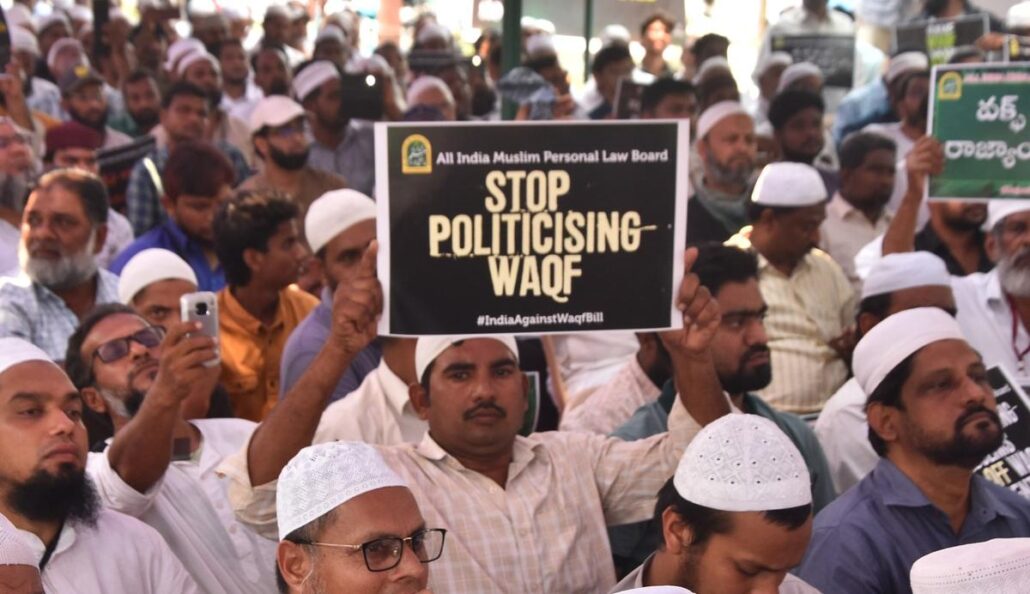
The Supreme Court of India on Thursday continued to hear a series of petitions challenging the constitutional validity of the Waqf (Amendment) Act, 2025—an amendment to the original Waqf Act of 1995, which governs the administration of Islamic religious endowments across the country.
The amendment, which was recently enacted by Parliament, has stirred controversy for making substantial changes to the structure and functioning of waqf boards. Among the provisions under challenge are those allowing the inclusion of non-Muslim members on waqf boards and enabling the de-notification of existing waqf properties—measures that petitioners argue violate the religious autonomy of Muslims and interfere with Islamic practices related to endowments.
Petitioners before the Court include religious organizations, waqf board members, and Muslim legal scholars. They argue that the amendments amount to a direct intrusion into the religious and charitable affairs of the Muslim community. In particular, they raise concerns that the inclusion of non-Muslims in the decision-making processes of waqf boards undermines the religious character of waqf properties and infringes upon Article 26 of the Constitution, which guarantees religious denominations the right to manage their own affairs in matters of religion.
Further, the petitioners contend that the new law opens the door for political and bureaucratic interference in the administration of waqf assets, which are meant to be preserved exclusively for community welfare as per Islamic jurisprudence.
In response, six states governed by the Bharatiya Janata Party (BJP) have moved the Supreme Court in support of the amendment, asserting that the changes bring greater transparency, accountability, and inclusivity to waqf governance. These states argue that public land disputes involving waqf properties have long needed clearer regulation, and that the amendment addresses these issues without violating religious freedom.
The case is being heard by a three-judge bench comprising Chief Justice of India Sanjiv Khanna, Justice PV Sanjay Kumar, and Justice KV Viswanathan. On Wednesday, the bench observed that it would examine whether certain key provisions of the amendment—particularly those affecting the composition of waqf boards and the status of existing waqf land—ought to be stayed while the constitutional questions are being deliberated.
The matter remains ongoing, with live updates being tracked as the hearings progress.
Live updates here:
SG Mehta: Give me one week’s time to file a preliminary reply with some documents. Meanwhile, the court should not issue interim orders.
The Chief Justice of India: The court plans to stay only on the three issues mentioned in the law. The situation will stay as it exists, and it will not be disturbed by the new law on these three specific issues.
CJI will dictate the order.
CJI: Only five writ petitioners can file an intervention. We only want five petitioners, and you select the five. Appoint a nodal counsel.
CJI Sanjiv Khanna: During the hearing, SG Mehta submitted that the respondents will file a short reply within seven days and assured that no appointments under the 2025 Act will be made, and the status of waqfs already notified or gazetted will remain unchanged. Reply to be filed within seven days; response within five days of service.
CJI: No Waqf property shall be de-notified.
CJI directed that the writ petitions challenging the 1995 Waqf Act and its 2013 amendments be listed separately. As a special case, petitioners who have filed writs in the 2025 matter are also granted liberty to file a reply. The Union, States, and Waqf Boards shall file their replies within seven days, with rejoinders to be filed within five days thereafter.
In proceedings challenging the Waqf Amendment Act, 2025, the Centre submitted before the Supreme Court that non-Muslims shall not be appointed to the Central Waqf Council or the State Waqf Boards.
No new appointments shall be made to the central or state Waqf boards until the next date of hearing.
The next hearing will be for preliminary objections and interim orders, scheduled for May 5, 2025, at 2:00 PM.
AIMIM chief Asaduddin Owaisi: “The Supreme Court has said that the Central Waqf Council and the State Waqf Board will not be constituted, and ‘Waqf by user’ cannot be deleted. During the deliberations of the Joint Working Committee, I have given a report opposing all amendments proposed by the government, and during the debate in the Parliament on the bill, I have called it (bill) unconstitutional. Our legal battle against this Act will continue.”
The People’s Democratic Party (PDP) President, Mehbooba Mufti: “The PDP and the people of Jammu Kashmir extend full solidarity with Muslims across India who are concerned about the future of Waqf properties. There was no concrete evidence against Afzal, yet the court ordered his hanging, citing the ‘collective conscience’ of the nation. We now hope that the same collective conscience will guide the court to protect the rights of Muslims in the Waqf matter.”
INC leader Imran Pratapgarhi: “I am thankful to the Supreme Court for the interim relief. The Court raised almost all the issues that we raised in the parliament. Today’s ruling shows that this law has been made against the Constitution. It’s a win for the Constitution and not any side. In the days to come, the Court will provide more relief and will stop the government’s conspiracy to grab the land.”
BJP MP Anurag Thakur: “It is very clear that a few people have taken control of assets worth two lakh crore rupees. Some leaders, in collaboration, even sold cemetery lands to build malls. Others permitted the construction of a 5-star hotel for just twelve hundred rupees. This open loot, which was happening under the name of ‘Waqf,’ is now being stopped. However, the benefits of these lands will now go to Muslim women, widows, girls, children, educational centers, healthcare centers, and in the form of their assistance. This is our commitment, and we will make it happen.”
AAP leader Amanatullah Khan: “We were here at the Supreme Court as petitioners. We are grateful to the Supreme Court for its historic decision in our favour. The government itself said that no amendments will be made in ‘Waqf by user’, it will remain as it is.”

- News Deskhttps://thekashmiriyat.co.uk/author/kashmiriyat/

- News Deskhttps://thekashmiriyat.co.uk/author/kashmiriyat/

- News Deskhttps://thekashmiriyat.co.uk/author/kashmiriyat/
- News Deskhttps://thekashmiriyat.co.uk/author/kashmiriyat/
