
Bhat Yasir
Chief Minister Omar Abdullah and PDP chief Mehbooba Mufti clashed on Friday over the Tulbul Navigation Project, as tensions between India and Pakistan remain high.
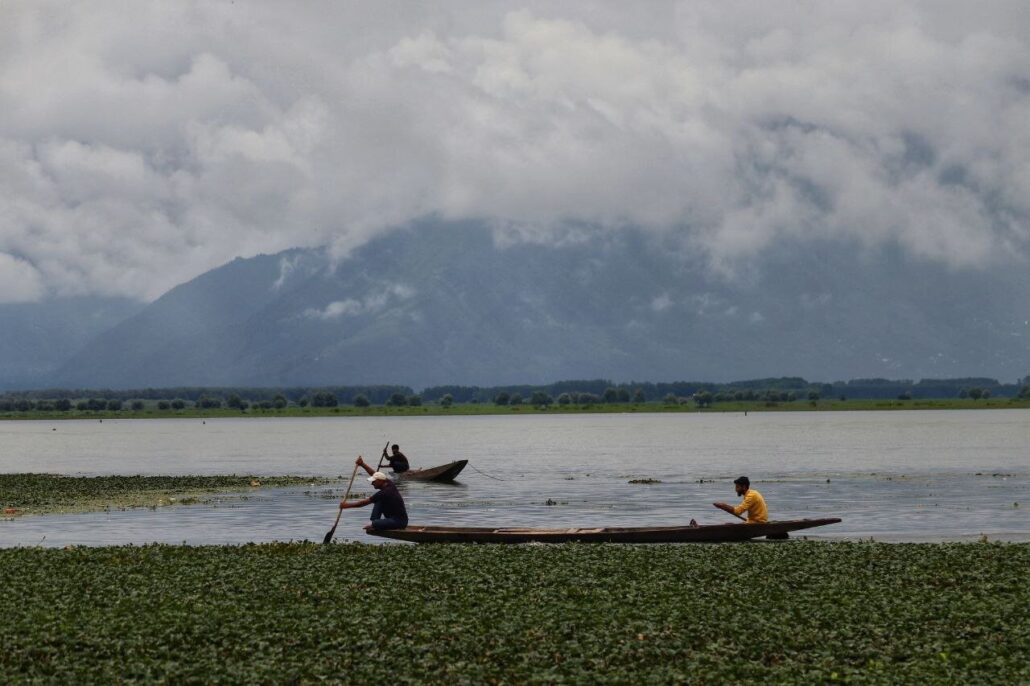
The exchange began after Omar Abdullah posted a video on X showing the civil works at the Wular Lake in north Kashmir. “The Wular lake in North Kashmir. The civil works you see in the video is the Tulbul Navigation Barrage. It was started in the early 1980s but had to be abandoned under pressure from Pakistan citing the Indus Water Treaty. Now that the IWT has been ‘temporarily suspended’ I wonder if we will be able to resume the project,” he wrote.
He added that reviving the project would offer significant benefits. “It will give the advantage of allowing us to use the Jhelum for navigation. It will also improve the power generation of downstream power projects, especially in winter.”
Responding sharply, Mehbooba Mufti called Omar’s remarks “deeply unfortunate.” In her post on X, she said, “Chief Minister Omar Abdullah’s call to revive the Tulbul Navigation Project amid ongoing tensions between India & Pakistan is deeply unfortunate. At a time when both countries have just stepped back from the brink of a full-fledged war—with Jammu and Kashmir bearing the brunt through the loss of innocent lives, widespread destruction and immense suffering—such statements are not only irresponsible but also dangerously provocative.”
She further warned against turning essential resources into instruments of conflict. “The people of Jammu and Kashmir deserve peace as much as anyone else in the country. Weaponising something as essential and life-giving as water is not only inhumane but also risks internationalising what should remain a bilateral matter,” she added.
Omar Abdullah then issued a scathing rebuttal. “Actually what is unfortunate is that with your blind lust to try to score cheap publicity points & please some people sitting across the border, you refuse to acknowledge that the IWT has been one of the biggest historic betrayals of the interests of the people of J&K,” he said.
He reiterated his long-held position on the Indus Water Treaty. “I have always opposed this treaty & I will continue to do so. Opposing a blatantly unfair treaty is in no way, shape, size or form warmongering, it’s about correcting a historic injustice that denied the people of J-K the right to use our water for ourselves.”
Tulbul Project
Signed in 1960, the Indus Water Treaty has long been a point of contention in Jammu Kashmir, where many see it as having restricted the region’s control over its own water resources. With the treaty now “temporarily suspended,” the debate around projects like Tulbul has resurfaced, triggering political friction in the region once again.
At the mouth of Wullar Lake near Sopore in Kashmir Valley, lies the long-disputed site of the Tulbul Navigation Project, which India began constructing in 1984.
The proposed barrage—439 feet long and 40 feet wide—aims to regulate the flow of the Jhelum River during the lean season, ostensibly to support navigation across a 22-kilometre stretch between Sopore and Baramulla. India maintains that the project would improve transport and trade in the Kashmir Valley and support downstream hydroelectric infrastructure, including NHPC’s Uri-I and Uri-II projects.
However, what India refers to as the Tulbul Navigation Lock, Pakistan calls the Wullar Barrage—and therein lies the diplomatic faultline.
Pakistan considers the project a violation of the 1960 Indus Waters Treaty, which governs the shared use of six rivers between the two countries. According to Islamabad, any storage above 0.01 million acre-feet on the Jhelum River—a Western River under the Treaty—is prohibited.
The proposed barrage’s original design envisioned a storage capacity of 0.30 million acre-feet, triggering fears in Pakistan that the structure could be used by India to manipulate water flows, either during hostilities or to damage the irrigation infrastructure critical to its Triple Canal Project, which links the Jhelum and Chenab rivers with the Upper Bari Doab Canal.
For decades, this technical dispute has remained unresolved despite at least thirteen rounds of bilateral talks, including five under the Composite Dialogue framework. In 2012, India even indicated a willingness to seek international arbitration under the Treaty after bilateral discussions stalled again.
New Delhi’s position, however, is that the project is legal under the Treaty’s allowance for non-consumptive use, like navigation.
According to Indian engineers, regulating the natural outflow of the lake would ensure minimum flow levels of 4000 cusecs and a lake level of 5,177.90 feet—both needed to keep the river navigable year-round, especially during the winter months when the flow often drops to just 2000 cusecs.
Beyond navigation, the constant winter flow would benefit both countries, say project engineers, by stabilising hydropower generation.
Interestingly, Indian officials have said that some Pakistani water experts who visited the site acknowledged the potential benefits of the project for Pakistan’s own Mangla Dam–fed hydropower operations in Muzaffarabad. Still, concerns persist in Islamabad over how the project might be misused.
The political and security environment in Kashmir has also played a role in halting construction. In 1987, following strong objections from Pakistan, then Prime Minister Rajiv Gandhi ordered the suspension of the project. Subsequent attempts to revive it, including by Omar Abdullah’s government, have been sporadic and met with resistance on the ground.
In April 2012, grenade attacks at the construction site in Ningli led to a mass exodus of migrant labourers, halting work again.
The site today remains strewn with rusted equipment, empty cement bags, and derelict offices—silent reminders of a project that has become both technically entangled and politically explosive.
The Tulbul site also has a longer, lesser-known history. As early as 1912 and again in 1924, the then Punjab government had approached the Kashmir Durbar to build a barrage on the Wullar Lake to help irrigate the plains of Punjab.
Both proposals were rejected out of fear they might flood large parts of North Kashmir. In the 1970s, as part of a renewed interest in reviving waterway transport in Kashmir, the idea of a navigation lock resurfaced—eventually resulting in the Tulbul plan. It was initially located closer to Sopore but later shifted to Ningli after objections from Pakistan’s Indus Water Commission.
In 2007, then Water Resources Minister Saifuddin Soz had claimed that the project did not violate the Treaty and that even a Japanese firm had shown interest in funding it.
That optimism, however, failed to translate into progress. Between 1987 and 2005, the Indian government incurred substantial costs—over ₹45 crore—for maintaining idle project staff, with total projected costs eventually ballooning to ₹150 crore.

- News Deskhttps://thekashmiriyat.co.uk/author/kashmiriyat/

- News Deskhttps://thekashmiriyat.co.uk/author/kashmiriyat/

- News Deskhttps://thekashmiriyat.co.uk/author/kashmiriyat/
- News Deskhttps://thekashmiriyat.co.uk/author/kashmiriyat/
