
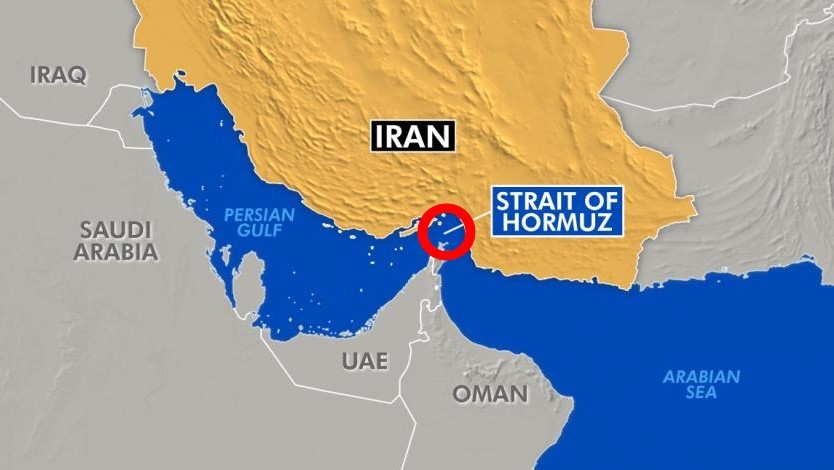
Amid widening regional escalation, a senior Iranian lawmaker has confirmed that Iran’s Parliament has formally recommended the closure of the Strait of Hormuz, with the final decision now lying with the country’s Supreme National Security Council.
Major General Esmail Kowsari, an influential member of the Iranian Parliament’s National Security Commission, said the chamber has “reached the conclusion” that shutting down the strategic waterway is now a necessary option in response to Israeli strikes and continued Western support for Tel Aviv.
“The decision, however, rests with the Supreme National Security Council,” Kowsari clarified, signaling that the measure—long treated as a last-resort deterrent—is now being seriously weighed at the highest levels.
This comes just days after Israel launched an unprovoked strikes against Iran.
The Strait of Hormuz is the world’s most vital energy chokepoint, with 17 to 20 million barrels of oil—roughly 30 percent of global seaborne oil—passing through it each day.
There is no alternative maritime route for oil exports from Gulf countries like Saudi Arabia, Iraq, the UAE, and Iran itself.
A closure of this waterway would immediately trigger global panic, send oil prices soaring, and plunge energy-importing economies into deep economic distress.
Experts warn that even a temporary disruption would shake oil markets, spark inflation, and lead to severe energy shocks across the world. Insurance companies are already recalibrating risk for vessels navigating the Persian Gulf, and many shipping firms are on high alert.
Bab al-Mandab
Adding to the global unease, Yemen has once again threatened to block the Bab al-Mandab Strait, the narrow waterway that links the Arabian Sea to the Red Sea and the Suez Canal.
Yemen has explicitly declared their intent to target Israeli or Israeli-linked vessels, even though a recent ceasefire brokered by the United States had paused direct attacks on American shipping.
“Our ceasefire has ended with the U.S agression of Iran,” Yemeni Ansar Allah group declared.
Bab al-Mandab sees the movement of over 6.2 million barrels per day of oil and petroleum products. Any blockade or ongoing threat in this area would force tankers to divert around Africa’s Cape of Good Hope, causing delays of 10 to 15 days in delivery time and dramatically increasing transportation costs.
If both the Strait of Hormuz and Bab al-Mandab were closed or seriously disrupted, the global oil supply would face an unprecedented shortfall.
Together, these two chokepoints account for nearly 26 million barrels per day of oil flow—almost 40 percent of the world’s maritime oil trade. Even without a total shutdown, the sustained threat from both fronts would tighten global supply chains, force countries to hoard reserves, delay shipping schedules, and create long-term volatility in global energy markets.
In such a scenario, oil futures would surge. Analysts believe crude oil prices could rise to between 130 and 150 dollars per barrel globally. In Asia, where countries are far more dependent on Gulf oil, the price could shoot above 155 dollars per barrel.
Nations like India, China, Japan, and South Korea would be among the hardest hit. India alone imports more than 80 percent of its oil, and most of it comes through these two straits. A price shock of this scale would lead to soaring fuel costs, a spike in inflation, widened trade deficits, and serious financial strain on already fragile economies.
The United States Navy and an EU-led maritime security coalition continue to maintain a heavy presence in the Gulf and the Red Sea.
However, any actual Iranian move to shut down the Strait of Hormuz would likely invite direct military retaliation and rapidly escalate into a larger regional conflict. Although Iran has not physically blocked the strait yet, its threat remains entirely credible—backed by decades of military preparation, war games, and missile systems stationed along its coastline.
For now, the world watches closely. But as Israeli strikes intensify, Yemen’s Houthis remain active, and oil corridors face growing risks, what began as a regional flashpoint is now threatening to evolve into a global energy and security crisis—one strait at a time.

- News Deskhttps://thekashmiriyat.co.uk/author/kashmiriyat/

- News Deskhttps://thekashmiriyat.co.uk/author/kashmiriyat/

- News Deskhttps://thekashmiriyat.co.uk/author/kashmiriyat/
- News Deskhttps://thekashmiriyat.co.uk/author/kashmiriyat/
