Suhail Dar
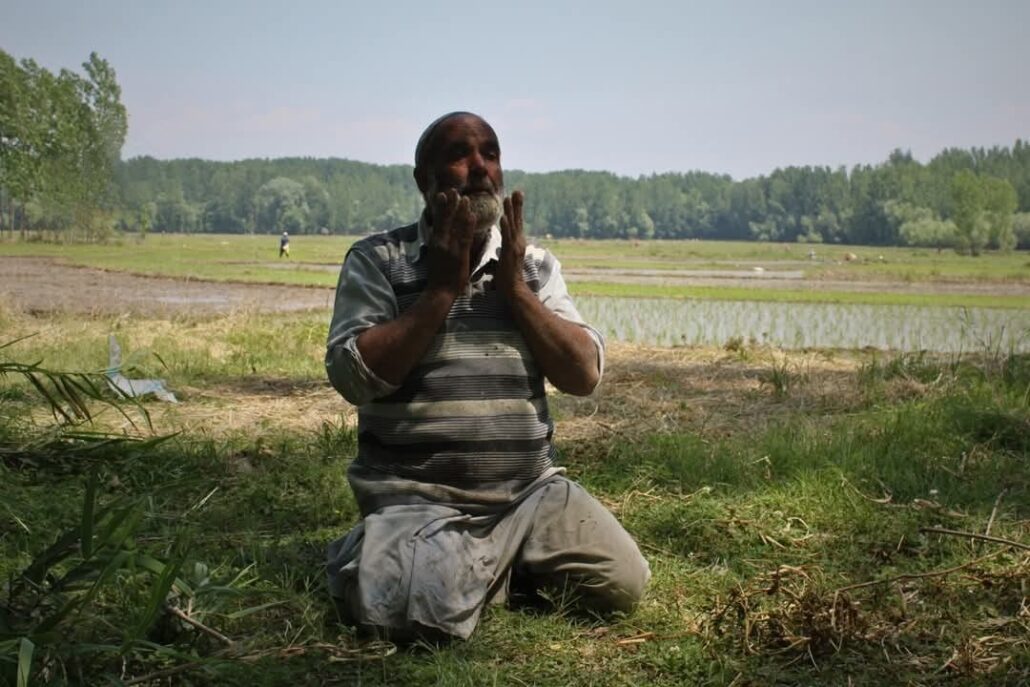
Mohammad Sultan Ganie, a farmer from Batengoo, surveys his cracked and parched fields. “The river is a shadow of itself,” he murmurs—his crops withering in the scorching sun.
The skies remain silent, the Jhelum’s flow diminished, and the land begs for water even as river and sky seem indifferent.
A record-breaking heatwave has gripped Kashmir since April 2025. On June 23, Srinagar recorded its hottest June day in two decades at 35.5 °C, with nighttime lows of 23.2 °C—the warmest in over thirty years.
The valley has endured 5–8 °C above-normal temperatures, and the government shut schools from June 23 to July 7 to protect children from the brutal conditions. Across villages and farms like Batengoo, the land lies bare and cracked, with no airflow to bring relief.
“Even in the evenings, there’s no relief. The air doesn’t move,” says Manzoor Dar, seated beside Sultan on a crumbling mud embankment. “It feels like the whole region has turned into a tandoor. It’s suffocating, sultry… there’s almost no wind.”
Officials told The Kashmiriyat that the Jhelum is flowing at just 30% of its usual volume, with multiple tributaries and springs completely dry. River levels at Sangam have fallen to as low as 0.66 feet, the lowest in a decade, and in places even below 0.99 feet.
Rainfall deficits stand at 75–80% in July and 45–50% in June, leading to a cumulative 27% shortfall for the year. An 83% rainfall deficit during January and February only worsened the crisis.
Irrigation systems have collapsed—72 of 394 vertical irrigation schemes are non-functional, and water pumps lie silent across the valley. Stream flows like Rambi Ara and Romshi have dried, leaving farmers helpless. The J\&K Power Development Department reported hydropower output at just 24 MW—down 76% from the normal 250 MW capacity.
Yet, villagers still turn to Sultan. “Sultan knows the soil like no one else,” Manzoor says. Sultan kneels and presses his fingers into the dry earth. “We used to have water here,” he whispers.
“Now the water flows like a whisper, and the land doesn’t listen anymore.” Then, pointing to the barren slopes: “It’s not just the skies—we’ve brought this upon ourselves. We kept cutting trees.”
Between 2023 and 2025, Kashmir lost over 40.6 square kilometers of forest cover. Project deforestation has been devastating: 110,000 trees felled for the Srinagar Ring Road, 21,000+ trees cut for the Kashmir-to-Rajasthan expressway, 214,500 trees cleared for the Ujh dam, and 38,000 removed for the new High Court complex.
Even the majestic Chinars are vanishing—The Chinar count has dropped from 42,000 in 1970 to just 32,500 today.
Suhail Farooq, a prominent environmentalist based in Srinagar, explains how the cutting of trees directly contributes to rising temperatures.
“Forests act like natural air conditioners. The leaves release moisture into the air through a process called transpiration, which cools the surrounding environment. When trees are removed, not only do we lose that cooling effect, but the exposed land absorbs and radiates more heat. It creates what we call a heat island effect, especially in areas where vegetation is replaced by roads or buildings. Moreover, forests absorb carbon dioxide, and when we cut them, we’re not just removing that sponge—we’re also releasing stored carbon into the atmosphere. This double impact—less cooling and more greenhouse gases—drives up local and regional temperatures.”
He adds, “Deforestation also reduces the ability of the soil to retain water. Without tree roots, the land dries faster after rainfall, and there’s nothing to slow down the wind. It changes wind patterns, soil moisture, humidity—everything becomes more extreme. You’re left with floods when it rains, and drought when it doesn’t.”
Temperature trends back these warnings.
From 1980 to 2020, maximum temperatures in Kashmir have risen by 2 °C, minimum temperatures by 1.1 °C. Snowfall has declined sharply, with 70% deficits reported in the 2024–25 winter season. Glaciers that feed Kashmir’s rivers have retreated by 10–23% in mass.
Meanwhile, rainfall patterns have shifted, and western disturbances have weakened, reducing spring recharge and disrupting farming cycles.
It’s not just Batengoo. Across Kashmir, lakes like Dal and Wular are receding, springs like Achabal and Bulbul have dried to trickles, and many villages now rely on water tankers.
Houseboats sit grounded in the silted beds of rivers. Orchard yields have plummeted. Farmers in south Kashmir report massive crop losses—up to 50% in apple production this season alone. With every passing year, sowing windows shrink and risk grows.
Yet Sultan remains a pillar. He urges contour hedges, rainwater harvesting, reviving traditional “khul” irrigation channels, and replanting native trees—especially deep-rooted Chinars and poplars—to rebuild the land’s sponge. “If we give something back to the land,” he says, “the land will forgive us.”
As dusk settles over Batengoo, the village is quiet but not calm. The fields lie in wait—thirsty, cracked, uncertain. Sultan and Manzoor rise and begin the walk home. “The fields are waiting,” Sultan says, his voice low and tired. “But they won’t wait forever.”

- News Deskhttps://thekashmiriyat.co.uk/author/kashmiriyat/

- News Deskhttps://thekashmiriyat.co.uk/author/kashmiriyat/

- News Deskhttps://thekashmiriyat.co.uk/author/kashmiriyat/
- News Deskhttps://thekashmiriyat.co.uk/author/kashmiriyat/
