
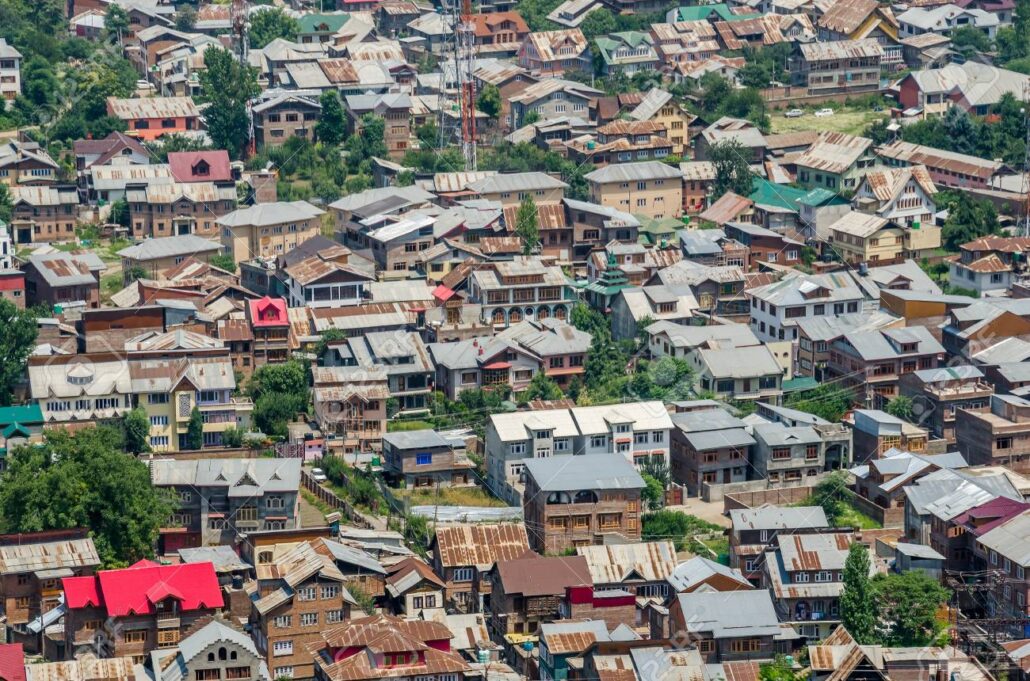
While the sun sets over Kashmir, a strange divide emerges—rural areas in Anantnag, Budgam, and Baramulla begin to breathe again under the cool breeze of dusk, but the urban centers continue to swelter deep into the night. The temperatures drop only marginally, leaving homes hot, streets radiating warmth, and people struggling to sleep. The reason is not just climate change, it’s what scientists call the Urban Heat Island (UHI) effect.
Urban Heat Islands are not a new discovery, but their consequences in the age of climate disruption are turning deadly. “Concrete, steel, glass—our cities are now heat traps,” says Dr. Meher Unnisa, an environmental scientist. “Where once trees breathed moisture into the air, we now have parking lots and shopping complexes that radiate stored heat through the night.”
Srinagar is perhaps the most dramatic example of how rapid, unplanned urbanisation fuels UHI. Between 2000 and 2020, the built-up area of the city increased by more than 75 percent, from around 34.5 square kilometres to over 60 square kilometres. Other studies show an even more aggressive sprawl—one report suggests the city expanded to nearly 80 square kilometres in just two decades, swallowing orchards, agricultural lands, wetlands and even parts of flood plains.
Satellite data from Global Forest Watch reveals that Jammu Kashmir lost 21,200 hectares (21.2 kha) of forest cover between 2001 and 2023, most of it in areas surrounding growing urban settlements.
“There’s been a quiet but devastating replacement of green lungs with grey infrastructure,” says Zahid Aslam Moghal from the Forest Department “It’s not just about beauty or aesthetics anymore. We are losing our natural air conditioners.”
The impact is more than discomfort. In June this year, Srinagar recorded a staggering 35.6°C, the highest temperature the city has seen in over 20 years. But the real shock is the nighttime heat, which refuses to relent even after sunset. “It’s like sleeping inside an oven,” says 54-year-old Farhat Jan, a resident of Bemina. “There’s no breeze, just hot air hanging over the city.”
Jammu, too, has suffered similar heat spikes, with several days in June crossing 42°C. Doctors in the region are reporting an increase in heat-related illnesses, including dehydration, heat stroke, and exacerbation of respiratory problems.
While authorities claim some action is underway, many experts argue that these steps are inadequate and uncoordinated. Latief Ahmed, District Forest Officer at Srinagar Municipal Corporation, stated that tree plantation drives have been initiated as part of the National Clean Air Programme (NCAP).
“We planted trees on 10 hectares in 2023–24 and plan to add 12 hectares more this year,” he said. “We’re working to bring down PM10 levels by 40 percent by 2030.” Yet the numbers pale in comparison to the scale of deforestation and construction.
Perhaps more worryingly, Srinagar does not currently have a Heat Action Plan (HAP), a basic preparedness strategy implemented by other Indian cities to deal with extreme temperatures. “We need a plan that’s not just about planting saplings but about reimagining urban planning itself,” says Dr. Meher Unnisa. “Cool roofs, green corridors, wetland restoration—all of it.”
The question remains: Can Kashmir’s cities adapt before it’s too late?
“We are heading toward a climate cliff,” says Moghal. “If we don’t halt the destruction of green spaces, we will soon face a public health emergency. Heatwaves, floods, poor air quality—it’s all interconnected.”

- News Deskhttps://thekashmiriyat.co.uk/author/kashmiriyat/

- News Deskhttps://thekashmiriyat.co.uk/author/kashmiriyat/

- News Deskhttps://thekashmiriyat.co.uk/author/kashmiriyat/
- News Deskhttps://thekashmiriyat.co.uk/author/kashmiriyat/
