By a young farmer, B.Sc Agriculture
I studied agriculture not to leave my village but to stay and serve it, not to dream of a job in the city but to protect what my father and grandfather built with their hands. I wanted to bring knowledge home, to improve our land, to strengthen our roots. But knowledge alone cannot irrigate a dying field. And now, even with my degree, I have failed to save what mattered most.
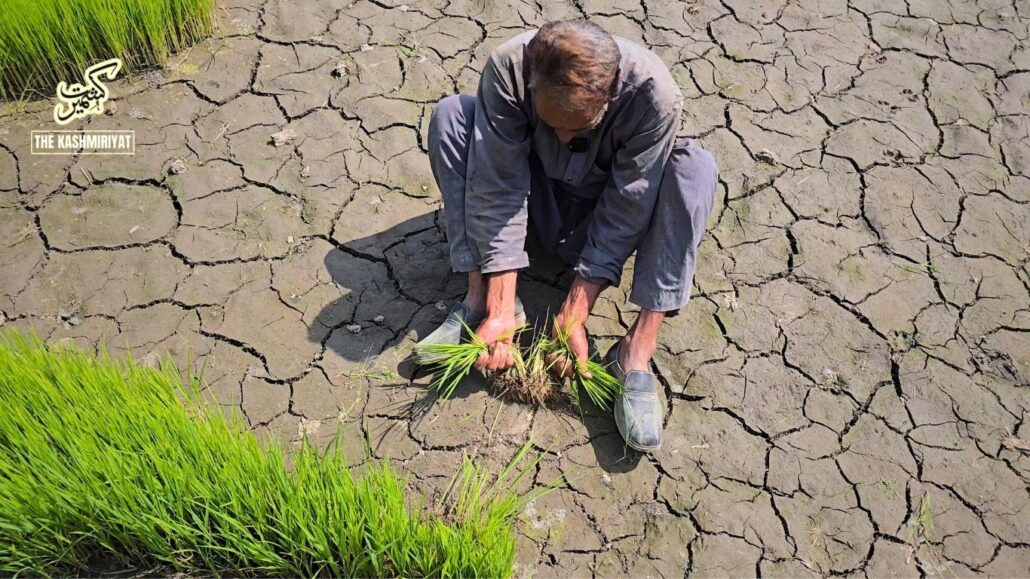
We are dying here. And no, this is not metaphor. We are watching our fields dry, our orchards rot, our backs break, and yet your cameras do not turn, your pens do not move. You find drama elsewhere, but ignore the slow death in the soil. I have watched our family go from sixty kanal to ten. The rest was sold to a brick kiln. My father cried as he signed the papers, and I, despite everything I knew, could not stop him.
We produce fruit that doesn’t sell, not because it isn’t good, but because imports fill the markets while our boxes gather dust. Our fields are cracked open, scorched, screaming for water, but no one comes, no one asks why. Journalists talk of climate change as if that is enough, as if that alone explains everything, as if naming the planet’s crisis gives you the right to ignore the man knee-deep in dust.
But this isn’t just about climate change. It’s about decisions, or the lack of them. It’s about policies that abandoned us, schemes that were launched and then left to die. Our irrigation canals haven’t been cleaned in years. The silt has choked them. The gates remain rusted and useless. Riverbeds have sunk lower due to relentless mining, but the inlets to our fields still sit at the same height they did decades ago, too high for the water to ever reach. Why weren’t they rebuilt? Why weren’t they deepened? Why haven’t any of you asked why most irrigation schemes were shut down, or why the government stopped caring? These are questions the press should raise, but you never do.
Instead, we see press conferences full of noise. You ask everything, everything, but not this. Not the crops, not the water, not the farmer who can no longer afford seed. You ask about election alliances, about the colour of a politician’s trousers, about which party fights whom. But not once have I heard a journalist ask about why Kashmir’s farmers are being pushed off the land they still want to protect.
And when we sell our land, because we must, because the banks won’t wait and the rains won’t come, you become “objective” suddenly and ask, why did they give up? But do we really have a choice? Roads cut through our lives for your convenience, and we cannot say no. The belief that every loss can be compensated is not rural, was never. Ours is a cyclic life, tied to seasons, not salaries. We don’t live in straight lines. We plant, we wait, we pray. But this rhythm, this way of being, is being erased.
Globalisation did not kill us. Urbanisation did. For your malls, your colonies, your highways, our fields were taken. And now, as we go hungry, you say we chose this. But we didn’t. It was chosen for us, by silence, by policy, and by your refusal to tell our story.
In Kashmir, we say, “Amis che andrem cze baed”, his intestines are bigger than yours. It means: he is incapable of empathy. And that’s what it feels like, this endless war of capitalism and expansion, disguised as progress, has numbed you to our suffering. Even those of you who come from villages now wear the city on your shoulders. You speak fondly of your roots, but your shifting to the ease of cities killed your rural roots and If you think it did not, your silence must clear your own doubts.
Some of you do cover these stories, but always with an urban lens. You talk about us as if we are some vanishing tribe, not as fellow citizens. You look at us through statistics and schemes, not through grief and anger. You frame our loss in soft language, but we live it in hard truths.
This letter won’t move you. I know. Because if our dying soil and our sold lands didn’t, then nothing I write will. Still, I will leave this as a testimony, for the day we lose the last ten kanal, for the day we can no longer stay. And I will say then, too, that you helped make this happen, not just by what you said, but by all that you chose not to.
Written by a Kashmiri farmer, son of a farmer, student of agriculture, watcher of loss, survivor of silence.
- News Deskhttps://thekashmiriyat.co.uk/author/kashmiriyat/
- News Deskhttps://thekashmiriyat.co.uk/author/kashmiriyat/
- News Deskhttps://thekashmiriyat.co.uk/author/kashmiriyat/
- News Deskhttps://thekashmiriyat.co.uk/author/kashmiriyat/


