Shah Basit
Grief turned into fury in Safapora on Sunday after a 28-year-old woman was allegedly raped and murdered under suspicious circumstances. The victim, originally from Safapora and married in Kondbal, just five kilometers away, had been visiting her sister-in-law’s house when tragedy struck. As per the family of the deceased who spoke to The Kashmiriyat, she had been staying at her parental home for a few days. “On Saturday night, she was invited by her sister-in-law to join a family picnic scheduled for the next day in Babarishi. The victim reached the Safapora residence around midnight. Around 2 a.m., she reportedly complained of severe tooth pain,” the mother of the victims said.
According to family members, the sister-in-law’s husband offered to take her to a hospital on his two-wheeler. “We later learned she had reached the hospital with him. But what happened on the way back, we still don’t know,” a relative told The Kashmiriyat.
By dawn, tragedy had struck.
A man knocked on the family’s door and claimed the woman had slipped in the washroom and injured herself. The family rushed to the hospital, only to be told she was already dead. “I wasn’t even allowed to see her face,” the victim’s mother said, breaking down. “When I asked what had happened, the doctor hesitated. Something felt wrong from the very beginning.” It wasn’t long before troubling signs emerged.
The woman’s body bore bruises and drag marks, raising doubts about the claim that she had fallen in a bathroom. Locals alleged she had been dragged across a concrete surface. Initially hesitant to allow a post-mortem, the family relented only after community members urged them to reconsider based on the visible injuries. “We thought it may have been a natural death. But when the police began asking questions, we realized something darker was at play,” a local resident told The Kashmiriyat. The accused, the same man who had taken her to the hospital, was taken into custody on Sunday morning. A police official confirmed that he is currently being interrogated.
Locals said that it was a plain case of rape and murder, though officials say they are awaiting forensic and autopsy reports.
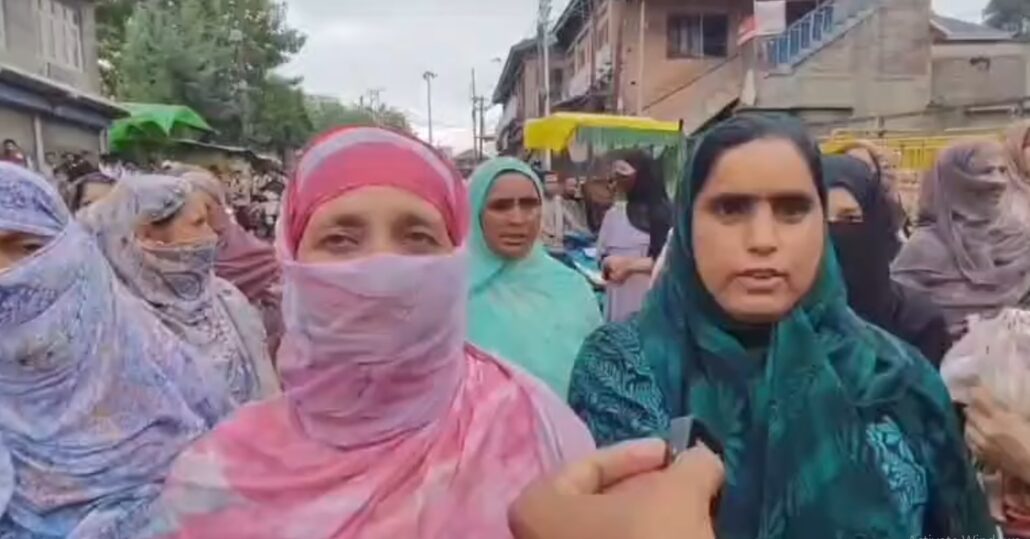
As news of the incident spread, Safapora erupted in protest. Residents voluntarily downed shutters in mourning and marched onto the streets demanding justice. Men, women, and children raised slogans against the rising tide of violence against women in Kashmir. “Today it was her. Tomorrow, it could be me, my daughter, or my sister,” said a local woman, tears in her eyes. “Where are we safe anymore?”
Another protester voiced deep anguish at the changing character of society, “We were raised on stories of Kashmir’s values, of respect and dignity for women. But that looks like a distant past now. What’s left of our morality if our daughters are not safe in their own homes?”
Senior police officials, including SSP Ganderbal, reached the site of the protest to pacify the crowd and assure a swift and impartial investigation. “We are treating this as a case of the highest priority. Strictest possible action will follow,” he assured the locals..
The crime has sent shockwaves not just through Ganderbal, but across the region.
According to the latest figures from the National Crime Records Bureau (NCRB), India recorded over 31,000 rape cases in both 2021 and 2022, averaging nearly 86 cases a day. Of these, over 89% involved perpetrators known to the victim. In Jammu Kashmir alone, 287 rape cases were reported in 2021, and 315 in 2022, marking a 21% increase in just one year. Srinagar continues to report the highest number of such crimes, including rape, acid attacks, and custodial abuse. Despite the high number of cases, conviction rates remain abysmally low. Between 27% and 33% of cases lead to convictions, reflecting serious shortcomings in the justice system.
Experts believe the actual figures are much higher, as shame, stigma, and fear of retaliation often stop survivors from coming forward. “This case is not just about one woman,” said a social activist at the protest. “It’s a reflection of everything wrong in our system—where women are most unsafe in places where they should feel most protected.”
As darkness falls over Safapora, so does a heavy silence, one that demands not just justice, but urgent societal reckoning.
Further updates are awaited as the investigation progresses.

- News Deskhttps://thekashmiriyat.co.uk/author/kashmiriyat/

- News Deskhttps://thekashmiriyat.co.uk/author/kashmiriyat/

- News Deskhttps://thekashmiriyat.co.uk/author/kashmiriyat/
- News Deskhttps://thekashmiriyat.co.uk/author/kashmiriyat/
