
Meer Irfan
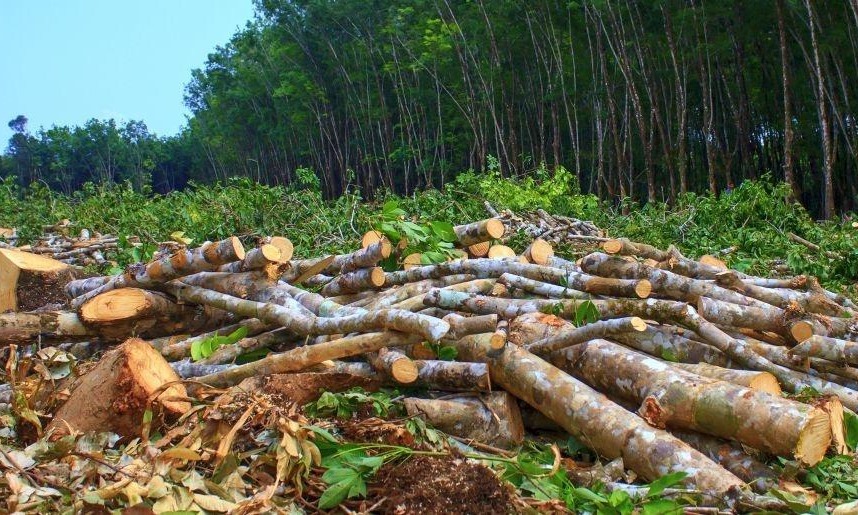
Fresh incidents of tree felling have been reported from south Kashmir’s Shopian district, with residents accusing authorities of ignoring the destruction of the region’s fragile green cover.
The area near Sukh Sarai along the historic Mughal Road, close to the tourist destination Dubjan, has recently witnessed the cutting of massive trees in a zone under the Wildlife Department’s jurisdiction.
Visuals from the site show freshly cut stumps, but during a visit, no forest or wildlife officials were present.
Locals allege timber smugglers operate in broad daylight despite the presence of protection staff, hinting at official collusion.
“No one dares to bring down such large trees without some level of protection from those who are supposed to guard them,” a resident told The Kashmiriyat.
When contacted, the Wildlife Range Officer in Shopian said only, “We will take action,” a statement locals dismiss as meaningless once the timber has already been transported.
Residents have appealed to Chief Minister Omar Abdullah to order an investigation, identify those involved including complicit officials and take strict legal action. Some say they will approach the High Court if the administration fails to curb the timber mafia.
Environmentalists stress that the problem is not confined to Shopian. Across Jammu and Kashmir, tree felling, both legal and illegal, has been steadily reducing forest cover.
Jammu Kashmir has over 21,000 sq km of forest, about 39% of its area. Recent Forest Survey of India data shows a decline in moderately dense and natural forests, with degradation most visible in parts of south and north Kashmir.
Illegal logging is fuelled by a lucrative black market for high-quality timber such as kail, deodar, and fir, which fetch high prices in the plains.
Smugglers often work under the cover of night or heavy snow, using pack animals or makeshift cable lines to move logs from remote areas.
In response, the Forest Department says it planted over 1.5 crore saplings in 2024–25 under the “Ek Ped Maa Ke Naam” campaign to restore degraded forest areas, but residents argue that planting without ensuring protection is futile.
A 2023 study by the Department of Ecology, Environment, and Remote Sensing warned that rampant deforestation and encroachment could worsen climate change impacts in Kashmir, leading to erratic snowfall, reduced water availability, and increased soil erosion.
Shopian, part of the Pir Panjal range, is critical for maintaining water sources that feed into the Kashmir’s rivers and streams.
“Losing trees here means losing water down in the villages and towns,” an environmental activist from Pulwama said. “Forests are our natural dams. Once they go, disasters will follow.”
As one Shopian resident put it, “The government talks of tourism and development, but what tourist will come to barren hills? Our forests are being stolen in plain sight. If no one stops this, we will be left with nothing but stumps.”

- News Deskhttps://thekashmiriyat.co.uk/author/kashmiriyat/
- News Deskhttps://thekashmiriyat.co.uk/author/kashmiriyat/
- News Deskhttps://thekashmiriyat.co.uk/author/kashmiriyat/
- News Deskhttps://thekashmiriyat.co.uk/author/kashmiriyat/


