
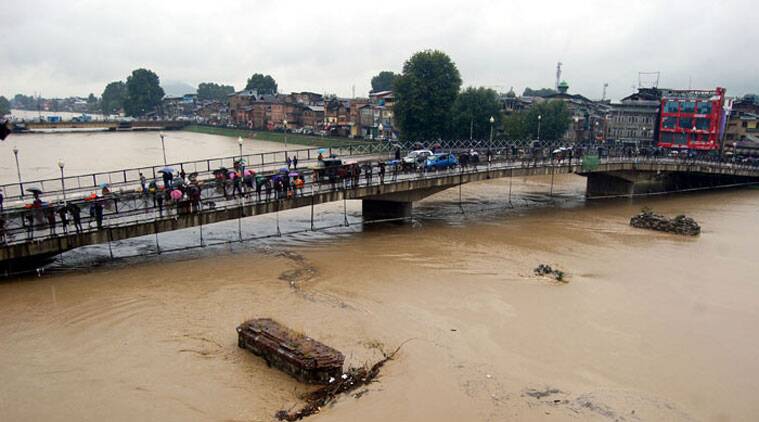
The water level in the River Jhelum and several of its tributaries rose sharply on Wednesday amid incessant rains across Jammu Kashmir, prompting large-scale evacuation efforts, high-level emergency meetings, and appeals for public caution as authorities battle flood-like conditions across both divisions of the region.
Officials said that as the rains have stopped, the levels are expected to stabilise in the coming hours.
According to the Irrigation and Flood Control Department’s 8:00 pm readings, the Jhelum was flowing at 23.35 feet at Sangam against the danger mark of 25 feet, at 21.07 feet at Munshi Bagh Srinagar against the danger level of 21 feet, and at 11.83 feet at Asham against the 16.5-foot danger mark.
The river continuing above the danger level in Srinagar has raised fresh concerns among residents.
Earlier in the day, the department had reported 23.99 feet at Sangam, 20.72 feet at Munshi Bagh, and 11.09 feet at Asham, indicating a steady rise in water levels through the day.
Divisional Commissioner Kashmir Anshul Garg said that the administration was closely monitoring the situation. “In view of prevailing weather conditions, Jhelum water level at Ram Munshi Bagh, Srinagar has crossed alert level. Field teams are closely monitoring the situation and contingency plans are in place,” he said.
Chief Minister Omar Abdullah chaired an emergency meeting to review the ground situation after heavy rains battered the region.
Deputy Commissioners from all 10 districts briefed him on rising water levels and damages to infrastructure.
The Chief Minister directed the administration to prioritise food, clean water, medicines, and essentials for affected families and to ensure uninterrupted power to hospitals.
He also called for urgent restoration of roads and coordination with the Army, SDRF, and Police for rescue and relief.
He later said that he had briefed Prime Minister Modi, who assured him that all possible help would be provided by the central government. “Relief and restoration will proceed as per SDRF norms, but where additional needs arise, I will personally ensure resources are made available,” Omar Abdullah said.
Lt Governor Manoj Sinha also spoke to Divisional Commissioner Jammu Ramesh Kumar and other senior officials to take stock of the situation. He announced that more than 5,000 people had been evacuated from low-lying areas to safer locations and directed immediate restoration of power, water, and communication services in flood-hit zones. “Army, NDRF and SDRF are working in coordination with the Divisional Commissioner’s office, and we are ensuring adequate supply of relief materials and all possible assistance to those affected,” the LG said in a message, while praying for the safety of all citizens and emergency responders.
Authorities have issued a strict advisory to residents, tourists, boatmen, sand miners, and others to avoid venturing near rivers, lakes, and water bodies until conditions improve.
Emergency contact numbers of District Emergency Operation Centres, ERSS, and local Police Control Rooms have been made available for assistance.
The UT-level Emergency Operation Centre has also been activated with helplines 0194-2502254, 0194-2950767, and 10170 for distress calls.
With rains forecast to continue till September 1, authorities across Jammu and Kashmir remain on high alert, urging people in vulnerable areas to stay away from slopes, rivers, and streams, and to follow official advisories closely.
Rescue operations, relief distribution, and restoration of essential services are underway as the administration braces for further challenges in the coming days.

- News Deskhttps://thekashmiriyat.co.uk/author/kashmiriyat/

- News Deskhttps://thekashmiriyat.co.uk/author/kashmiriyat/

- News Deskhttps://thekashmiriyat.co.uk/author/kashmiriyat/
- News Deskhttps://thekashmiriyat.co.uk/author/kashmiriyat/
