
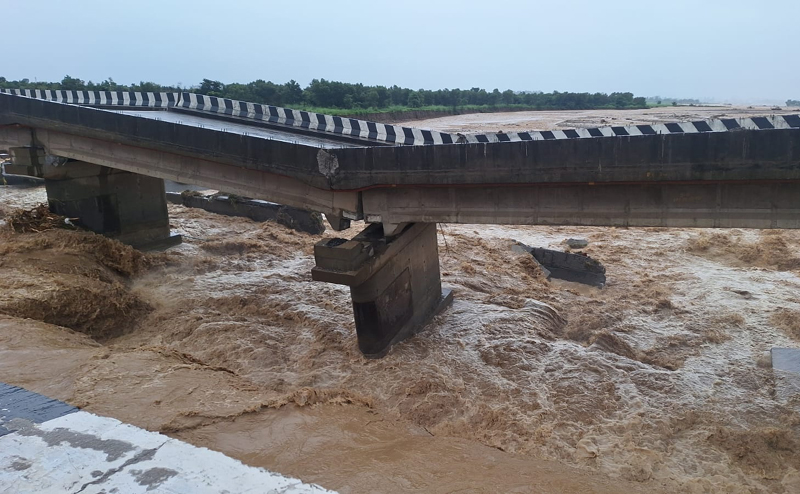
The continuous spell of rains, cloudbursts, and flash floods since mid-August 2025 has left Jammu Kashmir grappling with the condition of its public infrastructure.
Bridges, highways, culverts, and road networks, most of them state-funded and maintained, have borne the brunt of nature’s force, leaving behind questions about durability and preparedness.
At least four major bridges have collapsed or sustained serious damage in just over two weeks.
On August 24, 2025, the Sahar Khad bridge on the Jammu–Pathankot highway was swept away after torrential downpours raised the water level, snapping a crucial connection between Jammu and Punjab. Traffic had to be diverted through longer alternate routes, causing heavy congestion and delays.
In Jammu city, the Fourth Tawi Bridge at Bhagwati Nagar collapsed on August 26, 2025, as floodwaters surged against its pillars. The bridge, inaugurated only a few years ago as a decongestion measure, was immediately closed to traffic. Locals pointed out that they had noticed cracks appearing as early as last monsoon.
In Kishtwar district, the Mughal Maidan bridge collapsed on August 26, 2025, after its base was eroded by flash floods. The loss has left entire hamlets cut off, with residents relying on makeshift wooden planks and boats to cross the swollen Chenab tributaries.
Smaller bridges in Rajouri and Kathua also succumbed to gushing streams during the last week of August 2025. Each of these was part of the Public Works Department’s (PWD) rural connectivity programme, built to serve villages that otherwise remain isolated during bad weather.
The Jammu–Srinagar National Highway (NH-44), lifeline of the Valley, faced repeated shutdowns over the past fortnight. Between August 23 and 27, 2025, landslides at Ramban and Banihal, mudslides at Cafeteria Morh, and road cave-ins near Panthyal disrupted movement for days at a stretch. Trucks carrying supplies were stranded, causing delays in essentials reaching the Valley.
The Mughal Road, considered an alternate highway between Jammu and Kashmir divisions, was blocked by boulders and landslides within 48 hours of the August 25 rainfall peak. Similarly, the Sinthan–Kishtwar–Doda road, often touted as a scenic but strategic link, was washed out at several points.
In Jammu city, culverts near the general bus stand collapsed on August 26, 2025, under pressure from rising waters of the Tawi, submerging adjacent markets and damaging state-built drainage systems.
The cloudburst in Chosoti, Kishtwar, on August 14, 2025, was the first major blow of the season. Entire sections of the Machail Mata pilgrimage route were wiped out within minutes. Road stretches, temporary bus stands, makeshift langar kitchens, and even the state-constructed shelters were reduced to rubble. Security camps and patrol huts along the yatra track were also damaged, forcing authorities to suspend the pilgrimage midway.
Later in late August 2025, another cloudburst in Kathua’s Jodh Ghati carried away road sections and disrupted rail traffic as water gushed onto nearby tracks.
Dozens of link roads under the Rural Development Department and PMGSY (Pradhan Mantri Gram Sadak Yojana) have been washed away in Rajouri, Poonch, and Reasi districts. Villagers in Mahore and Kalakote reported that recently laid blacktopping peeled off within days of rain, exposing loose gravel beneath.
Drainage failures in Pulwama and Anantnag towns, where government-funded projects were meant to prevent waterlogging, instead turned into cesspools after silt-choked drains overflowed into residential lanes during the August 25–27 deluge.
Each incident has been attributed to “unprecedented rainfall,” yet the sheer scale of losses across districts highlights deeper structural vulnerabilities. With most projects built in the last two decades, residents are beginning to ask why bridges and culverts are giving way so easily.
“The floods are natural, but shouldn’t a highway built with crores last longer than one monsoon?” asked Mushtaq Ahmad, a shopkeeper in Ramban, standing near a washed-out stretch of NH-44.
Officials maintain that restoration work is underway and alternative routes are being cleared. But for thousands of residents across Jammu and Kashmir, these repeated breakdowns of public infrastructure during every rain spell have made life a cycle of disruption, detours, and uncertainty.
In Kashmir, damage has occurred as well, but local media coverage largely focuses on relief efforts and official assistance, with little reporting on the extent of damage to public infrastructure.

- News Deskhttps://thekashmiriyat.co.uk/author/kashmiriyat/

- News Deskhttps://thekashmiriyat.co.uk/author/kashmiriyat/

- News Deskhttps://thekashmiriyat.co.uk/author/kashmiriyat/
- News Deskhttps://thekashmiriyat.co.uk/author/kashmiriyat/
