Shabnum Khatoon
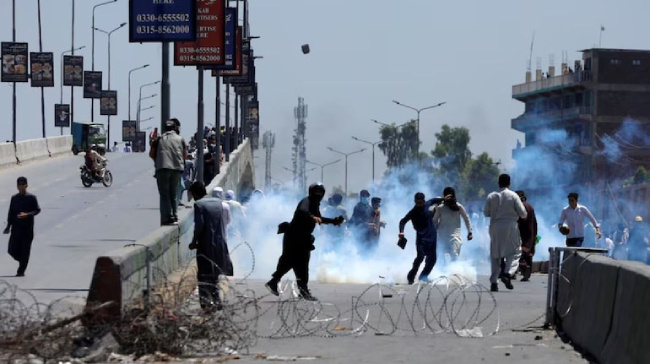
Muzaffarabad in Pakistan is grappling with the aftermath of violent protests that have claimed the lives of at least nine individuals, including six civilians and three police officers. The unrest, which began on September 29, 2025, has intensified over the past days, with demonstrators clashing with security forces while demanding economic relief and political reforms.
Among the deceased are Constables Khurshid and Jameel from Bagh, and Constable Tahir Rafi from Muzaffarabad. Their families are now left to mourn their untimely deaths. “He was the sole breadwinner for our family,” said Khurshid’s widow, tears streaming down her face. “Now, I don’t know how we’ll survive.” Jameel’s mother, sitting silently outside their modest home, clutched his uniform cap. “He was only 22,” she whispered, her voice breaking. “He had so many dreams… and now they have all ended on the streets he wanted to protect.”
The victims of the unrest were not only uniformed officers; ordinary citizens, students, and traders also paid the ultimate price. Many of them were part of recurring protests that have been taking place across Muzaffarabad for months, steadily gaining momentum as economic disparities deepened and political frustrations simmered. Residents say the protests are the culmination of years of neglect, inconsistent governance, and a growing sense that their voices remain unheard in the corridors of power.
In the heart of the city, near the Secretariat, the signs of grief are everywhere. Colorful banners demanding justice now hang alongside makeshift memorials, adorned with flowers, candles, and photos of the deceased. Locals say that the protests are not just about immediate grievances; they are about reclaiming dignity and visibility for a region that often feels marginalized.
“The government says it is listening, but we feel invisible,” said Asma Rafiq, a local teacher who joined the protest march. “We have protested peacefully for months, and yet, every week, more lives are lost. It is heartbreaking to see young men, some barely out of school, fall while calling for what is rightfully ours.”
In contrast, the regional government, led by Prime Minister Chaudhry Anwar ul Haq, has called for dialogue, stating that most of the protesters’ demands have been addressed. However, he acknowledged that certain issues, such as reducing ministerial positions and eliminating reserved seats for refugees, still require legislative action.
Meanwhile, the federal government of Pakistan, represented by Prime Minister Shehbaz Sharif, expressed deep concern over the situation and has expanded the negotiation committee to seek a resolution and end the ongoing violent protests
In Muzaffarabad, however, shops remain shuttered, and the usual hum of daily life is replaced by the quiet murmur of grieving families and concerned citizens. Markets that were once alive with bargaining and laughter now echo with silence. School gates remain closed, buses sit idle, and even the ubiquitous aroma of roadside tea stalls is noticeably absent. For many, the fear of another outbreak of violence keeps them indoors.
As dusk falls, Muzaffarabad’s hills, which usually glimmer with the golden hue of sunset, now seem distant and detached from the struggles below. Families sit outside their homes, recounting memories of loved ones lost to the unrest, wondering if tomorrow will bring peace or more sorrow. In the shadows of these mountains, the city’s heartbeat is one of grief, resilience, and a quiet, unyielding demand for justice.
The People’s Demands and the History of Protests
Muzaffarabad, the capital of Pakistan-administered Kashmir, has long been a focal point of political activism and public demonstrations. The recent unrest, which erupted on September 29, 2025, is the latest chapter in a series of protests spanning more than a decade, reflecting the deep-seated frustrations of its citizens over governance, economic inequality, and political representation.
The current wave of protests is being led by the Jammu Kashmir Joint Awami Action Committee (JKJAAC), a coalition of civil society groups, students, traders, lawyers, and transporters. Formed in 2023, the JKJAAC has consistently organized demonstrations across the territory, advocating for structural reforms and greater local autonomy. At the heart of their movement is a 38-point Charter of Demands, which encapsulates both immediate grievances and systemic issues affecting the population.
Key demands include:
Abolition of Reserved Seats for Refugees: The committee calls for the removal of 12 assembly seats reserved for Kashmiri refugees settled in Pakistan, arguing that these allocations distort democratic representation and fail to reflect current demographic realities.
Reduction of Ministerial Positions: The JKJAAC seeks to streamline governance by cutting the number of ministerial positions and reducing administrative costs.
Economic Relief Measures: Protesters demand subsidies on essential services such as electricity and wheat, aiming to alleviate the burden on households struggling with rising prices.
Free and Uniform Education and Healthcare: The coalition calls for accessible education and healthcare services across the territory, ensuring equal opportunities for all residents.
Judicial Reforms: Reforms to the judicial system are sought to improve transparency, accountability, and efficiency
Despite the government addressing some immediate concerns—such as reducing electricity tariffs and withdrawing charges against certain demonstrators—the more structural demands, particularly those requiring legislative reform, remain unresolved. Tensions continue to simmer, highlighting the complex socio-political environment in the region.
The unrest of 2025 is part of a long continuum of protests in Muzaffarabad. In May 2024, the JKJAAC led demonstrations against rising commodity prices, including wheat and electricity. These protests, which included shutter-down strikes, road blockades, and sit-ins, resulted in clashes with security forces and the arrest of movement leaders. Ultimately, the government conceded to several demands, granting a 23 billion PKR economic package, subsidies on essential goods, and establishing a judicial commission to review official privileges.
In November 2024, the Azad Kashmir government introduced the Peaceful Assembly and Public Order Ordinance, requiring prior permission for public gatherings. This move sparked criticism and protests, which resulted in injuries and arrests, emphasizing the ongoing friction between government authority and citizens’ rights to assemble.
The 2025 protests reflect the continuation of these patterns: widespread public dissatisfaction, recurring clashes with authorities, and a persistent call for justice, economic relief, and political reform. Citizens, led by JKJAAC, remain resolute in their pursuit of change, while the government grapples with addressing both immediate and structural grievances.
Strain, Grief, Reform
The unrest has also exposed significant gaps in public infrastructure and emergency response systems in Muzaffarabad. Local hospitals and clinics have been stretched beyond capacity, struggling to accommodate the influx of injured protesters and civilians. Health authorities have reported shortages of medical supplies, while relief organizations have mobilized to provide basic necessities to families affected by the violence. “We are running out of beds and basic medicines,” said Dr. Sana, a senior physician at Muzaffarabad General Hospital. “Every day we see more people arriving with injuries that could have been prevented if conflicts were avoided.”
Economic disruption has compounded the social strain. Many small businesses and transport services remain suspended, and daily wage earners face severe hardship. Traders and shopkeepers report losses amounting to millions of PKR, while students and educators are concerned about prolonged school closures disrupting the academic calendar. “Our shop has been closed for over a week,” said Muhammad Anwar, a local shop owner. “Every day we lose money we cannot afford to lose, and families are struggling to put food on the table.” Analysts note that these economic stresses may exacerbate public dissatisfaction if left unaddressed.
Civil society leaders continue to emphasize the need for structural reform and transparency. JKJAAC representatives insist that their 38-point Charter of Demands addresses fundamental issues in governance, economic equity, and social services, and that piecemeal concessions are insufficient to restore public trust. “This is not just about electricity tariffs or a few minor concessions,” said Shaukat Nawaz Mir, the committee’s central leader. “The people are asking for justice, fair governance, and a voice in decisions that affect their lives.” Observers suggest that the coalition’s ability to coordinate across diverse sectors—students, transporters, lawyers, and traders, demonstrates an emerging culture of organized civic engagement in the region.
The regional and federal governments have acknowledged these challenges and pledged further dialogue. Prime Minister Chaudhry Anwar ul Haq indicated that while certain immediate demands have been met, legislative action will be necessary to address more complex reforms. “We are committed to resolving these issues, but structural changes take time and parliamentary processes,” he stated. Federal authorities under Prime Minister Shehbaz Sharif have similarly expanded negotiation efforts to prevent escalation and restore stability.
Looking ahead, experts argue that long-term stability in Muzaffarabad will depend on sustained investment in public services, transparent governance, and mechanisms for political accountability. Addressing structural inequities, providing consistent economic support, and ensuring access to healthcare and education are seen as essential to preventing future unrest. “Without addressing the root causes, we risk repeating the same cycle of protests and unrest,” said political science teacher, wishing to remain anonymous.
For the residents of Muzaffarabad, the aftermath of the September 2025 protests is a period of cautious vigilance. Families mourn loved ones, workers count financial losses, and students await the reopening of schools. “We are living in fear and uncertainty,” said Amina Bhat, a mother of two. “Every day feels fragile; we hope the government listens before more lives are lost.” While streets are quieter than before, the underlying issues driving public discontent remain unresolved, leaving the city in a fragile state where any lapse in dialogue or governance could reignite unrest.
The events of 2025 highlight the broader socio-political challenges in Pakistan-administered Kashmir and underscore the need for systemic reform. As Muzaffarabad seeks to recover, the city faces the dual task of addressing immediate humanitarian needs while embarking on long-term governance solutions that can prevent recurring cycles of protest and violence.
“Muzaffarabad deserves peace and fairness,” said journalist Imran Qureshi. “The people have spoken; now it is up to the authorities to respond, not just with words, but with action.”

- News Deskhttps://thekashmiriyat.co.uk/author/kashmiriyat/

- News Deskhttps://thekashmiriyat.co.uk/author/kashmiriyat/

- News Deskhttps://thekashmiriyat.co.uk/author/kashmiriyat/
- News Deskhttps://thekashmiriyat.co.uk/author/kashmiriyat/
