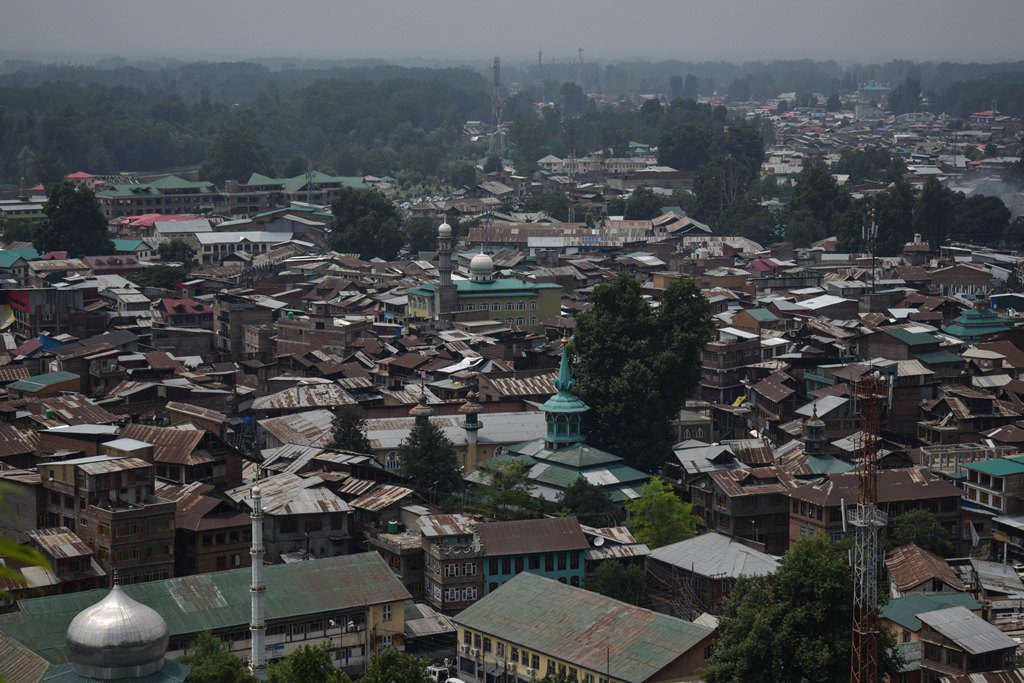
Every morning, eight-year-old Aamir leaves his home in a remote village of Kishtwar long before sunrise. His small frame is often lost in the mist that rolls down the mountains as he makes his way to a government school several kilometres away. He crosses muddy paths, a wooden bridge over a stream, and climbs a rocky trail before reaching his classroom, a crumbling building with half-broken windows, no toilets, and barely any heating in winter.
In the same valley, another child, perhaps of the same age, waits comfortably at the gate of his house in Srinagar’s suburbs. A private school bus stops right at his doorstep, its seats cushioned, its windows fog-free, and his attendance recorded on a tablet. His classroom is warm, brightly lit, and equipped with smart boards. His lunchbox holds homemade snacks, not the khichdi served as part of a mid-day meal scheme,
Both children are citizens of the same Republic, entitled to the same fundamental right to education. Yet, the distance between their opportunities is wider than the distance between their homes. It is in this gap, between promise and privilege, that the idea of reservation finds its moral and constitutional grounding.
Inequality and Baba Saheb’s Vision
From a position of privilege, reservation often seems unnecessary or unfair, an outdated idea that supposedly rewards caste over merit. But what is merit in a society built on centuries of exclusion? A child who studies under a leaking roof, without electricity, who walks miles to school, who faces ridicule or bias because of caste, tribe, or religion, can he be measured by the same yardstick as a child who grows up with tutors, digital tools, and social acceptance?
Even in professional courses or jobs, the comparison remains hollow. One student pays 1 percent of his father’s income for college; another sells his family’s land to afford admission. One secures an internship through a family friend; another is rejected at a clinic because patients don’t want to be treated by “someone from that background.” These are not exceptions, they are reminders that equality in law is not equality in life.
Dr. B.R. Ambedkar never saw reservation as a charity, he saw it as a mechanism to restore balance in a deeply unbalanced society. His argument was grounded not only in logic, but in humanity. “Equality may be a fiction,” he wrote, “but nonetheless one must accept it as a governing principle.” To him, social democracy, the belief in liberty, equality, and fraternity, was impossible without state intervention to counter centuries of structural inequality.
Reservation, therefore, was not merely about compensating historical wrongs; it was about building the conditions for a fair future. It was never meant to be permanent — but neither was it meant to be dismantled before its purpose was served.
In recent months, as Kashmir engages in its own debate over reservation, the arguments sound familiar, that 75 percent of seats should be “open merit,” that affirmative action must be “rationalised.” But how can rationalisation begin when the very data required to make that judgment does not exist?
India has not conducted a caste census since 2011, leaving policymakers and critics alike without any real understanding of who benefits and who remains left behind. To argue for “rationalisation” in absence of this data is to build an argument on air, to replace fact with assumption and justice with convenience.
The Myth of the Level Playing Field
When people claim that “reservation has outlived its purpose,” they are often speaking from a world that was never denied to them. They imagine a level playing field because they have never had to climb up the slope. Rationalisation, in such voices, becomes a euphemism for rollback, for restoring the comfort of hierarchy.
In Kashmir, as in the rest of India, caste may often hide behind religion or region, but it persists, subtly in marriage alliances, in community status, in hiring, and in silence. The Scheduled Tribes, Scheduled Castes, and Other Backward Classes here face not only economic barriers but also cultural invisibility. Reservation, in this landscape, remains a fragile thread that connects constitutional promise with lived reality.
Yes, rationalisation is necessary, not to weaken reservation, but to strengthen its integrity. For that, we need transparency, periodic caste-based data, and an honest audit of both progress and deprivation. But rationalisation must begin with empathy, not arrogance; with Baba Saheb’s spirit of social justice, not the impatience of the privileged.
Until every child in Kashmir, whether on a mountaintop in Kishtwar or in a Srinagar suburb, has equal access to quality education, nutrition, and dignity, reservation is not a privilege. It is a constitutional necessity. Ambedkar’s warning still echoes: “Political democracy cannot last unless there lies at the base of it social democracy.” If we forget that, the Republic may remain intact, but its promise will not.

- News Deskhttps://thekashmiriyat.co.uk/author/kashmiriyat/

- News Deskhttps://thekashmiriyat.co.uk/author/kashmiriyat/

- News Deskhttps://thekashmiriyat.co.uk/author/kashmiriyat/
- News Deskhttps://thekashmiriyat.co.uk/author/kashmiriyat/
