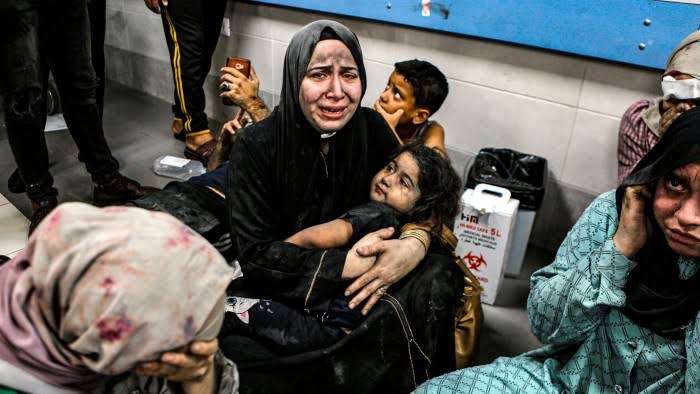
After nearly two years of relentless devastation, the massacres in Gaza may finally be coming to an end. Entire families have been buried beneath rubble, hospitals reduced to ash, and a generation of children orphaned under a sky filled with drones. Now, a fragile but historic moment is taking shape—one that could bring the bloodshed to a halt.
The world is watching as something shifts. After 632 days of war, Gaza’s silence may no longer be the silence of death, but the first breath of a people long suffocated. A war that burned across borders is nearing its end, and the decisions made in these coming days will ripple across history.
But this turning point didn’t arrive on its own. It followed a cascade of pressure—not from the streets of Arab capitals or the halls of the United Nations, but from Tehran.
Iran, which suffered direct Israeli strikes and lost senior military commanders, took a firm and unusual stand: it refused to engage in any nuclear negotiations with the United States until Israeli aggression across the region—including in Gaza and Lebanon—was halted.
Following the ceasefire between Iran and Israel, Iranian Foreign Minister Abbas Araghchi made the position unambiguous during a press briefing in Tehran. “There is no room for negotiations with the U.S. in nuclear talks, until Israeli aggression stops in the entire region,” Araghchi said.
Iranian officials repeatedly have referred to “Zionist crimes across Gaza, Lebanon, and the region” in public discourse and media calling for an end to them, in the past too.
Argahchi’s statement has since been widely interpreted as a demand for a broader regional ceasefire.
This declaration marked a significant escalation in Iran’s diplomatic rhetoric. Rather than confining its preconditions to its own territorial integrity or nuclear interests, Iran effectively elevated the suffering of Palestinians and Lebanese civilians as central to any renewed engagement with Washington.
The move has positioned Tehran as a regional actor willing to leverage its most critical bargaining chip—the nuclear file—for the sake of a wider political outcome.
Under pressure, Israel appears to be preparing for a formal end to its Gaza war. According to a June 26 report in Israel Hayom, Prime Minister Benjamin Netanyahu and U.S. President Donald Trump have agreed in principle to end the Gaza war within two weeks.
Citing a “source familiar with the conversation,” the report said that the deal was brokered following the U.S. strike on Iranian nuclear and military sites. The war-ending plan includes the removal of Hamas from power, exile of its leadership, and the establishment of a joint Arab governance framework in Gaza, likely led by Egypt and the UAE.
The same report suggests that Gazans who wish to emigrate will be absorbed by unnamed third countries.
The release of all hostages held by Hamas is also part of the agreement. In return, the United States will recognize limited Israeli sovereignty over parts of the West Bank, while Israel will publicly support a future two-state solution—albeit conditionally, based on reforms by the Palestinian Authority.
However, the plan has already met resistance. Several Arab states, including Egypt, the UAE, and Saudi Arabia, have insisted that any postwar arrangement in Gaza must include a meaningful role for the Palestinian Authority.
Netanyahu has consistently rejected that condition, opposing any PA foothold in the coastal enclave. Hamas, for its part, has also refused to accept exile for its leadership.
The broader deal prepared by the Trump led administration appears aimed at expanding the Abraham Accords, with recognition of Israel from Saudi Arabia and Syria on the table.
According to the Times of Israel, U.S. Secretary of State Marco Rubio and Israeli Strategic Affairs Minister Ron Dermer were also on the late-night call between Trump and Netanyahu that produced the preliminary agreement.
While Washington and Tel Aviv present the deal as a forward-looking diplomatic breakthrough, many analysts see Iran’s hardline stance as a critical factor that accelerated these developments.
Tehran’s refusal to engage in nuclear talks while Gaza burned placed significant pressure on the Biden administration to resolve the war before pushing for a return to the negotiating table.
The Iranian strategy has tied its nuclear diplomacy not just to sanctions or technical inspections, but to justice for Palestinians and an end to Israeli offensives in the region.
On June 26, Ayatollah Khamenei praised what he called Iran’s victory in the 12-day war with Israel. “America gained nothing from this war. The resistance remains alive,” he said in a televised address.
Funerals for IRGC commanders killed in Israeli strikes have been turned into platforms for anti-Israeli and anti-American rhetoric, reinforcing the idea that Iran’s military and diplomatic strategies are closely aligned.
Iran’s messaging throughout the conflict has centered on linking regional resistance movements—particularly those in Gaza and Lebanon—with its broader national security strategy.
While some Western officials have dismissed the rhetoric as grandstanding, Tehran’s actions have demonstrated that its commitment to the Palestinian cause is now shaping the contours of high-stakes diplomacy with global powers.

- News Deskhttps://thekashmiriyat.co.uk/author/kashmiriyat/

- News Deskhttps://thekashmiriyat.co.uk/author/kashmiriyat/

- News Deskhttps://thekashmiriyat.co.uk/author/kashmiriyat/
- News Deskhttps://thekashmiriyat.co.uk/author/kashmiriyat/
