
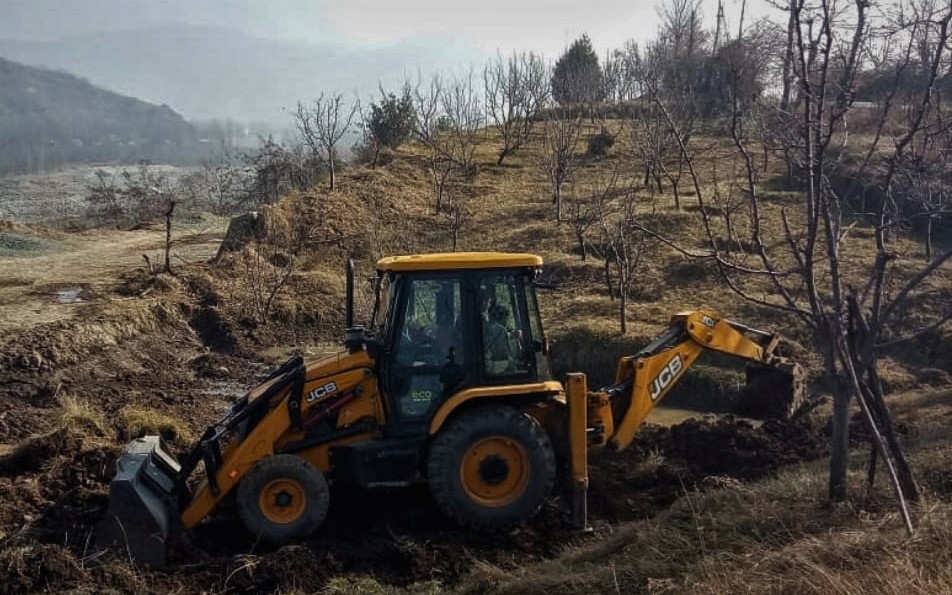
Agriculture in Jammu Kashmir, once the backbone of the region’s economy, now contributes just 20% to its Gross Value Added (GVA), marking a dramatic decline from 28% fifteen years ago. The sharp downturn in the sector has triggered growing concerns about food security, rising inflation, and unchecked land conversion, even as government-backed reports push for diversification to salvage what remains of the agrarian landscape.
According to the 2023–24 Economic Survey of J-K, the primary sector—including agriculture, horticulture, forestry, and allied activities—is steadily shrinking due to a combination of extreme weather, poor infrastructure, and rapid repurposing of farmland for industrial and infrastructure projects. The result has been a growing reliance on food imports from outside the region, contributing to capital flight and an inflation rate that consistently remains above the national average.
The shift in economic power is stark. The services sector now commands a dominant 61.7% share of J&K’s GVA in 2024–25, driven by tourism, trade, transport, education, IT, and healthcare. Construction and industrial activities—clubbed under the secondary sector—account for 18.3% of the GVA, bolstered by a series of government-led infrastructure projects, including expressways, tunnels, power corridors, and new townships.
However, much of this development has come at the cost of fertile land. While legislation theoretically protects agricultural zones, enforcement has proven ineffective. Thousands of kanals of paddy and orchard land have been quietly converted or acquired for projects ranging from railways to expressways.
In recent years, government ceremonies celebrating “milestones” in infrastructure have become increasingly common across the region—from tunnel completions in Anantnag and Baramulla to road expansion projects in Jammu and Samba. These events often coincide with the silent displacement of farmers whose land was acquired, sometimes under compulsion or with inadequate compensation.
The Udhampur-Srinagar-Baramulla Railway Line has been a flagship example. While touted as a marvel of engineering, its construction involved the takeover of vast stretches of orchard and farmland, especially in Pulwama, Shopian, and Kulgam. In Budgam, several dozen families were uprooted to make way for the Srinagar ring road project. A similar pattern played out during the Delhi-Amritsar-Katra expressway construction, celebrated by officials but lamented by villagers who lost generations-old farmland.
In addition to land loss, erratic rainfall and declining snowfall—down by nearly 80% in some areas—have devastated traditional cropping patterns. Water-guzzling staples like rice are becoming unviable. As per the survey, a single kilogram of rice consumes up to 4,500 liters of water, making it unsustainable in the face of prolonged dry spells.
The government now advocates switching to water-efficient and high-value vegetables such as broccoli, red cabbage, celery, and zucchini. These crops not only require less water but also offer significantly higher returns—up to ₹7–8 lakh per hectare per year, compared to just ₹1.6 lakh from rice. Similarly, baby corn and sweet corn have been identified as promising alternatives to traditional maize, which currently earns farmers ₹90,000–1.2 lakh per hectare.
Horticulture, particularly high-density apple, walnut, and cherry farming, is also being pitched as a key to rural revival. However, the transition requires investment, technical knowledge, and market access—all of which remain limited or unevenly distributed.
Despite rising risks, farmers in J&K remain outside the safety net of a robust crop insurance scheme. A single season of untimely rain, hail, or drought can wipe out entire harvests, plunging households into debt. The absence of regulated mandis and cold storage facilities further limits their bargaining power, leaving them at the mercy of middlemen and private buyers.
This institutional neglect is pushing more young people away from farming, accelerating rural depopulation in regions like Kupwara, Anantnag, and Kishtwar.
As if domestic challenges weren’t enough, Kashmir’s fruit and spice growers are now confronting fierce competition from foreign imports. Over the past year, Indian markets have seen a surge in cheaper Iranian apples, American almonds, Afghan walnuts, and Iranian saffron, severely undermining the value of local produce.
In Shopian and Baramulla, growers say their apples are fetching as little as ₹600–800 per box, down from ₹1,500 just a few years ago. Walnut traders in Handwara report losing clients to cheaper California imports. Pampore’s saffron farmers, long regarded as custodians of a centuries-old tradition, now find themselves priced out of their own markets by Iranian varieties.
Despite policy declarations and public statements in support of agriculture, the ground reality paints a different picture. Land continues to be acquired for “development,” water scarcity worsens, and imported goods outcompete local produce. While diversification strategies may offer a path forward, they cannot succeed without institutional safeguards, infrastructure, and actual political will.
The secondary sector—which covers manufacturing, construction, electricity, gas, water supply, and utilities—accounts for 18.3% of GVA. Infrastructure development and government-led construction projects have played a significant role in this sector’s expansion.
To counter agricultural decline, the Economic Survey outlines strategies such as shifting from low-yield crops like rice to high-value vegetables including broccoli, red cabbage, and celery. This shift is considered necessary due to an 80% decline in rainfall and snowfall that has impacted traditional farming.
Water usage is a critical factor—rice requires 4,500 liters of water per kilogram, whereas vegetables use significantly less. The potential income from diversified vegetable farming is estimated at ₹7–8 lakh per hectare annually, compared to ₹1.6 lakh from rice. In maize farming, traditional varieties yield ₹90,000–1.2 lakh per hectare, while high-value variants like baby corn and sweet corn, paired with processing, can significantly boost earnings.
High-density horticulture—especially in apples, walnuts, cherries, and strawberries—is also identified as a key growth area with potential for job creation and increased economic contribution.
Despite existing laws protecting agricultural land, enforcement remains weak, creating hurdles in halting its conversion. The gap between policy and implementation continues to challenge efforts to revive the primary sector.
Alll o this has to be in the news. Make it sound unlike that information I have sent earlier
For now, J&K’s agricultural sector remains in limbo—caught between celebration of infrastructure milestones and the silent erosion of its rural backbone.

- News Deskhttps://thekashmiriyat.co.uk/author/kashmiriyat/

- News Deskhttps://thekashmiriyat.co.uk/author/kashmiriyat/

- News Deskhttps://thekashmiriyat.co.uk/author/kashmiriyat/
- News Deskhttps://thekashmiriyat.co.uk/author/kashmiriyat/
