
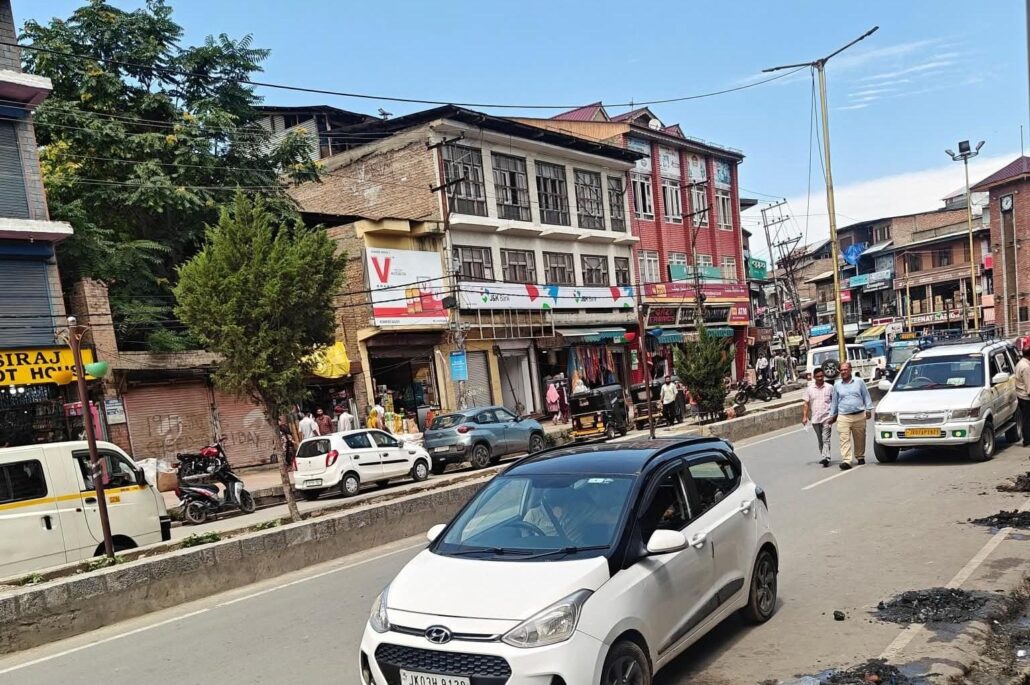
It is a Sunday in Anantnag, but for the first time in years, the stretch from Mehndi Kadal to Janglat Mandi lies empty.
The usual hum of bargaining, the colours of stalls, and the press of pedestrians are gone. The streets, once an inclusive space for hundreds of traders and shoppers, now carry only the sound of passing vehicles. Yes, traffic moves freely, but the life of the street has vanished.
For years, the Sunday market had been a designated space for roadside vendors, most of them from low-income families, selling everything from footwear and clothes to household goods.
Hundreds of small traders from across Kashmir would travel to Anantnag every week to earn their livelihood.
“I have been selling footwear here near Lal Chowk for seven years,” said Mohammad Faizan, a trader from Kulgam. “This market was my only source of income. Today, we are just sitting at home, not knowing what comes next.”
The Municipal Council Anantnag (MCA) announced earlier this week that the Sunday market would no longer be allowed, warning of strict action against those occupying roads or footpaths, including shopkeepers, street vendors, and illegal roadside parkers.
On social media, reactions to the move have been sharply divided. Many traders and local residents have criticised the decision as an attack on the poor, while a section of residents, mostly from affluent neighbourhoods, have called it a “much-needed step” for restoring order in the main town.
Several users hailed it as a “noble move” that journalists had long been advocating for, framing it as a matter of civic discipline rather than livelihood.
“This is a welcome decision. Roads are meant for traffic, not for turning into open markets. The town already suffers from congestion,” said a local resident in the main bazaar area.
A member of the local shopkeepers’ association also backed the move, arguing that roadside vendors were eating into their customer base. “Encroachments make it hard for customers to even reach our shops. Clearing the roads will benefit everyone in the long run,” he said.
Dr. Amir Khan, a sociologist from Srinagar currently teaching at a private university in Noida, said such evictions often follow a pattern of manufactured consent.
“People don’t know what’s wrong and what’s right. There are a few people who manufacture consent, and journalists have been seeking such eviction drives,” he said. “Once the narrative is set that these people are the reason for traffic chaos, public opinion shifts, and the administration simply acts on what appears to be the ‘people’s will’.”
Explaining the dynamics further, Dr. Khan noted, “Officials will obviously do as per the will of the people. But the question is, whose will are we talking about? Societies cannot be exclusive. These roadside vendors are a part of our society. Who gets to throw them out? Why does the street only belong to the rich?”
He added that removing vendors without offering alternatives deepens social inequality. “If the aim is order, it should not come at the cost of livelihoods. An inclusive street is not one where only cars can move, but one where all sections of society have a place.”
While some see it as a win for traffic management, traders say it has left hundreds of families without income. The elected government has not issued any statement on the ban.

- News Deskhttps://thekashmiriyat.co.uk/author/kashmiriyat/

- News Deskhttps://thekashmiriyat.co.uk/author/kashmiriyat/

- News Deskhttps://thekashmiriyat.co.uk/author/kashmiriyat/
- News Deskhttps://thekashmiriyat.co.uk/author/kashmiriyat/
