


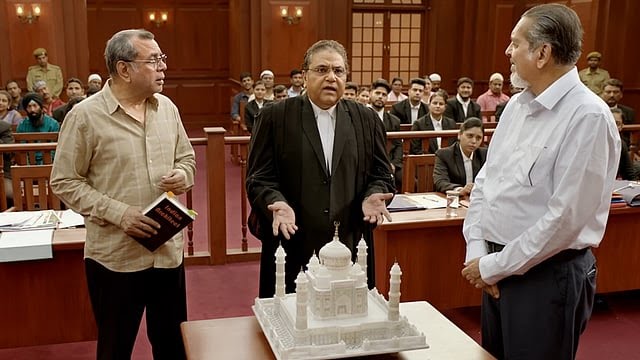
The trailer for Paresh Rawal’s upcoming film, The Taj Story, was released on Thursday, immediately stirring debate across social media.
Written and directed by Tushar Amrish Goel, the film features an ensemble cast including Zakir Hussain, Amruta Khanvilkar, Namit Das, Sneha Wagh, Shishir Sharma, Brijendra Kala, Akhilendra Mishra, and Srikant Verma.
In the film, Paresh Rawal plays Vishnu Das, a guide at the Taj Mahal in Agra, who controversially claims that the iconic monument is actually a Hindu temple.
The trailer shows him passionately explaining to visitors, “The Taj Mahal is a crown of the world, into which everyone has poured their own stories. What is the truth? What is a lie? Have we forgotten our own history?” Later, he is seen filing a court case to prove his theory, reminiscent of Rawal’s courtroom role in OMG (2012).
Rawal’s character is heard challenging society’s silence on historical distortions, saying, “Those who remain silent upon being slapped is cowardice. Those who remain silent on insults after insults of those who have done whatever it takes to distort our traditional history are cowards.”
In another courtroom scene, he warns, “If we don’t ask questions now, our history will disappear,” emphasizing the urgency of uncovering what he believes is hidden truth.
The trailer also delves into the Taj Mahal’s architecture. In a close-up of the tomb’s minaret, Vishnu Das claims, “It actually is a Shivling, the structure found in minarets of nations which have no distant connection to Indian architecture.” In the same courtroom, he asks pointedly about the 22 sealed rooms beneath the monument: “The important thing is what was in the 22 rooms under the Taj Mahal.”
The Archaeological Survey of India (ASI) has consistently addressed the controversy surrounding the 22 sealed rooms beneath the Taj Mahal, emphasizing that there is no evidence to support claims of hidden treasures or religious artifacts within them.
In one of the more philosophical moments, Rawal’s character references Lord Krishna, saying, “Silence is smartness,” before critiquing those who remain passive against the erasure of history, “Those who remain silent on distortions of history are cowards.”
He further argues that Shah Jahan’s legacy includes destroying temples and stresses that children, schools, and teachers are being taught the wrong version of history, highlighting the film’s focus on the battle over historical narratives.
The motion poster of the film, which depicted a Lord Shiva idol emerging from the Taj Mahal’s dome, triggered widespread backlash, with many accusing the film of promoting religious propaganda. In response, the filmmakers issued a clarification, “The makers of the film The Taj Story clarify that the movie does not deal with any religious matters, nor does it claim that a Shiv temple resides within the Taj Mahal. It focuses solely on historical facts. We would kindly request you to watch the film and form your own opinion.”
Paresh Rawal defended his role, saying, “Vishnu Das is a character rooted in courage and conviction. Through his journey to uncover the truth behind the Taj Mahal, the film challenges long-held beliefs and invites audiences to engage with history critically. I am proud to be part of a story that doesn’t shy away from asking difficult questions and encourages reflection on our past with honesty and integrity.”
Director Tushar Amrish Goel added, “With *The Taj Story*, we wanted to create more than a film; we wanted to spark a conversation. The trailer is just a glimpse of the moral and historical questions we explore, and I am thrilled that audiences will experience this journey alongside such an extraordinary cast.”
The narrative of the film draws inspiration from the controversial theories of historian P. N. Oak, who in 1989 claimed the Taj Mahal was originally a Hindu temple named Tejo Mahalaya.
Despite controversies, the film has gained attention internationally. It was previewed for Anil Agarwal, chairman of the Vedanta Group, and held special screenings at the House of Commons in London in April 2025, where it received positive response and won the ‘Best Film’ award in the International category at the Global Business Excellence Awards.
Political observer Arvind Deshmukh criticized the wave of controversy, calling it a distraction from real societal issues. “This is not a Hindu-Muslim matter,” he said. “It’s about treating people as if they are fools, keeping them trapped in endless debates over religion so that the focus shifts away from education, healthcare, jobs, and governance. Certain groups benefit politically by keeping the population divided and preoccupied with symbols rather than substance.”
Deshmukh further elaborated, “Films, statements, or social media trends like these are amplified precisely because they provoke emotional reactions. They turn history into a battlefield of beliefs while the real issues—poverty, inequality, corruption—remain ignored. People should question why such narratives get more attention than actual developmental work.”
He added, “This is a dangerous trend. The narrative isn’t about truth or history—it’s about control and distraction. The audience must learn to differentiate between genuine historical inquiry and manufactured controversies designed for political gain.”
The Taj Story is set to release in theatres on October 31, 2025, and is expected to continue sparking debate on historical narratives, public perception, and the intersection of cinema and politics.


- News Deskhttps://thekashmiriyat.co.uk/author/kashmiriyat/

- News Deskhttps://thekashmiriyat.co.uk/author/kashmiriyat/

- News Deskhttps://thekashmiriyat.co.uk/author/kashmiriyat/
- News Deskhttps://thekashmiriyat.co.uk/author/kashmiriyat/

