Bhavna Singh
Years ago, while wandering through a bylane in Bengaluru, I stumbled upon a modest tea stall owned by an elderly woman. Beside her shop, a few makeshift homes had cropped up — slum dwellers who had built a tiny life for themselves, complete with little gardens of marigolds and sunflowers. In the evenings, they would gather on patches of open land, talking in dialects I could barely understand, laughter bouncing between tin roofs and bougainvillea vines.
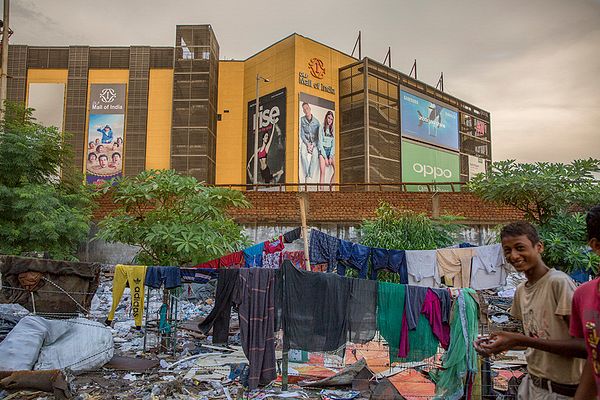
When I returned recently, I couldn’t locate the tea shop. In its place stood a gleaming shopping mall — glassy, silent, air-conditioned. There was no sign of the people who once lived and laughed there. Their homes had vanished without a trace.
This isn’t just about nostalgia or memory. It is about a silent restructuring of our cities — the systematic erasure of public and informal spaces that once belonged to everyone, now replaced by structures meant only for those who can afford to enter.
Across Indian cities, public parks, community grounds, and informal gathering spaces are disappearing. According to a study by the Delhi-based Centre for Science and Environment (CSE), India lost over 31% of its green cover in urban centres between 2000 and 2020, much of it to real estate and infrastructure development. In cities like Hyderabad and Delhi, parks have been cleared for flyovers, metro stations, or gated colonies. In Mumbai’s Mankhurd, entire settlements have been displaced for “beautification drives” and expressways.
The poor, who once had access to the margins of parks or nooks of public space to rest, play, or simply exist, are being squeezed out. What is emerging in their place are malls, luxury cafes, and “mixed-use” plazas — spaces designed for a specific class, built under the language of development.
We are told this is progress. That cities must grow. But what kind of growth reduces a city’s ability to care for its vulnerable? Are we building urban centres or fortresses of exclusion?
In his work on “right to the city,” theorist Henri Lefebvre argued that cities are shaped by those who inhabit them — not just through ownership, but through lived experience and collective memory. Yet, in India’s neoliberal push to reimagine the urban, cities are being handed over to builders, consultants, and private interests. The life of the city is being reduced to transactions.
This has class implications. Where once families irrespective of their class could share a park bench or spend Sunday in a local ground, now those grounds are sealed off for “smart city” projects, or replaced by private clubs and malls. Malls are not public spaces. They mimic public life, but only allow those who can pay.
I want to dispel the illusion that malls are spaces meant for everyone. In reality, access is often governed by class-coded norms—cases have surfaced where individuals were denied entry based on their attire or even because their feet were dirty. In 2024, a group of farmers staged a protest outside GT World Mall in Bengaluru, alleging that an elderly farmer had been barred from entering simply for wearing a dhoti.
A 2017 study by the Indian Institute for Human Settlements (IIHS) found that access to open space in Indian cities is deeply unequal — slum areas have less than 1 square metre of open space per capita, compared to 15–20 in elite neighbourhoods.
India is growing, yes. But the question remains: who is this growth for? The Life Index 2024 puts cities like Delhi and Bengaluru high in infrastructure spending, but low in citizen well-being. Meanwhile, India ranks 126 out of 146 countries in the World Happiness Index, a number that challenges the very foundations of our development narrative.
The tragedy is not only that people are displaced, but that their absence is never accounted for. There are no commemorative plaques where their homes were, no mention of their gardens in the brochures of the new mall. They vanish into the city’s amnesia.
We must ask harder questions. What is a city without its chai stalls, its evening gatherings, its informal laughter? Can we call a place democratic if public space itself is becoming a luxury?
This is not just a matter of nostalgia — it is a matter of justice. Because in the end, when the poor are pushed to the fringes, and malls take the place of shared spaces, we do not become modern — we become hollow.

- News Deskhttps://thekashmiriyat.co.uk/author/kashmiriyat/
- News Deskhttps://thekashmiriyat.co.uk/author/kashmiriyat/
- News Deskhttps://thekashmiriyat.co.uk/author/kashmiriyat/
- News Deskhttps://thekashmiriyat.co.uk/author/kashmiriyat/


