Meer Irfan
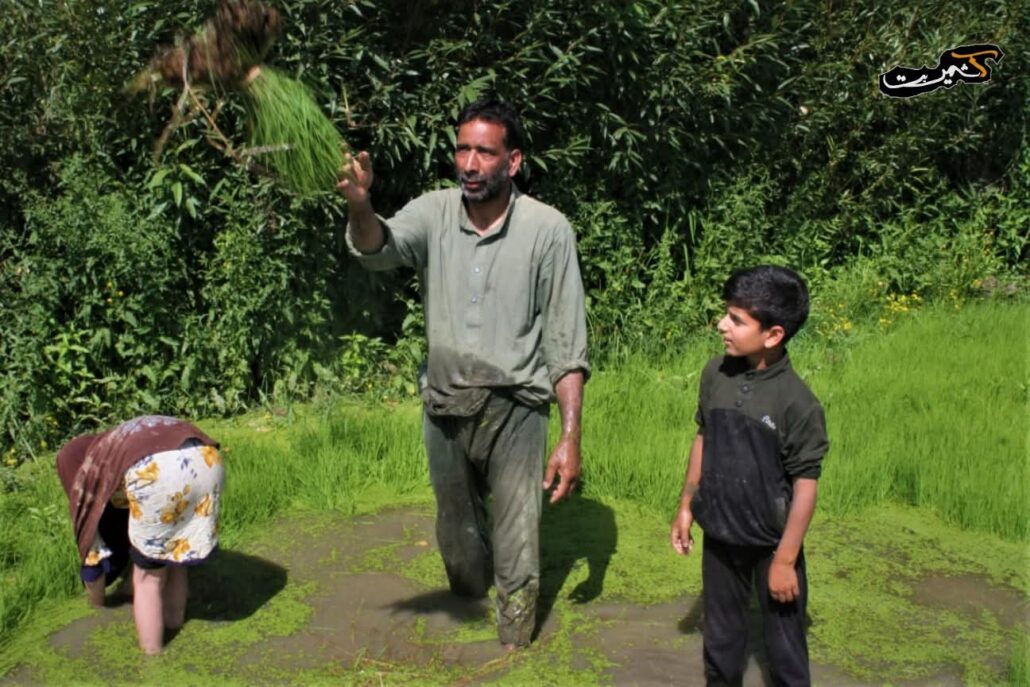
“Dada says the earth remembers who feeds it,” says 11-year-old Mohammed Ahmad Mir, his eyes wide with wonder as he watches his grandfather sink his feet into the soft mud of their paddy field in Arwani, Bijbehara.
It’s his first time in the fields, and while the sun rises over south Kashmir, generations walk side by side into the land that has fed them for centuries. This practice of generational farming is not merely about growing rice—it’s a living legacy, passed from hands wrinkled by decades of labor to those just beginning to learn what it means to work with the earth.
But that legacy is under siege.
Across the Valley, agricultural land is shrinking at an alarming pace. Farming is increasingly framed as unviable by policymakers and land-use planners, while road projects, housing colonies, and tourism infrastructure eat away at the very soil that has sustained Kashmir for generations. In this collision between modern development and traditional farming, families like the Mirs are not just sowing paddy—they are resisting a future where Kashmir grows concrete instead of food.
The field lies just off a newly expanded road—one that did not exist a few decades ago. Mohammed Subhan Mir, the 73-year-old patriarch of the Mir family, points toward the ribbon of asphalt slicing through the middle of once-contiguous farmland.
“These fields ran endless,” he says, “until the road came. Many families lost their best plots. We were paid some compensation, yes, but you can’t eat concrete.” He explains that while infrastructure brings connectivity, it has also fragmented agriculture and reduced the economic viability of farming in many villages.
The loss was not just of land, but of scale—fields that once operated as large, interconnected ecosystems are now broken into isolated patches, difficult to irrigate and harder to harvest.
In the shadow of tourism’s current slump—especially after the recent attack in Pahalgam that saw fear replace footfall—Kashmir’s land tells a different story.
Its fields remain generous, its trees patient. Despite fewer tourists, a failing global climate, and policies that often ignore the farmer’s voice, agriculture in Kashmir continues to sow hope. Farming, even in its strained condition, is one of the few lifelines that locals can still rely on without external interference.
This June, as tourists rethink their travel plans, families like the Mirs return to what remains of their ancestral plots. “We arrive at dawn,” says Subhan, his voice steady as he watches his grandson take his first steps into the paddy field. “The eldest enters first. Feet bare. Heads bowed. It’s not ritual—it’s reverence. They want to turn everything into real estate, but this land feeds us—it remembers us. That’s why we bow, not to the soil, but to what it means to us. It’s our way of resisting the onslaught of urban expansion.”
The grim story of numbers
According to official figures, Jammu Kashmir has lost more than 30,000 hectares of agricultural land in just the last decade, much of it to urban expansion, road construction, and housing colonies. The area under paddy cultivation alone dropped from over 1.63 lakh hectares in 1996 to around 1.35 lakh hectares in 2023, despite a rising population and food insecurity concerns.
“Blame is always placed on farmers,” says Iqbal Ahmad Mir, Subhan’s son, who works remotely for a software company but returns each year to sow with his family. “People say we’re selling our land for greed, but they forget: we don’t have storage, price protection, or basic facilities. They build roads across our paddy belts and then lecture us about food security.”
The irony is stark: the same roads meant to boost development are making farming more difficult and reducing local food production capacity. Kashmir imports most of its food grains, even as fertile land lies abandoned or is repurposed for construction.
Farming is not simply a rural occupation here—it is the backbone of the Kashmiri economy, directly or indirectly employing over 60% of the region’s population, according to the Directorate of Economics and Statistics, Jammu Kashmir. Agriculture contribution is around 16-18%, but this has remained stagnant or decreased largely due to poor infrastructure, policy neglect, and extreme climate volatility. “It’s a sector that feeds all, but gets fed the least,” says Iqbal.
But in 2025, the land is looking up.
In Gasoo on the outskirts of Srinagar, cherry trees have bloomed with an unusual abundance. In Pulwama and Ganderbal, the strawberry yield is being called the best in nearly a decade. “This is the most beautiful crop I’ve seen,” says Tariq Ahmad, a strawberry farmer near Srinagar. “But it also makes me anxious. These berries have a shelf life of 48 hours. No cold storage. No jam units. If the tourists don’t come, we lose them all.”
Jammu Kashmir produces over 12,000 metric tonnes of strawberries annually, and nearly 16,000 tonnes of cherries, yet the lack of post-harvest infrastructure means much of it is consumed quickly or lost. A single processing facility or cooperative cold-chain could preserve not just fruits, but entire livelihoods.
Despite these challenges, farmers are returning with optimism. “The fields are quiet, but they’re not lifeless,” Subhan says. “They are listening.”
More than food: Fields as archives
Farming in Kashmir isn’t just about income—it’s about intergenerational memory, reverence for land, and a deep cultural rhythm. It defines everything from the songs sung at harvest to the food on every urban table.
A 2022 study by Sher-e-Kashmir University of Agricultural Sciences and Technology (SKUAST) noted that every rupee invested in paddy cultivation in Kashmir generates ₹1.80 in value addition through labour, seed, local tools, and small-scale marketing.
The fields also foster employment across other sectors—carpenters, basket-weavers, plough-makers, seed sellers, livestock caretakers, and even tech-savvy youth managing online supply chains. “Agriculture in Kashmir is not isolated—it sustains an ecosystem,” says Dr. Zahoor Ahmad, an agroeconomist from Shopian.
As the political narratives rage on television and the tourist towns fall quiet, Kashmir’s fields speak another language—one of calm persistence.
The Mir family arrived at 6 a.m., when the sun was still gentle, casting a mellow light across the Arwani fields. All around them, hundreds of other families were already beginning their day in golden stretches of paddy land. The fields glowed in harmony with the tall poplars lining their edges, while narrow paths bustled with women carrying tea kettles and traditional samavars, weaving through the rows like living rituals.
Before the day’s labour begins, they all gather briefly—sipping the warm nun chai, sharing a quiet moment of conversation. Then, one by one, they roll up their trousers, step barefoot into the water-logged fields, and begin the backbreaking but sacred work of transplanting paddy.
“Farming is not just a task here,” says Subhan, watching his family with quiet pride. “It’s a rhythm, a routine, a return to what we are. This land teaches us patience, humility, and gratitude every single season.”
By noon, the sun is directly above, and the women return home—only to come back a little later with lunch wrapped in cloth bundles. Under a willow or in a corner where the trees lean low, the family shares a meal of rice, curd, and vegetables, their laughter echoing in the summer air. Around 5 p.m., they return once more—this time with pink nun chai and kulchas, a small tea break to mark the end of a long day’s work.
Iqbal, who works remotely for a private firm, joins the family on the weekends during the sowing season. “This is my real office,” he says with a smile. “Sitting behind a screen pays the bills, but being in the fields reminds me who I am. This land doesn’t just grow crops—it grows people.”
Here in the heart of Kashmir, farming is not merely agriculture—it is the architecture of belonging. Every seed carries memory. Every meal near the field strengthens bonds. And every step in the slush is a celebration of resilience.
The sowing of paddy becomes a poem, written in the footsteps of elders and the laughter of children like Mohammed Ahmad, who for the first time presses his toes into the memory of the earth.
“Tourism may bring money,” says Iqbal, “but agriculture brings dignity, money and sustainability.”
At Arwani, the Mir family takes a break near the canal, the sun now high above. Mohammed Ahmad looks at the breeze rippling across the water. “Dada says this land is like a prayer,” he whispers, “and every seed we sow is an answer waiting to grow.”
In Kashmir, farming doesn’t just survive—it resists, remembers, and sings.

- News Deskhttps://thekashmiriyat.co.uk/author/kashmiriyat/

- News Deskhttps://thekashmiriyat.co.uk/author/kashmiriyat/

- News Deskhttps://thekashmiriyat.co.uk/author/kashmiriyat/
- News Deskhttps://thekashmiriyat.co.uk/author/kashmiriyat/
