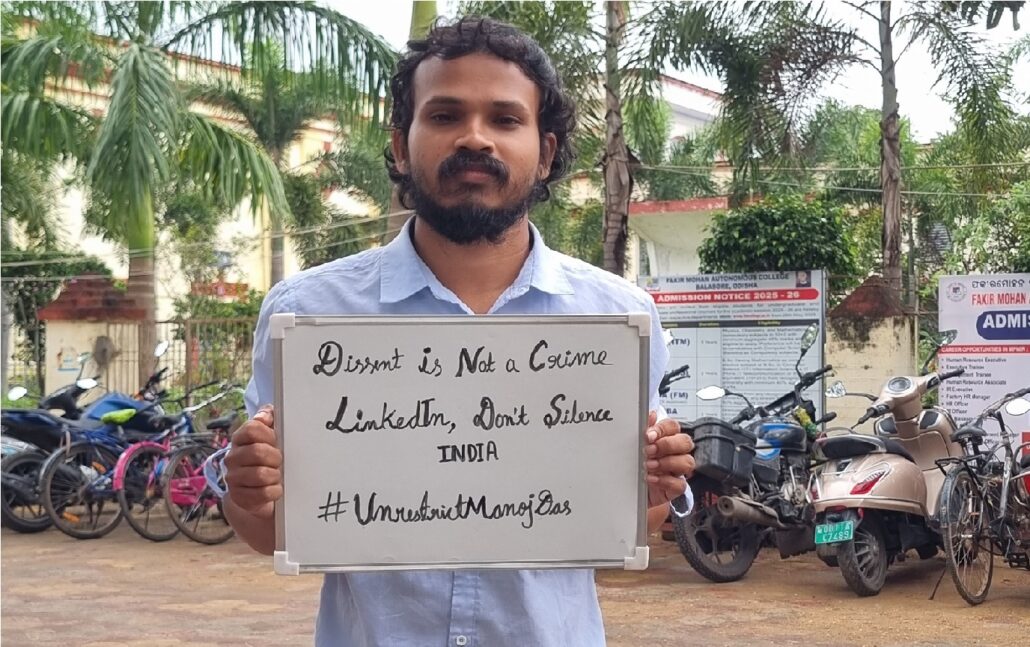
An Odisha-based social worker has accused Microsoft-owned LinkedIn of arbitrarily silencing his voice by permanently restricting his account, a move he says has devastated his livelihood, crippled his NGO, and left marginalized communities unsupported.
Speaking to The Kashmiriyat, Manoj Das, founder of the Sadaqat Welfare Foundation, said his account with over 36,000 followers was permanently restricted on March 11, 2025, despite receiving a written assurance from LinkedIn just six days earlier that no further action would be taken without evidence of a violation. He shared a copy of LinkedIn’s email dated March 5, 2025, in which the platform confirmed the restoration of his account and advised him that “any additional violation” would be required for further restrictions.
“This was not just my account,” Das said. “It was a platform for Dalits, Adivasis, migrant workers, minorities, and even Palestine. By silencing me, LinkedIn has silenced thousands of voices that relied on my advocacy.”
According to him, the permanent restriction followed a hacking attempt on his account. “Instead of supporting the victim, LinkedIn penalized me,” he said. He alleged that his primary email ID linked with LinkedIn was also tampered with and blocked on March 19, cutting him off from even filing proper appeals.
Das said he has written more than 2,000 grievance emails, including over 500 addressed directly to LinkedIn India’s Grievance Officer. “Every time, the excuse kept changing—from suspicious activity, to authentication issues, to illegitimate ID, despite my submission of Aadhaar, PAN, and even a notarised affidavit. Finally, they left it at a vague policy violation, never citing any lawful explanation.”
The collapse of his online presence, he said, has had far-reaching personal and professional consequences. “My NGO has collapsed, leaving entire communities unsupported. My family is in debt. My mother cannot receive treatment, and my 70-year-old father has been forced to work in others’ fields just to keep us alive. I have slipped into depression, but I refuse to stay silent.”
He said he already went on a hunger strike earlier this year, which he had to abandon after his health worsened. “I am prepared to go on an indefinite hunger strike again if that is the only way to demand justice,” he told The Kashmiriyat.
Lawyer Khatija B., who has been examining the case, said the restriction represents not just an individual’s ordeal but a wider failure of corporate accountability. “On March 11, 2025, Manoj had his LinkedIn account restricted due to a hacking attempt he did not make. Instead of supporting the victim, LinkedIn has penalized him. For over three years, Manoj cultivated a following of 36,000, raising awareness on human rights and the struggles of vulnerable communities. That reach is now lost. This isn’t just silencing Manoj, it is silencing the people who depended on his advocacy,” she told The Kashmiriyat.
The lawyer described the consequences in stark terms, noting that the restriction crippled the Foundation’s outreach, blocked its visibility, and left Das trapped in a cycle of ignored affidavits and unanswered support tickets. “This is not just one activist’s struggle. It is a digital injustice we cannot ignore,” she said, adding that they are calling for immediate reinstatement of his account, a transparent explanation, and an end to harassment of activists.
Das has also framed his case in legal terms, calling LinkedIn’s action a violation of India’s IT Rules, 2021, which require platforms to provide specific reasons for restrictions and resolve user grievances within 15 days. He further cited violations of constitutional rights under Article 19, principles of natural justice, and global commitments such as the Santa Clara Principles on transparency and accountability in content moderation, which LinkedIn is a signatory to.
“Global tech companies cannot operate in India by ignoring Indian laws,” Das said. “This is not corporate policy, this is digital dictatorship.”
The Sadaqat Welfare Foundation has since resolved to pursue legal action, including a writ petition before the Odisha High Court, a public interest litigation, and even possible criminal charges if harm comes to Das. The organisation also plans to collaborate with digital rights groups to amplify the issue.
For Das, the fight is not just about his account but about setting a precedent. “I want to make this case a precedent for others who are silenced for speaking truth to power. Arbitrary suspensions have affected Palestinian activists, climate justice campaigners in Sweden, Amazon campaigners, and others across the world. It must stop.”
He linked his suspension to his open support for Palestine and criticism of rising majoritarian politics in India. “On LinkedIn, I consistently wrote about the genocide in Palestine and crimes against minorities in India. For this, I am being punished,” he said.
Das concluded by saying that his dream of building a lasting platform for social upliftment has been shattered. “I left my job one and a half years ago to dedicate myself fully to my people. That dream has been broken before it could take off. Both I and the community I worked for have been devastated.”
- News Deskhttps://thekashmiriyat.co.uk/author/kashmiriyat/

- News Deskhttps://thekashmiriyat.co.uk/author/kashmiriyat/

- News Deskhttps://thekashmiriyat.co.uk/author/kashmiriyat/
- News Deskhttps://thekashmiriyat.co.uk/author/kashmiriyat/
