
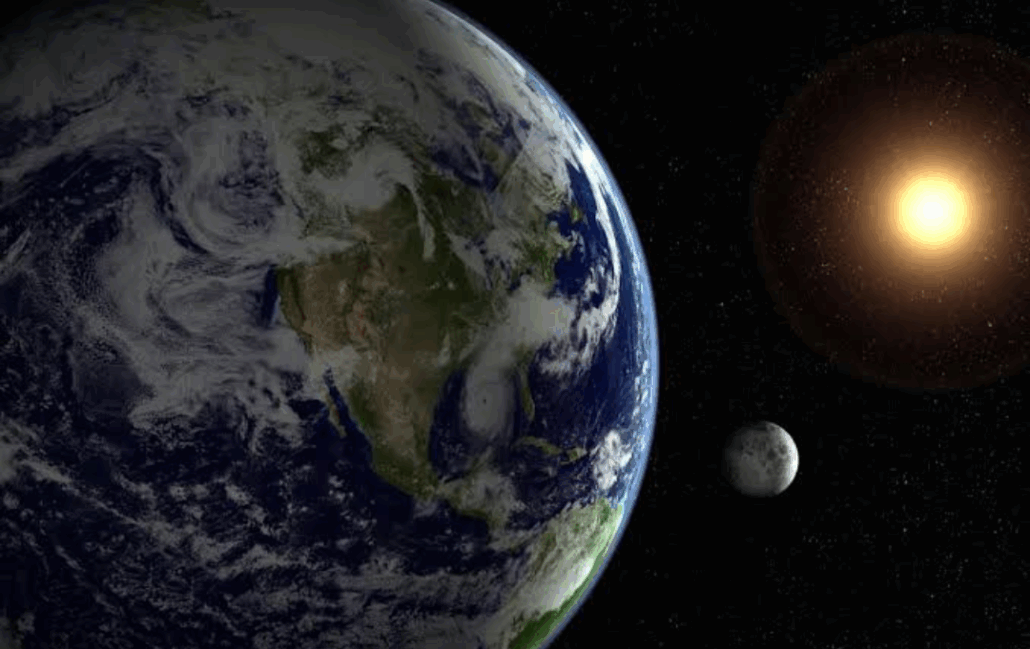
Earth is spinning slightly faster than usual this month, and scientists say this isn’t the first time it’s happened.
On July 9, the planet completed its rotation a little quicker than normal, shaving off about 1.3 milliseconds from the standard 24-hour day. And it’s expected to happen again soon.
According to researchers, July 22 and August 5 will also see shortened days due to the moon’s position in relation to Earth’s equator.
On those dates, Earth’s rotation is predicted to speed up enough to reduce the day by between 1.3 and 1.5 milliseconds.
A day is typically 86,400 seconds, the time it takes Earth to complete a full rotation. However, various factors can influence this, including the gravitational pull from the moon and sun, changes in Earth’s magnetic field, large-scale climate activity, and the shifting of mass across the planet.
This isn’t the first time Earth has spun faster than usual. In 2020, scientists observed a string of unusually fast rotations.
In fact, 28 of the shortest recorded days since modern tracking began in the 1970s occurred during that year. On July 19, 2020, for instance, Earth spun 1.47 milliseconds faster than average. Prior to that, the previous record for the shortest day had stood since 2005.
More recently, on July 5, 2024, Earth recorded its fastest-ever day — completing a full spin 1.66 milliseconds short of 24 hours, according to data from timeanddate.com.
The latest changes are linked to the moon’s current position. When the moon is further away from Earth’s equator and closer to the poles, its gravitational pull interacts with the planet differently, causing it to spin a little faster.
Think of Earth like a spinning top — how it spins depends on where the force is applied.
Although we won’t notice these shifts in daily life, clocks still tick through 24 hours, they matter in the long term.
If differences accumulate and the total length of a day shifts by more than 0.9 seconds, international timekeepers step in to adjust coordinated universal time (UTC) by adding or removing what is known as a leap second.
This process is managed by the International Earth Rotation and Reference Systems Service (IERS).
Researchers are also examining how human activity may be influencing Earth’s rotation.
A NASA study found that from 2000 to 2018, the melting of polar ice and depletion of underground water reservoirs added approximately 1.33 milliseconds per century to Earth’s day length.
Single seismic events can have an impact too. The 2011 earthquake in Japan, for instance, shortened the day by 1.8 microseconds.
Even the change of seasons plays a role. In the northern hemisphere, summer leads to mass shifting upward as trees grow leaves, subtly changing Earth’s inertia and slowing the spin.
According to geophysicist Richard Holme of the University of Liverpool, it’s the same principle as an ice skater slowing their rotation by extending their arms outward.
With July 9 behind us, scientists are now closely monitoring July 22 and August 5 to track exactly how much shorter those days will be, and what they might reveal about our planet’s changing dynamics.

- News Deskhttps://thekashmiriyat.co.uk/author/kashmiriyat/

- News Deskhttps://thekashmiriyat.co.uk/author/kashmiriyat/

- News Deskhttps://thekashmiriyat.co.uk/author/kashmiriyat/
- News Deskhttps://thekashmiriyat.co.uk/author/kashmiriyat/
