


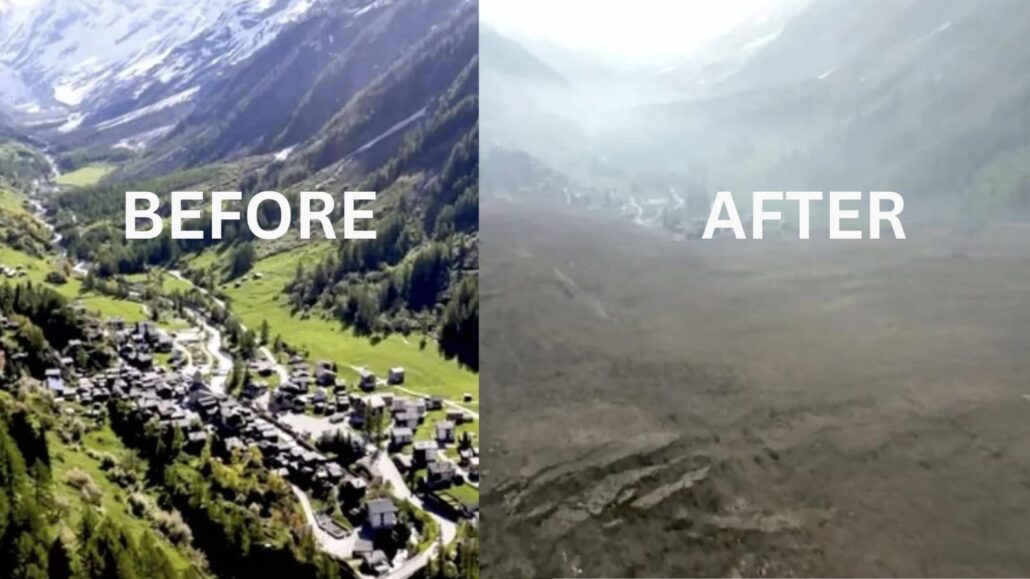
On May 28, 2025, a massive landslide triggered by the collapse of the Birch Glacier tore through the Swiss alpine village of Blatten, burying nearly 90% of it under a torrent of ice, mud, and rock.
At least 40 buildings—homes, barns, and public structures—were swallowed in seconds, transforming a centuries-old settlement into a wasteland of debris.
One person remains missing, though the toll could have been far worse had residents not been evacuated on May 19 after scientists detected signs of imminent collapse.
Drone footage and satellite imagery reveal the scale of destruction: what was once a scenic village at the foot of a glacier is now an uninhabitable scar in the landscape.
But this is no mere natural tragedy. It is the culmination of decades of relentless human reshaping of the Alps.
Switzerland’s mountains, long viewed as untouchable symbols of natural majesty, have been systematically pierced, carved, and hollowed. Tunnels, roads, and railway lines—like the Gotthard and Lötschberg base tunnels—have turned bedrock into passageways.
Entire slopes have been modified for tourism, ski infrastructure, and year-round access, often at the cost of environmental stability.
The expansion of road networks and mining operations has only deepened this vulnerability, disturbing delicate permafrost layers and weakening the structural cohesion of alpine terrain.
Experts say the collapse of the Birch Glacier was primarily driven by rising temperatures and melting permafrost. But climate change is not acting alone. It is being accelerated—and its effects magnified—by the physical interventions humans continue to make into mountainous environments already on the brink.
For years, scientists warned of glacial retreat and slope destabilization, but those warnings were largely absorbed into environmental reports rather than acted upon in policy or planning.
The disaster in Blatten is not an unpredictable anomaly; it is a predictable consequence of ignoring geological limits.
What was lost in Blatten is not just infrastructure—it is trust in the myth that human engineering can outwit nature.
As rescue teams retreat and experts begin to assess long-term recovery, Switzerland—and the world—must confront a sobering truth: the mountains are shifting, and we have helped them fall.


- News Deskhttps://thekashmiriyat.co.uk/author/kashmiriyat/

- News Deskhttps://thekashmiriyat.co.uk/author/kashmiriyat/

- News Deskhttps://thekashmiriyat.co.uk/author/kashmiriyat/
- News Deskhttps://thekashmiriyat.co.uk/author/kashmiriyat/

