
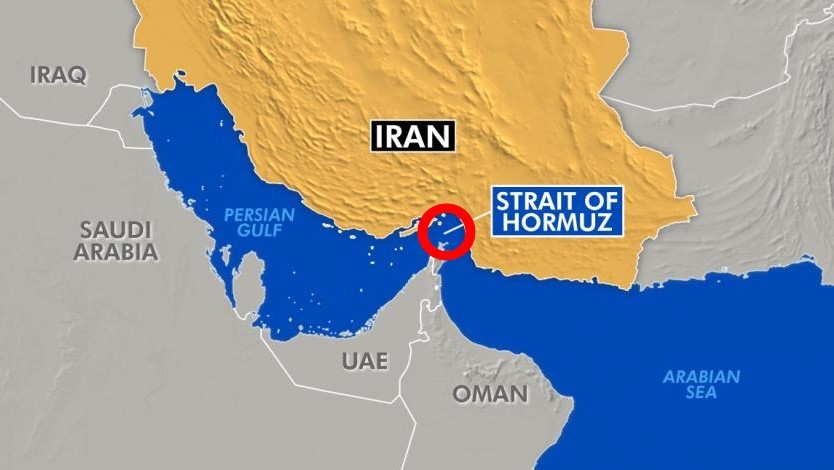
Amid deepening hostilities with Israel, Iran has raised the stakes by threatening to close the Strait of Hormuz, a narrow but crucial artery for the world’s oil.
Esmail Kosari, a senior Iranian parliamentarian and influential voice in the Islamic Revolutionary Guard Corps (IRGC), told domestic media that Tehran is “seriously considering” the option — a signal that Iran is willing to weaponize its geography as tensions spiral.
This isn’t just sabre-rattling. The Strait of Hormuz carries nearly a fifth of the world’s oil, making it a singular pressure point in the global energy system. Around 17 million barrels of oil per day—much of it from Saudi Arabia, the UAE, and Kuwait—must pass through this waterway to reach global markets. There is no alternative sea route out of the Persian Gulf.
Geographically, the strait is just 33 kilometers wide at its narrowest, but the actual shipping channels used by tankers are even more restricted due to maritime safety regulations and underwater topography. With Iran’s coast hugging one side of the strait, and its military presence deeply entrenched in the region—including naval bases, missile batteries, and fast-attack craft—it has the ability to disrupt or choke traffic, even if only temporarily.
A Dangerous Gamble
Shutting the strait—or making it too risky to navigate—would have instantaneous ripple effects: oil prices would spike, insurance premiums on Gulf shipping would skyrocket, and markets already rattled by war would tilt into panic. Even countries that don’t buy oil from the Middle East would be hit hard by global supply shocks.
But the move carries enormous risks for Iran, too. About 80% of Iran’s own oil exports also depend on the same strait. Any closure would not just invite military retaliation, particularly from the United States, but also sabotage Iran’s economy.
During the Tanker War of the 1980s, both Iran and Iraq targeted each other’s oil shipments in the Gulf. More recently, Iran has seized commercial vessels near the strait in response to western provocations. In 2019, a series of limpet mine attacks on tankers and the downing of a U.S. drone off its coast brought the two countries to the brink of open war. In April 2024, Iran intercepted a container ship following Israeli strikes on its consulate in Damascus by Israel.
Unlike the Bab el-Mandeb near Yemen—another flashpoint disrupted by Houthi attacks—there is no alternative route to bypass Hormuz. It’s the only way out for Gulf oil, making its closure not just a regional issue, but a global emergency.
Kosari’s warning follows a dramatic escalation: Israel’s strike campaign on Iranian territory this week targeted Iran. Iran’s response—hundreds of missiles launched toward Israel—marked the largest direct exchange between the two foes to date. Though the U.S. assisted in intercepting Iranian projectiles, Washington has publicly distanced itself from Israel’s actions, hoping to avoid being pulled into the conflict.
Still, the U.S. Navy maintains a strong presence in the Gulf, and any serious Iranian move to interfere with shipping would almost certainly provoke a direct military response.
For now, Iran’s threat appears calibrated — a warning, not a declaration. But as the Israel-Iran conflict moves from shadow war to direct confrontation, even a temporary disruption at Hormuz could tip an already volatile situation into something far more dangerous.
The world should take Kosari’s words seriously, not because Iran has closed the strait before — it hasn’t — but because it has repeatedly prepared for it. The threat of closure may be Tehran’s sharpest remaining card, and it is now being laid face up.

- News Deskhttps://thekashmiriyat.co.uk/author/kashmiriyat/

- News Deskhttps://thekashmiriyat.co.uk/author/kashmiriyat/

- News Deskhttps://thekashmiriyat.co.uk/author/kashmiriyat/
- News Deskhttps://thekashmiriyat.co.uk/author/kashmiriyat/
