Meer Irfan
The healthcare system in Jammu Kashmir has long faced scrutiny, but in recent months, allegations of medical negligence—especially affecting underprivileged patients—have intensified.
At the forefront of this campaign is Mehraj Malik, MLA from Doda and Jammu Kashmir’s Aam Aadmi Party chief. Malik has consistently alleged that government hospitals, particularly Government Medical College (GMC) Doda, systematically fail the poor while serving the affluent with ease.
In multiple social media videos, Malik has highlighted disturbing stories of patients allegedly mistreated or subjected to unnecessary procedures. One case involves a patient who underwent eye surgery at GMC Doda, only to be told later by doctors in Amritsar that the surgery was not medically required.
The patient claimed that a compounder—not even officially posted at the hospital—participated in the operation. “They did it only for money,” the patient alleged in a Facebook video Malik shared.
Malik’s campaign gained momentum in May 2025, when a 22-year-old pregnant woman from Hadal Bhalessa died following a cesarean section at GMC Doda. Her family alleged that the procedure was performed without senior doctors present and that her post-operative care was severely lacking. They further accused the hospital of trying to cover up the incident by shifting her body to another facility after her death.
“These are not isolated incidents,” Malik has said. “This is the daily reality for the voiceless in our hospitals.”
Across the region, several other cases echo similar patterns of negligence and lack of accountability. In Anantnag, 27-year-old Rozy Jaan died in July 2020 at the Maternity and Child Care Hospital due to the absence of a ventilator, which her family said could have saved her life.
Two months earlier, 25-year-old Shakeela Akhtar died after being transferred from Sub-District Hospital Seer Hamdan to the same hospital in Anantnag. The family blamed delays and poor care, and the fallout led to the suspension of a medical officer and a nurse.
In January 2023, Shabnum Farooq died after receiving an injection at the same hospital despite a known allergy. Her family directly blamed the doctors for negligence.
In Srinagar, in July 2024, Gulzar Ahmad Sheikh died after bypass surgery at Paras Hospital. His family said they were promised a 98 percent survival rate, only to be asked for Rs 3 lakh more for a second procedure. Despite paying, Sheikh died.
His family has demanded a refund of the Rs 6 lakh already spent and called for an investigation.
There are also silent stories, like that of a patient in Anantnag whose family claims a doctor on night duty refused to leave his car when called for an emergency.
The patient died waiting. Though an inquiry was launched, the outcome was never made public. This is a pattern familiar to families who raise complaints and rarely get closure.
One might have issues with his language and behavior, but Malik’s allegations point towards a larger, unspoken truth: that access to treatment in Jammu Kashmir is often dictated by one’s social or political connections and economic status.
Care is frequently denied or delayed for those from poorer backgrounds or rural areas, while the rich and urban elite—who often dominate public discourse—fail to see this as a major issue.
The privileged classes rarely experience the fear and neglect that the underprivileged endure in government hospitals. Meanwhile, the aspirational class, though chasing the dream of upward mobility, also suffers immensely when seeking treatment.
They face challenges not only in overburdened public hospitals but also in private facilities where exorbitant costs and opaque billing practices add to their burden.
The government itself has, on several occasions, acknowledged the existence of a deep-rooted rot within the healthcare system.
Multiple reports and inquiries have confirmed systemic medical negligence and a lack of accountability that disproportionately harms the poor. Despite these acknowledgments, meaningful reforms have been slow, and many patients continue to fall victim to negligence, corruption, and inefficiency.
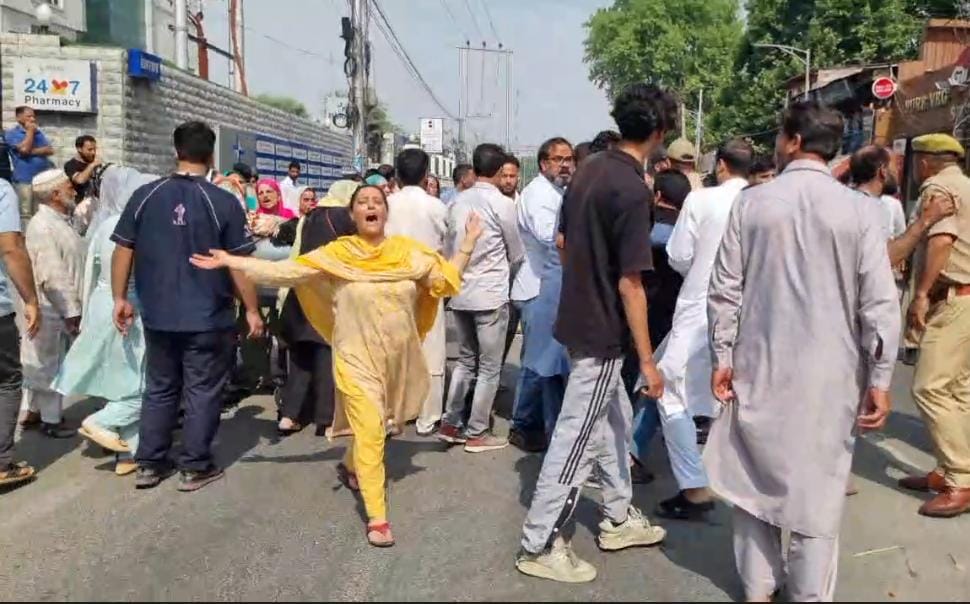
Recently, in response to serious allegations of medical negligence, the Chief Medical Officer (CMO) Srinagar issued a formal suspension order against eight members of the medical and paramedical staff at Paras Hospital, Srinagar.
This action follows mounting public anger over the death of a patient, Waseem Ahmad Pathan, who reportedly died under questionable circumstances while receiving treatment at the hospital.
The suspended personnel include senior surgeons, anesthetists, an operation theatre technician, the ICU in-charge, and nursing staff.
The CMO’s directive prohibits all of them from practicing medicine not only at Paras Hospital but at any other medical facility in the region until the ongoing inquiry is completed.
Mehraj Malik often states on his Facebook live broadcasts that he is championing the cause of the poor in Doda. However, his voice resonates far beyond that district, representing the collective anguish of the people across Jammu Kashmir who are caught in the relentless cycle of medical negligence.
This systemic failure is not confined to isolated incidents but is a chronic malady afflicting the entire healthcare system, eroding public trust and costing lives.
Even media houses that dare to expose these harsh realities have faced intimidation and threats of FIRs, a tactic that undermines press freedom and stifles the crucial discourse needed for reform. Such actions reveal a disturbing pattern of attempts to silence voices speaking truth to power, further perpetuating the culture of impunity.
The recurring exposure of this “vicious cycle” of medical negligence underscores an urgent need for accountability and transparent reforms. It is a stark reminder that healthcare, a fundamental human right, should never be a privilege reserved for the wealthy or well-connected.
This battle goes beyond any single politician; it is a call for justice and responsibility from all who govern and serve. When human lives are valued differently based on wealth or influence, the very foundations of our society crumble. This struggle belongs to every citizen who demands fairness and dignity in healthcare. Ignoring this reality only deepens the wounds and delays the accountability that the people of Jammu Kashmir rightfully deserve.
To ignore these systemic failures is to betray the vulnerable and to allow this tragic performance of neglect to continue, with human lives as its casualties.
The views expressed by the author are his own.
- News Deskhttps://thekashmiriyat.co.uk/author/kashmiriyat/
- News Deskhttps://thekashmiriyat.co.uk/author/kashmiriyat/
- News Deskhttps://thekashmiriyat.co.uk/author/kashmiriyat/
- News Deskhttps://thekashmiriyat.co.uk/author/kashmiriyat/


