

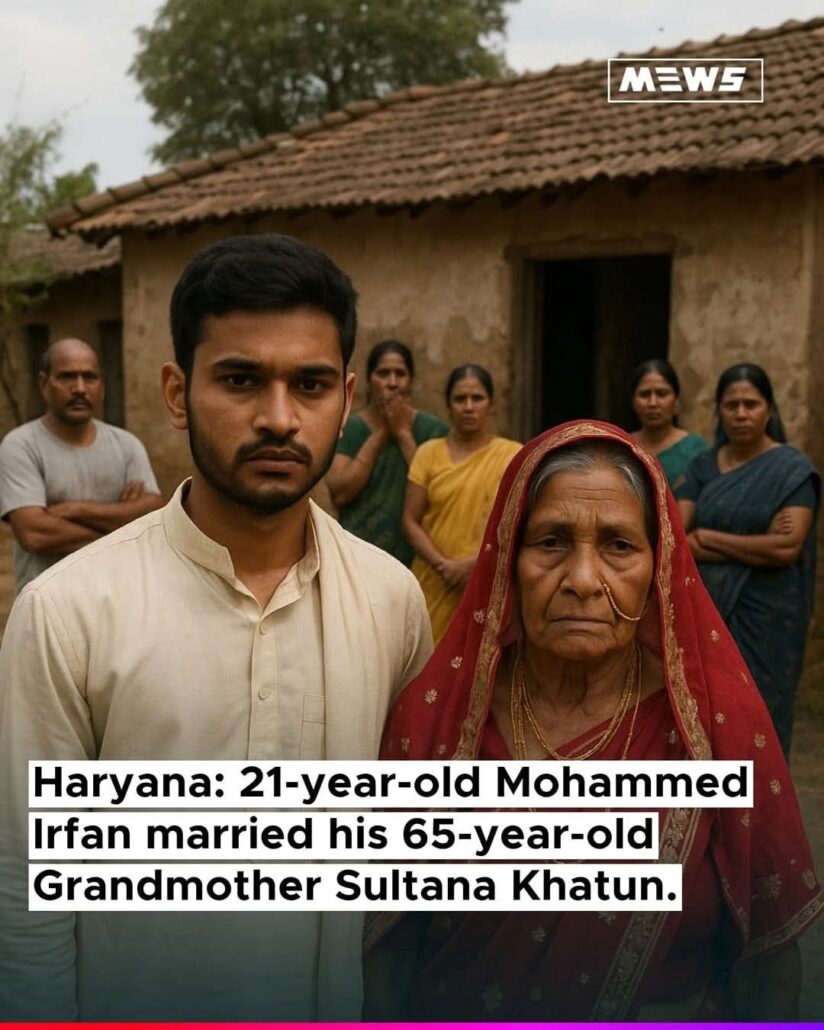
An image has gone viral on social media claiming that a 21-year-old man named Mohammed Irfan from Haryana married his 65-year-old grandmother, Sultana Khatun.
The post, widely circulated by meme pages and Instagram accounts, has generated a wave of Islamophobic commentary and ridicule online.
What is especially troubling is that these types of narratives don’t emerge from meme pages alone. Over the past year, mainstream media channels including Aaj Tak, Zee News, News24, TV9 Bharatvarsh, and Times Now Navbharat have repeatedly amplified similar fake or dramatized videos involving so-called “unusual” Muslim marriages without any verification.
A prime example is a viral video showing a 21-year-old man with a 52-year-old woman, widely misreported as a real wedding. This video was actually a scripted piece created by Instagram content creator Paresh Sharma, who goes by the username techparesh.
Paresh Sharma produces relationship-themed skits — all fictional — designed purely for virality. The same actors are repeatedly featured in multiple roles: as newlyweds, as love triangle characters, or as victims of societal rejection.
In that particular case, the man alleged to be “marrying” the 52-year-old woman appears in multiple other videos on the same account, including one where he is romantically involved with two younger women, and another in which the same older woman is shown “married” to a different 22-year-old man.
These videos are heavily dramatized, acted, and fictional, but were still picked up as news by major outlets with headlines like:
“21 साल का दूल्हा, 52 साल की दुल्हन” (21-year-old groom, 52-year-old bride)
and
“प्यार में उम्र नहीं देखी जाती” (Age is no bar in love)
Now, this newer image — claiming Mohammed Irfan married his grandmother Sultana Khatun — appears to follow the same formula. A reverse image search reveals it is from a fictional video or skit, likely scripted and posed by actors.
There are no official marriage records, no media coverage from Haryana, and no verified individuals with the names mentioned.
The setting, expressions, and styling all resemble low-budget dramatic short films or AI-enhanced thumbnails made to bait engagement.
In addition to scripted content, recent months have seen a rise in AI-generated fake images used by what can only be described as engagement farms.
These include photos of elderly Muslim men marrying underage Hindu girls, or Muslim men in polygamous weddings — none of which are real, but often framed to stir outrage and spread communal misinformation.
This image is part of a disturbing trend where Muslim names are deliberately attached to fabricated or exaggerated relationship stories in order to provoke Islamophobic responses, ridicule Muslim culture, and paint the community as regressive or immoral.
It becomes even more dangerous when this content is validated by mainstream news media without any verification process.
Verdict: Fake
The people in the image are actors. No such marriage took place in Haryana. The content follows a now-recognizable pattern — likely created or inspired by the fictional videos of content creator Paresh Sharma (techparesh), who routinely publishes skits portraying controversial relationships.
Yet such content continues to be circulated as news, often with communal undertones.


- News Deskhttps://thekashmiriyat.co.uk/author/kashmiriyat/

- News Deskhttps://thekashmiriyat.co.uk/author/kashmiriyat/

- News Deskhttps://thekashmiriyat.co.uk/author/kashmiriyat/
- News Deskhttps://thekashmiriyat.co.uk/author/kashmiriyat/

