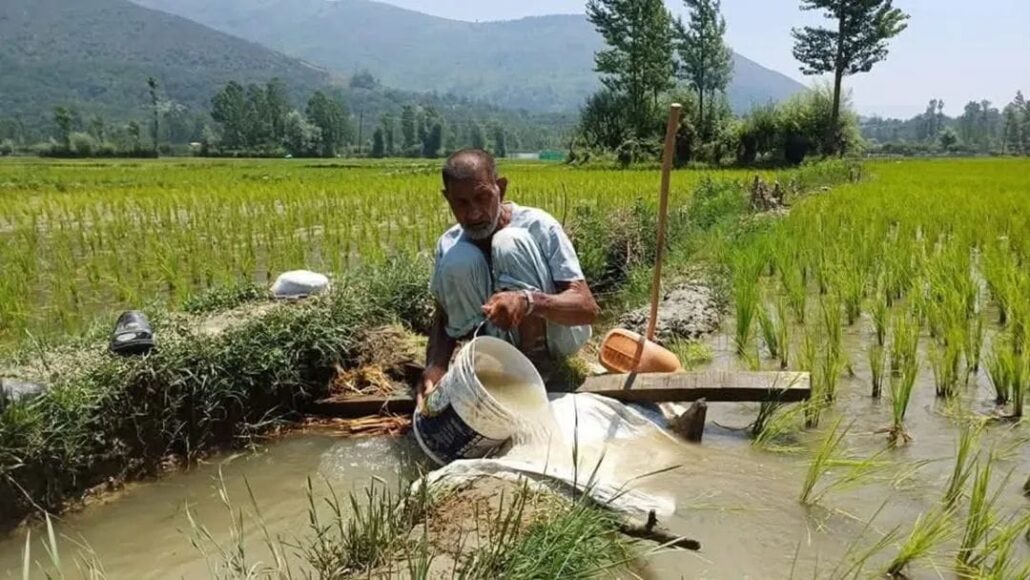
People’s Democratic Party leader Iltija Mufti on Saturday raised alarm over a growing irrigation crisis in south Kashmir, warning that the districts of Anantnag and Kulgam are “staring at an acute irrigation crisis” due to prolonged dry spells that have severely affected paddy transplantation.
“Farmers are on the brink of despair & desperation,” she wrote on social media, appealing to Deputy Commissioners of both districts to expedite measures to manage the worsening water shortage.
On the ground, her concerns are echoed by farmers across the region, particularly in villages that depend on the Bringi and Jhelum rivers for irrigation.
In areas like Brinty, Hakura, Palpora, Ara Koshipora in Anantnag, the crisis has reached alarming levels. “We have lost hope,” says Mohammed Junaid, a young farmer in Palpora Ara. “Our paddy fields have dried up and cracked. We’ve begun planting corn and pulses instead—only because we must keep going.”
Across the paddy belt of South Kashmir, fields are turning brown instead of green. Villages like Sherpora, Frisal, Chinnigam, Kujar, Khudwani, Hassanpora, and Wapora in Kulgam are among the hardest hit.
“This is the peak time for paddy cultivation, but many of our fields have not received a drop of water,” said Ghulam Rasool, a farmer from Frisal. “I’ve already lost over half my crop. If it doesn’t rain soon or water isn’t supplied, we won’t survive the year.”
The Kashmiriyat has learned from the Irrigation and Flood Control Department that the water level in River Jhelum is at a dangerously low 30 percent of its usual capacity. “This is supposed to be the time of peak discharge,” said a senior department official. “Canals that rely on glacier-fed and river-fed flow are running dry. It’s a grave situation.”
Executive Engineer Irrigation Division Kulgam, Parvaz Ahmad Naik, acknowledged the severity of the crisis. “We are trying to manage the limited supply by prioritizing some areas, but the gap between availability and demand is too wide this year,” he said.
The Meteorological Department in Srinagar reports a more than 40 percent drop in precipitation compared to the seasonal average. The prolonged dry spell, compounded by an intense heatwave, has created near-drought conditions. Agricultural experts fear a sharp decline in paddy output, calling it a “climate-induced crisis.”
“We are seeing glacier-fed streams drying up much earlier than they used to, and rainfall is becoming erratic,” a senior officer from the Agriculture Department said. “This isn’t just a temporary problem—it’s a threat to food security.”
In the Bringi-fed belts of Anantnag, desperate farmers like Nazir Ahmad Mir say they now place their hope in divine mercy. “Our fields are cracked, the saplings are dying, and we await the rain. Only Allah can save this crop now.”
With the sowing window closing rapidly, calls for intervention grow louder. Iltija Mufti’s appeal may have brought attention to the unfolding disaster, but in the fields of south Kashmir, farmers continue to work under a sky that offers no promise of rain.

- News Deskhttps://thekashmiriyat.co.uk/author/kashmiriyat/

- News Deskhttps://thekashmiriyat.co.uk/author/kashmiriyat/

- News Deskhttps://thekashmiriyat.co.uk/author/kashmiriyat/
- News Deskhttps://thekashmiriyat.co.uk/author/kashmiriyat/
