

A volatile situation unfolded at SMHS Hospital on Wednesday following the death of a patient and an alleged assault on a doctor, leading to a strike by medical staff, chaos at hospital gates, and the heckling of a journalist on duty.
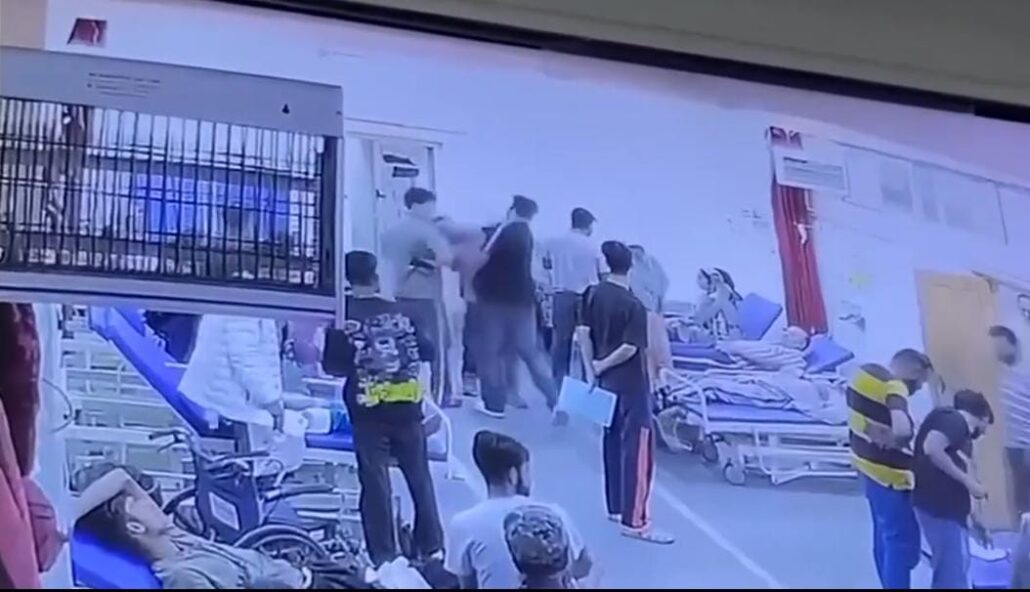
The protest erupted after Abid Hussain Bhat, a resident of Basant Bagh, Srinagar, allegedly slapped a doctor inside the emergency ward on Tuesday night.
According to Government Medical College (GMC) Srinagar, the doctor was attending to patients when he was attacked by an attendant, prompting a shutdown of services and widespread condemnation by the medical fraternity.
“This is strongly condemnable. We are here to serve people, but there must be cooperation and respect,” a group of protesting doctors told the press.
Hundreds of doctors from GMC Srinagar and affiliated hospitals gathered at SMHS, demanding strict action and improved safety for medical personnel.
A CCTV video of the incident, showing a man slapping a doctor, went viral on social media, intensifying public outrage and calls for accountability. GMC Srinagar termed the hospital a public asset and urged restraint from patients and attendants.
A senior police officer confirmed that FIR No. 11/2025 was registered on July 23, and investigations are underway.
However, the family of the deceased patient, Javid Ahmad, tells a different story.
According to Abid Hussain, his brother-in-law Javid was admitted around midnight on Tuesday with severe chest compression and breathlessness.
“He asked for oxygen multiple times, but the doctor didn’t listen. My sister begged them to help, but they didn’t even check him. They just prescribed an injection and left,” Abid told a Srinagar based Facebook news page. “When I returned, my brother-in-law had passed away. I found the doctor laughing with colleagues. That’s when I lost control. Anyone would react the same to such inhumanity,” he said, in a video interview which is viral on social media now.
The aftermath was severe. Resident doctors shut the hospital gates on Wednesday and staged a sit-in, halting even emergency services. The gate closure caused distress to dozens of patients, including a young child who had suffered an electric shock, but was denied entry.
Journalist Sufi Hidayah, who had gone to report on the incident, said she was heckled, physically pushed, and insulted by a group of doctors at the protest site. “They tried to pull my clothes and called me unprofessional. One shouted, ‘We don’t need the media here, get out.’ They also tried to stop patients from talking to me,” she said.
Patients and their attendants staged a counter-protest outside the locked gates, accusing doctors of abandoning their duty. “We understand their anger, but how can they shut the hospital and let patients die?” asked an attendant.
The SMHS administration has appealed for calm, confirming that legal proceedings are underway and that efforts are being made to restore normal functioning.
This is not the first allegation of medical negligence at a hospital in Kashmir. Anyone who has visited a government hospital here has either witnessed or experienced the frustration of unresponsive staff, delayed care, or outright denial of treatment.
In May 2025, a 34-year-old man from Pampore died at Paras Hospital in Srinagar following a surgery. The family alleged that no senior doctor ever checked on the patient despite charging over ₹2.5 lakh. They blamed sheer negligence for the death, prompting a protest and suspension of hospital staff.
In December 2024, at GMC Handwara, a 37-year-old father of three died after allegedly being treated by a compounder instead of a qualified doctor. The family claimed their requests for proper care were ignored and that the patient’s ECG report was deliberately withheld.
Another case emerged at GMC Baramulla in November 2024, where the family of a deceased patient accused doctors of refusing timely oxygen support. The patient died minutes after being told to wait. The family staged a sit-in, demanding accountability from the hospital administration.
Meanwhile, the incident at SMHS hospital has triggered a broader public debate on medical ethics, patient rights, safety of health workers, and press freedom, all under intense scrutiny in a public healthcare system already strained by mistrust and systemic shortcomings.

- News Deskhttps://thekashmiriyat.co.uk/author/kashmiriyat/

- News Deskhttps://thekashmiriyat.co.uk/author/kashmiriyat/

- News Deskhttps://thekashmiriyat.co.uk/author/kashmiriyat/
- News Deskhttps://thekashmiriyat.co.uk/author/kashmiriyat/

