
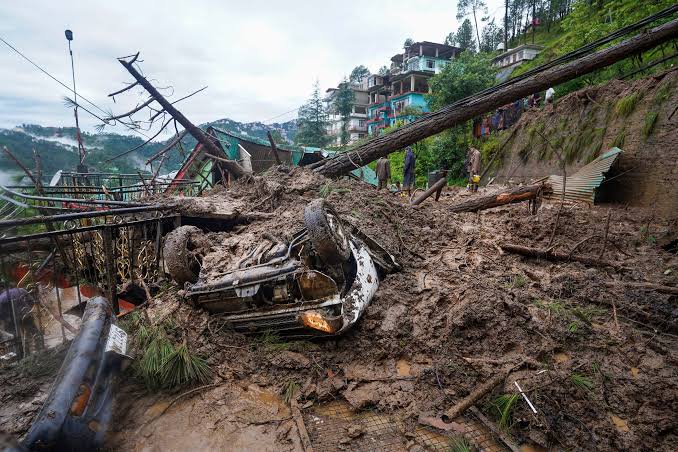
The Supreme Court on Monday observed that the ecological challenges seen in Himachal Pradesh were not confined to the state but extended across the entire Himalayan range, which it described as being “very violent” this season.
A bench of Justices Vikram Nath and Sandeep Mehta, hearing a suo motu case on environmental degradation in Himachal Pradesh, said it would issue an order on September 23 after examining submissions.
“Ultimately, it is not going to be limited to Himachal only. It is the entire Himalayan range that is facing this. This time around, it has been very very violent,” Justice Mehta remarked.
During the hearing, the Himachal Pradesh government placed a report before the court outlining its assessment of environmental conditions. The document covered tree cover, mining, glaciers, hydropower, highways, and the rise in extreme weather events.
Senior advocate K Parmeshwar, assisting the court as amicus curiae, noted that while the report addressed a wide range of issues, it lacked precise details—especially on glacier reduction and movement. He added that the state had only proposed setting up a committee and preparing a glacier registry.
According to the report, a comparative study of glacier inventories between 2001–2002 and 2016–2019 showed that while the number of glaciers remained largely stable, their total area had declined, indicating gradual shrinkage.
It also attributed recent devastations—including cloudbursts, flash floods, landslides, erratic snowfall, and receding glaciers—to climate change caused by industrialization, greenhouse gas emissions, and unsustainable practices. Between 2018 and 2025 alone, the state recorded 434 extreme weather incidents, which claimed 123 lives and inflicted heavy losses on agriculture, horticulture, and livestock.
On the issue of hydropower projects, the report argued that these could not be considered the main cause of destruction, noting that recent floods and cloudbursts occurred in areas without such installations. It further said highway projects were taken up after due diligence and that afforestation drives were being carried out to offset deforestation caused by development.
In July, another bench of the Supreme Court had warned that Himachal Pradesh might “vanish in thin air” if corrective steps were not taken. The court had observed that climate change was having a “visible and alarming impact” on the state and stressed the need for expert consultation before approving large development projects in the fragile Himalayan belt.

- News Deskhttps://thekashmiriyat.co.uk/author/kashmiriyat/

- News Deskhttps://thekashmiriyat.co.uk/author/kashmiriyat/

- News Deskhttps://thekashmiriyat.co.uk/author/kashmiriyat/
- News Deskhttps://thekashmiriyat.co.uk/author/kashmiriyat/
