
Shah Basit
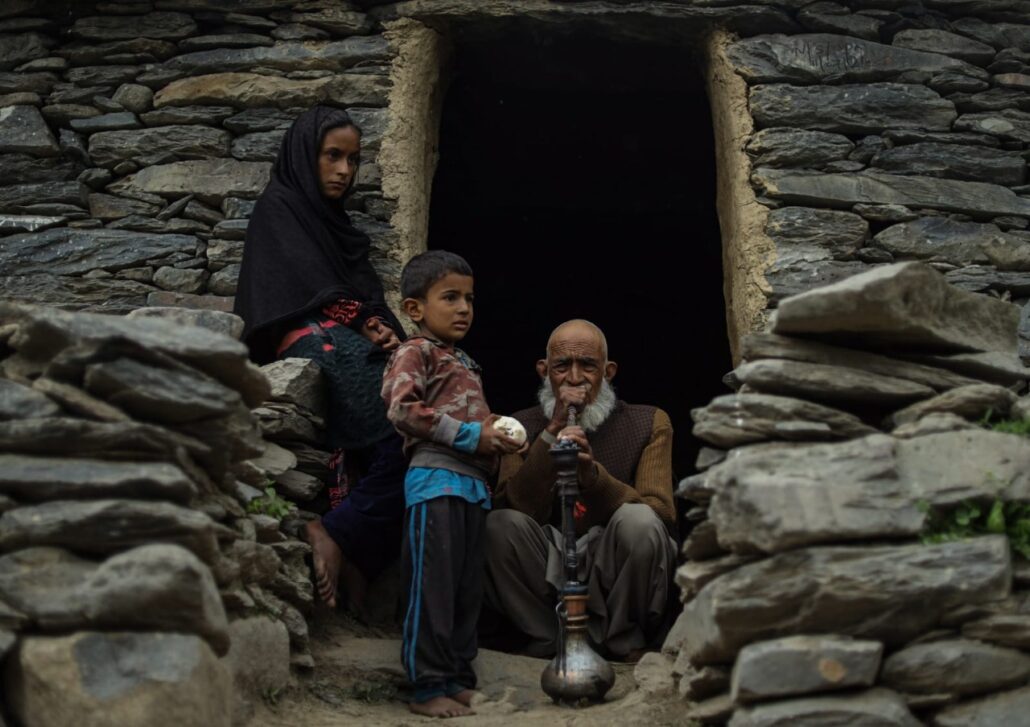
Each year, Ghulam Hassan Shergojri, a pastoralist from Jammu, begins his steep seasonal migration to the hills of Kashmir. Accompanied by a flock of over 600 sheep, he follows the well-trodden uphill trail to Batkote in Pahalgam, about fifteen kilometers above Abshar Park. This journey, a tradition deeply rooted in memory and necessity, felt unfamiliar this time. “I could feel the intense heat there,” Shergojri said as he stood beside his house in Batkote, Pahalgam. “I have been grazing cattle in these pastures for five decades. This is the first time in my life that I saw flies in the Dhokas.” (High-altitude shepherd huts)
For him, the presence of flies at that altitude wasn’t a trivial nuisance—it was a marker of something deeper, a disorienting shift in the mountains’ behavior.
The disruption is not limited to his experience alone. Many pastoralists from the Gujjar and Bakarwal communities, who traditionally migrate each summer from Jammu to Kashmir’s highland pastures, have been facing erratic climatic patterns that upend the rhythms of their migration. In April, unusual heat in Jammu forced herding families to start their journey earlier than usual. But when they reached Kashmir’s higher elevations, they found the meadows still under snow, the air cold, and no fresh grass in sight. “In the plains, our sheep would die from heat,” said Shaheena Begum, a herder from Rajouri, who halted early in Pahalgam.
A broader climate pattern confirms what these families feel. According to a 2024 study by the Indian Institute of Integrative Climate Research, Kashmir’s average annual temperature has increased by 1.2 degrees Celsius over the last forty years. Winters have shortened, spring now arrives earlier than before, and rainfall patterns are increasingly erratic. In May this year, South Kashmir recorded 40 percent less precipitation than average. Highland regions saw daytime temperatures surge by 4 to 6 degrees Celsius above normal, triggering rapid snowmelt in some areas while leaving others dry and parched.
The implications are grave for those dependent on natural cycles. “Our sheep got sick this year because the water sources dried early,” said Mohammad Shafi, a herder in Shopian. “There used to be snow-fed streams all around here. Now we carry water in drums.” The absence of consistent meltwater in higher altitudes is forcing families to carry drinking water over long distances, making survival even harder for livestock and people.
These changes in climate are being intensified by unabated deforestation in the region. Locals in Batkote, Aru, and Sedow in Shopian say the scale of tree cutting—both legal and illegal—has grown in recent years. What was once dense forest cover is rapidly thinning. “Trees are being cut like weeds,” said Sharik Ahmad, a shopkeeper from Sangam, Anantnag. “These forests used to hold the snow, give us shade, feed the earth. Now it’s all gone. The hills feel naked.” With the loss of tree cover, the region is losing not only its natural insulation but also the sponge-like capacity of forests to regulate water and soil health.
The distress is not confined to pastoralists. Farmers across Kashmir are struggling with the impact of erratic seasons. According to the Department of Horticulture, apple production in 2024 declined by 23 percent due to unseasonal rains during the blossoming phase and intense heat in May. Maize and pulse yields dropped by 15 to 18 percent in the Pir Panjal belt. At the same time, pest infestations—such as woolly aphids and whiteflies—have spread to higher altitudes where they were once rare. “We now spray chemicals twice as much as we used to,” said Manzoor Dar, a farmer from Kulgam. “Still, the crops are less. And everything is costlier.”
Climate scientists warn of far-reaching consequences if these patterns continue. The Himalayan region, including Kashmir, is warming nearly twice as fast as the global average. If emissions and land degradation are not addressed, the region could lose up to 40 percent of its snow cover by 2050. “Anomalies are becoming the new normal,” said Dr. Sameer Qadri, a climate scientist. “And it’s always the poor who bear the first and worst brunt.”
With no pasture insurance, minimal shelter infrastructure, and no formal support systems, pastoralist communities remain among the most vulnerable to these accelerating climate disruptions.
Despite growing evidence of crisis, policies have failed to keep pace. Basic facilities for migratory families—like mobile health camps, schools, and animal care units—are absent or erratic. Families survive on inherited knowledge and mutual support, but even that is under strain as the seasons themselves grow unreliable.
As dusk settled over the hills of Batkote, Shergojri looked over his sheep, scattered thinly over a dusty, grass-starved patch of land. “Kashmir is changing,” he said softly.
“It’s not just the snow or the sheep. Even the silence feels different now.” What once felt eternal in these highlands—the rhythm of snow, sun, and shade—is now cracking under the weight of a warmer world. And for those whose lives are tied to the land, the warning signs are no longer distant—they are here, and they are everywhere.

- News Deskhttps://thekashmiriyat.co.uk/author/kashmiriyat/
- News Deskhttps://thekashmiriyat.co.uk/author/kashmiriyat/
- News Deskhttps://thekashmiriyat.co.uk/author/kashmiriyat/
- News Deskhttps://thekashmiriyat.co.uk/author/kashmiriyat/


