
Dr. Shabir Hussain
When I stepped inside the house last month, I could still hear the echoes.
Not voices, no. But echoes. Of wooden slippers clacking on the staircase. Of my grandfather’s slow cough before Fajr. Of my mother singing in the kitchen while scraping dried turnips with a blunt knife. The house, even in its ruin, remembered everything.
I grew up here in Tral. Back then, we didn’t call it “rural.” We just called it home.
There was no electricity in winter. We kept our milk in clay pots, tucked near the earthen walls to stop it from freezing. My sister and I would scrape ice from the inside of the windows and draw crooked hearts with our fingers. Outside, the sky was heavy with snow. But inside, there was warmth—not just from the fire, but from people. Especially during Chillai Kalan, the harshest 40 days of winter.
Every evening, my father would gather the neighbours—Hajji Ghulam who once walked to Anantnag by foot, old Ruqaya who claimed she’d seen a leopard snatch a sheep in broad daylight, and Saleem kaka who used to be a storyteller. They’d sit around the bukhari, wrapped in pherans, steam rising from their kangris, and the room would fill with stories. “Yem chun Kathe—yem che waris,” Saleem kaka would say. “These aren’t just tales—they’re inheritance.”
We children sat in a circle near their feet, sipping noon chai that tasted of dried milk and salt. The smoke stung our eyes. But no one blinked. The stories were too precious.
I still remember one night when the snow outside had risen past the windows. Someone knocked at the door. It was a young shepherd, half-frozen, his sheep lost in the dark. My father gave him a blanket, and my mother made him Kahwa. He stayed for three days. By the time he left, he knew all our names. That was the kind of house it was.
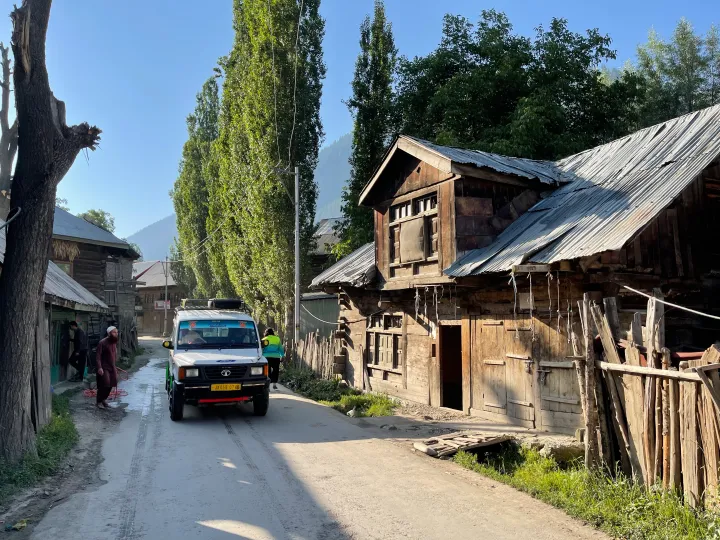
Now, the roof has collapsed on one side. The inner walls are green with moss. Part of the wooden ceiling has caved in. But the carved walnut panels in the sitting room are still intact. So is the shelf where my mother kept her clay spice jars. I picked one up. Still smelt faintly of fennel.
I had come with Yaqoob, an old neighbour and mason. We stood in the courtyard where my father used to sun-dry apples on reed mats. “I fixed that wall in ’87,” Yaqoob said, pointing. “We used cow dung and straw. No cement.” He sighed. “It was better.”
I nodded. “There was a peace in these walls.”
He turned to me. “Srinagar has come everywhere now.”
He’s right. The city has spread like shadow. Tin roofs, concrete gates, cars with tinted windows, noisy roads, people wanting to build more, earn more, selling “plots” in what used to be apple orchards. I didn’t tell him what I had done earlier that morning.
I had dug it when I was twelve—behind the pear tree, near the moss-darkened stone wall. That summer, I buried 21 rupee coins there. I told no one. It was my secret treasure, saved from stolen errands and leftover change from the baker in Tral. I always believed I’d return for it someday.
Last month, I did.
The coins were still there. Blackened, stuck together, barely worth anything now. But when I held them in my palm, my hands trembled—just like they had the day I buried them. What mattered wasn’t the metal, but what the earth had remembered, and what we had forgotten. I stared at them for a long time, unable to move. As if the soil still remembered the boy I used to be. A boy who believed a home would wait forever.
And now, the government wants to bring in rural building laws. They’re calling it regulation.
The house still stands, but just barely. The roof has collapsed inward. Rain drips through broken rafters. Mud bricks have softened into silence. The hearth is cold. And yet, the window grilles still cast the same familiar shadows on the floorboards where my mother once dried apricots.
I didn’t come for closure. I came to apologise.
But now, no house can rise without approval. Plans must be drawn. Permissions granted. A system will soon regulate what villagers have done for generations—build homes with their hands, their hearts, and their neighbours. Officials say it’s necessary. They say rural construction has been “unregulated” for too long. That it’s time for order.
Maybe they’re right. But where does that leave houses like mine? Where’s the form that accounts for walnut-scented winters, for a beam stained with kangri smoke, for a wall that once held up three generations? No code can capture that.
When I left the house, I placed my hand on the old threshold. The wood was soft with age, but warm. “I’m sorry,” I whispered. “I should’ve come back sooner.”
Yaqoob didn’t speak. He didn’t need to.
As we walked down the old stone path, past the dried-out hakh fields and the canal that once ran like a silver ribbon through the village, I turned for one last look. The house stood crooked, leaning like an old man who had outlived all his children. But it still stood.

- News Deskhttps://thekashmiriyat.co.uk/author/kashmiriyat/

- News Deskhttps://thekashmiriyat.co.uk/author/kashmiriyat/

- News Deskhttps://thekashmiriyat.co.uk/author/kashmiriyat/
- News Deskhttps://thekashmiriyat.co.uk/author/kashmiriyat/
