Javid Ahmed
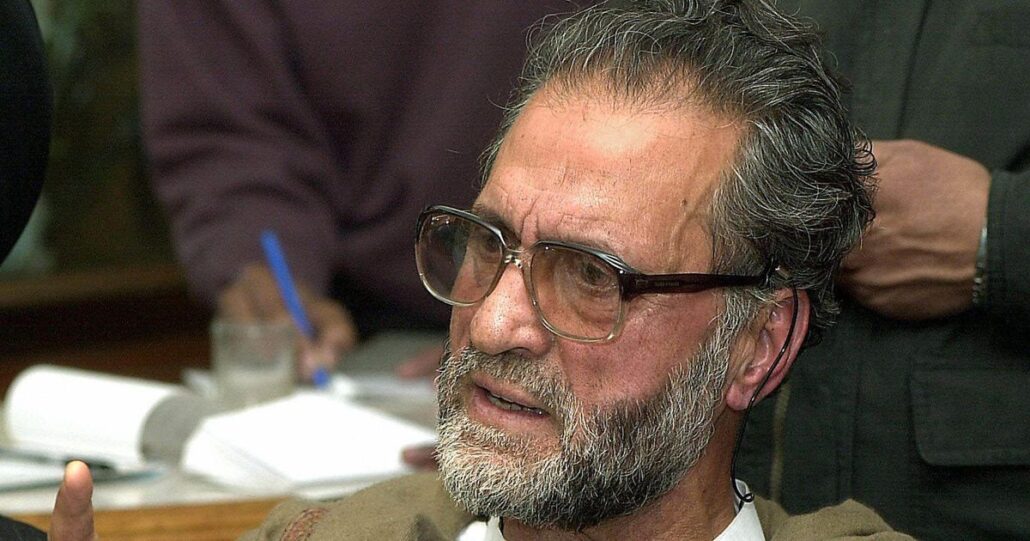
On the anniversary of his tragic death, Kashmiris must remember the harrowing incident in Jammu when an extreme right-wing Hindutva leader brutally attacked the All Parties Hurriyat Conference leader Abdul Ghani Lone during a news conference.
Kalkiji Maharaj, Jammu Kashmir state president of the Vishwa Hindu Parishad (VHP) attacked Lone, while armed policemen, assigned to protect Lone, stood by silently. The incident took place in a hotel lobby where Lone was being interviewed.
Maharaj, of Vishwa Hindu Parishad (VHP) — a militant wing of former Prime Minister Atal Bihari Vajpayee’s Bharatiya Janata Party — repeatedly slapped and pushed Lone. As he struck, Maharaj shouted, “You are anti-Indian. Your people are responsible for killing Hindus in Jammu,” despite the presence of armed police.
Born in 1932 in Dard Harie, Kupwara, district, Abdul Ghani Lone pursued higher education with dedication. He completed his B.A. and B.Ed., and later secured an LLB from Aligarh Muslim University in 1967.
Lone was actively involved in the students’ union during his university days. After graduating, he joined the Congress party in northern Kashmir and began practicing as an advocate in the High Court. His career progressed as he took on roles such as Director of the Jammu Kashmir State Cooperative Bank, Land Development Bank, and Senior Vice President of the Jammu Kashmir Cooperative Union.
In 1967, Lone was elected to the legislative assembly and became a member of its privilege committee. By 1970, he was appointed a deputy minister in G.M. Sadiq’s ministry, handling the portfolios of irrigation, law, and cooperatives. He was re-elected to the assembly in 1972 from Handwara with a significant majority and was elevated to the position of Minister of State for Tourism, Health, and Education in Syed Mir Qasim’s government.
Despite the political challenges, he was one of the two party candidates who successfully secured a seat in the assembly in 1977, overcoming the dominance of the National Conference.
In 1977, Lone founded the Jammu Kashmir People’s Conference. He became a key figure in the secessionist Hurriyat Conference at its inception in 1993.
It was April 01, 2002, Lone, an executive member of the All Party Hurriyat Conference, was in Jammu advocating for the release of Kashmiri prisoners including Yasin Malik. Following his press conference, Lone was addressing television crews when the VHP leader began the assault, calling Lone a traitor. Although Lone’s security guard attempted to intervene, he was restrained by Maharaj’s security officers.
After the attack, Maharaj exited the hotel shouting slogans like “Jammu ke gadaron ko nikal do. Desh ke gadaron ko nikal do” (Throw out the traitors of Jammu. Throw out the traitors of India).
Despite the violence he endured, Lone chose not to file a formal complaint. “These people have no sense. They are the same thugs from Gujarat. I pray to God that he gives them some sense. I do not want to take any action against him. I am not sure who is behind this,” he said.
Earlier that day, Lone had pleaded for the release of JKLF chief Yasin Malik, whose health was reportedly deteriorating in detention. He called for the Prime Minister’s intervention. However, the government responded by arresting Javed Ahmed Mir, Malik’s deputy, ahead of a protest march he was to lead in Srinagar.
Lone condemned right-wing groups for obstructing peace efforts in Kashmir and reiterated his appeal for Malik’s release, emphasizing Malik’s serious health condition.
Today, as Kashmir commemorates Abdul Ghani Lone’s legacy and mourn his loss, we reflect on his dedication to peace and justice amidst adversity. In 1987, Lone played a significant role in the formation of the Muslim United Front (MUF) — a coalition of Islamic and socio-political groups that sought to challenge the National Conference-Congress alliance through democratic means.
The MUF’s strong performance in that year’s assembly elections was crushed by widespread rigging, an event widely seen as one of the triggers for the insurgency that followed. For Lone, it was yet another betrayal of Kashmir’s democratic aspirations.
In 1993, he became a founding member of the All Parties Hurriyat Conference, where he consistently argued for a peaceful resolution of Kashmir. Crucially, unlike many contemporaries, Lone rejected armed struggle, calling instead for peaceful negotiation and mutual respect.
That commitment cost him dearly. He was vilified not just by nationalists but also by factions within Kashmir’s separatist camp — especially the “sleeper, but powerful cells” that quietly justified the killing of moderates in the name of purity and resistance. For years, the murder and marginalization of leaders like Lone were defended or ignored. Today, some of those very factions participate in electoral politics, now sanitized under the veil of pragmatism, yet rarely mention Lone — as if he never existed.
On April 21, 2002, just weeks after the attack in Jammu, Abdul Ghani Lone was assassinated in Srinagar during a public rally. Many believe he was killed not just by the enemies of peace, but by those threatened by the return of political moderation in Kashmir, in which they had received no role.
We must remember him.
Abdul Ghani Lone stood for dialogue when silence was safer. He sought peace when violence was fashionable. He dared to speak for an peaceful future, and was killed for it.
His legacy belongs not to the footnotes, but to the front lines of Kashmir’s unfinished story.
The views expressed by the author are his own.
- News Deskhttps://thekashmiriyat.co.uk/author/kashmiriyat/

- News Deskhttps://thekashmiriyat.co.uk/author/kashmiriyat/

- News Deskhttps://thekashmiriyat.co.uk/author/kashmiriyat/
- News Deskhttps://thekashmiriyat.co.uk/author/kashmiriyat/
