
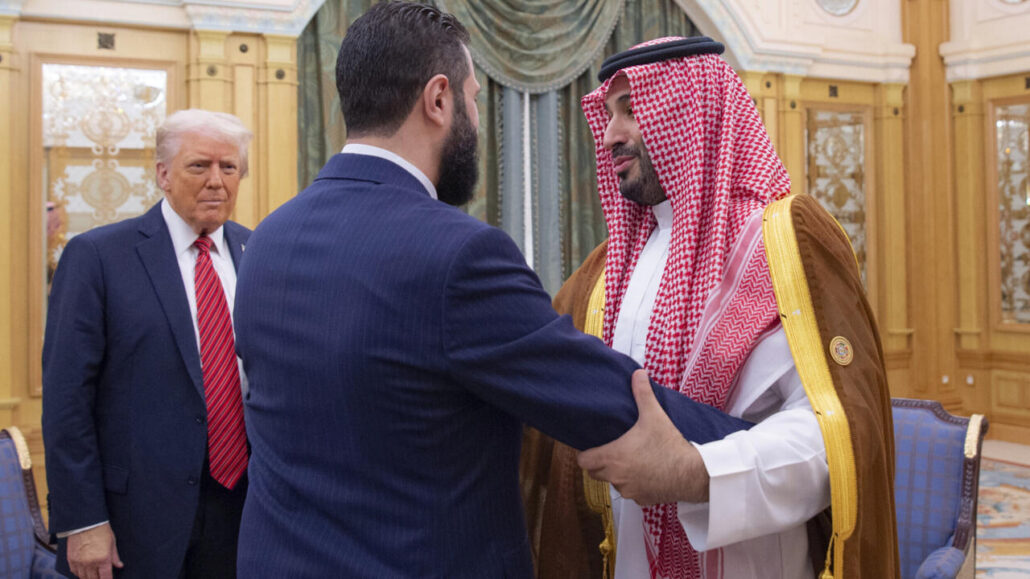
Israel has stopped publicly referring to Syria’s new president, Ahmed al-Sharaa, as a terrorist, a striking change in tone that reflects the shifting political landscape in the Middle East following the ouster of Bashar al-Assad, New York Times reported.
This rhetorical shift, from branding al-Sharaa a jihadist with ties to Al Qaeda to recognizing him as Syria’s de facto head of state, coincides with indirect talks between Israel and Syria, which are underway, according to the New York Times report.
It is the most serious diplomatic engagement between the two countries in more than a decade.
In the immediate aftermath of Assad’s fall in December 2024, Israeli officials, including Foreign Minister Gideon Sa’ar, had warned that Syria had fallen into the hands of a “terrorist gang,” referring to al-Sharaa’s past leadership of Hayat Tahrir al-Sham, a rebel group formerly aligned with Al Qaeda. But by mid-2025, such language has faded from public discourse, replaced by more neutral references to Syria’s “new authorities” or “interim government.”
The change in tone comes amid quiet backchannel diplomacy.
The Trump administration, which has taken a leading role in Middle East negotiations, has helped facilitate indirect discussions between Israel and Syria, according to U.S., Israeli, and Syrian officials cited by the New York Times.
Thomas J. Barrack Jr., President Trump’s envoy to Syria and ambassador to Turkey, confirmed that the U.S. is pushing for a nonaggression pact between the two countries. While full normalization remains unlikely in the short term, the talks reflect shared strategic interests, especially opposition to Iranian influence.
Al-Sharaa, who led a coalition of groups that overthrew Assad, has expressed interest in regional stability but remains a figure viewed with caution due to his Salafi ties.
Despite this, the Trump administration recently removed Hayat Tahrir al-Sham from its list of foreign terrorist organizations and lifted most U.S. sanctions on Syria, significant gestures of goodwill.
Syrian officials have indicated a willingness to cooperate on restoring the 1974 Disengagement Agreement, which established a U.N.-monitored buffer zone in the Golan Heights.
“Based on what I absorbed and heard from the president, we’re less likely to hear about Abraham Accords in the short term and more likely to hear about de-conflicting and making sure Israel and Syria are not enemies,” said Rabbi Abraham Cooper, who met al-Sharaa in Damascus last month.
Cooper is an American rabbi and the associate dean of the Simon Wiesenthal Center, a Los Angeles-based Jewish human rights organization.
Though not an Israeli official, Cooper is a longtime pro-Israel advocate closely aligned with Israeli security perspectives. He has been a vocal defender of Israeli positions on Iran, antisemitism, and regional extremism.
His visit to Damascus, alongside evangelical figure Johnnie Moore, a former Trump advisor, was widely seen as symbolic of the unusual thaw now unfolding between two longtime enemies.
Despite the progress, tensions persist. Israel has conducted hundreds of airstrikes inside Syria and remains wary of al-Sharaa’s long-term intentions.
The Israeli military also moved deeper into parts of southern Syria after Assad’s fall, raising fears in Damascus of a prolonged occupation.
Syrian Foreign Minister Asaad Hassan al-Shaibani confirmed his government’s openness to cooperating with the United States to reimpose the ceasefire arrangement that had existed prior to the civil war, a move that would help reduce friction along the Golan Heights.
Ultimately, both Israel and Syria appear to be pragmatically realigning, driven less by ideology and more by shared regional threats, particularly Iran and its proxies.

- News Deskhttps://thekashmiriyat.co.uk/author/kashmiriyat/

- News Deskhttps://thekashmiriyat.co.uk/author/kashmiriyat/

- News Deskhttps://thekashmiriyat.co.uk/author/kashmiriyat/
- News Deskhttps://thekashmiriyat.co.uk/author/kashmiriyat/
