


Bhat Yasir
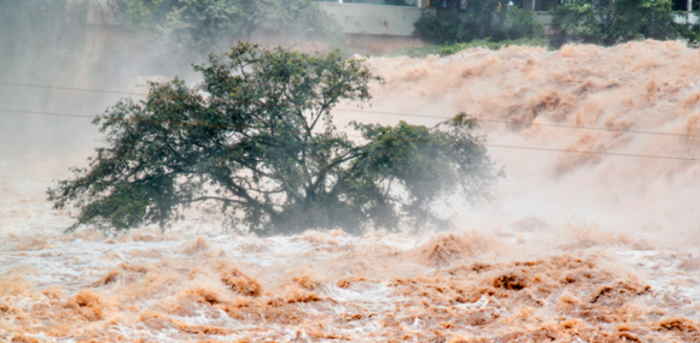
The devastating floods of August–September 2025 have laid bare the vulnerability of Jammu Kashmir’s infrastructure, with roads, bridges, schools, and water systems collapsing under the impact of relentless rains. While natural forces played their part, experts and residents point to decades of negligence, inadequate planning, and poorly designed structures that are ill-suited for the Union Territory’s hilly terrain.
In Kashmir alone, approximately 90 km of roads and 87 bridges were damaged. The Jal Shakti Department reported 279 works destroyed, including a major breach in Budgam, while 563 water supply schemes were hit, disrupting essential services for thousands. In the education sector, 115 schools were damaged, notably in Pulwama and Anantnag, with partial or no safety certifications highlighting chronic neglect. In Anantnag, several embankments of Jhelum collapsed causing massive damaged to a mosque and several houses.
“The devastation is unprecedented. We have lost precious lives, including during the yatras in Kishtwar and Katra. Alongside the human toll, the destruction of property has been massive. Nearly 330 bridges have been washed away, over 1,500 kilometers of roads lie in ruins, many government buildings have been damaged, and crops — including our vital dry fruits, stand destroyed,” Chief Minister informed.
In Anantnag district, several bridges were damaged or collapsed entirely. The Sakhras Bridge in Pahalgam and the Movera–Yanmar Bridge were swept away by swollen streams, paralysing the Khanabal–Pahalgam road. The approach road of Chandrigam Bridge in Awantipora caved in, forcing closure of the route and diverting traffic through longer, unsafe stretches. Reports also confirmed damage to Larkipora Bridge, Doru–Verinag Bridge, and the Hiller Shahabad Bridge, leaving dozens of villages isolated.
The strategic NH-44 (Jammu–Srinagar Highway) suffered repeated landslides and cave-ins at Ramban, Banihal, Cafeteria Morh, and Panthyal, disrupting Kashmir’s only all-weather road link with the rest of India. The Mughal Road, another key route connecting Shopian with Poonch and Rajouri, was blocked by landslides within hours of the heavy rainfall, cutting South Kashmir off from Jammu’s border districts. The Sinthan–Kishtwar–Doda road also washed out at multiple locations, leaving hundreds of vehicles stranded.
Local roads under the Rural Development and PMGSY schemes were hit especially hard in south Kashmir’s Anantnag and Kulgam districts, where swollen nallahs and flash floods washed away culverts and narrow link roads. Several footbridges collapsed in Budgam and Pulwama, further hampering movement of people and emergency supplies.
In Jammu Division, restoration estimates soar to ₹2,568.50 crore, covering roads and bridges (₹1,026.89 crore), power (₹237.46 crore), water systems and flood control (₹401.80 crore), schools (₹353.47 crore), rural development assets (₹129.90 crore), and agriculture, horticulture and fisheries losses (₹40+ crore).
Heritage sites, including Mubarak Mandi, suffered losses worth around ₹18 crore. The floods also destroyed 4,269 houses fully and 8,616 partially, left 1,455 livestock dead, and damaged 1,322.90 hectares of crop land, showing the scale of human and economic loss.
Critics argue that much of this damage could have been mitigated. Roads and bridges in hilly districts like Kishtwar, Reasi, and Udhampur have repeatedly collapsed under high rainfall, indicating that the existing infrastructure was neither flood-resilient nor suited for steep mountainous terrain. Dr. Farooq Ahmed, a former civil engineer told The Kashmiriyat. “Many roads and bridges here were designed for low-intensity rainfall and moderate river flows, similar to those in Delhi or Uttar Pradesh. In hilly regions like Jammu Kashmir, the forces of water multiply due to steep slopes and narrow valleys. Without proper embankments, drainage, and flood-resistant design, disasters become inevitable,” he added.
He added, “The floods exposed the administrative neglect in enforcing building codes and monitoring compliance. Decades of construction shortcuts, coupled with encroachment along riverbeds, have turned these rivers into agents of destruction.”
Environmental experts warn that the floods also exacerbate ecological damage. Landslides and soil erosion have stripped vegetation cover, destabilizing slopes and increasing sediment flow into rivers. Contaminated floodwaters carry sewage, dead livestock, and decomposed crops, raising E. coli and other bacterial levels in water sources.
Kishtwar bore the brunt of human casualties, with 66 deaths, 137 injuries, and 31 missing persons, while Reasi reported 48 deaths. Thousands remain displaced in unsafe shelters after losing homes, livestock, and livelihoods.
In Jammu Division, Udhampur alone recorded 1,895 fully damaged and 3,107 partially damaged houses, with 268 livestock dead and 476 hectares of crops destroyed. In Kashmir Valley, the toll was lower but no less serious: 16 fully damaged, 57 severely damaged, and 791 partially damaged homes, 28 livestock deaths, and major disruptions to water supply, schools, and roads. Relief measures have been rolled out under the UT Disaster Response Fund and Chief Minister’s Relief Fund, but experts stress that relief cannot substitute for resilient infrastructure and proactive planning.
Dr. Farooq emphasized that hilly terrains like Jammu Kashmir demand specially engineered roads, bridges, flood channels, and water management systems. Uniform safety audits, strict enforcement of building codes, and ecological restoration are essential to prevent future disasters.
“Mountains are not just scenery; they are dynamic systems. When mismanaged, they hit back,” said Dr. Farooq. “The 2025 floods are a wake-up call, authorities must rethink infrastructure design, land use, and disaster preparedness for this fragile region.”


- News Deskhttps://thekashmiriyat.co.uk/author/kashmiriyat/
- News Deskhttps://thekashmiriyat.co.uk/author/kashmiriyat/
- News Deskhttps://thekashmiriyat.co.uk/author/kashmiriyat/
- News Deskhttps://thekashmiriyat.co.uk/author/kashmiriyat/


