


Danishwar Hameed
Apple growers in Kashmir on Monday announced that they will file a missing report, accusing the government of being absent at a time when the Kashmir’s crucial horticulture sector is reeling under massive losses.
Farmers’ bodies, Jammu Kashmir Kisan Tehreek and Apple Farmers Federation, said the unusual decision symbolises their desperation, as apples worth crores continue to rot on the highways while authorities, they alleged, are doing little beyond symbolic gestures.
Speaking to The Kashmiriyat, Zahoor Ahmad, a senior member of the farmers’ unions, said the step reflected the level of frustration among growers. “We invested a year’s labour in these orchards only to see our produce wasted because nothing substantial has been done,” he said. The unions are demanding the implementation of a Minimum Support Price (MSP) for apples, a robust Crop Insurance scheme, and swift restoration of transport links to save the industry from collapse.
He added that the reality on the ground paints a grim picture, far removed from the glossy claims made in official gazettes and government advertisements. “In the last few years, the central government has done very little other than symbolic gestures for farmers. The only prospering farmer you see is in newspapers or on television screens, projected for political gain. The ground reality is that farmers are committing suicides, selling off their ancestral fields, and migrating to cities to work as labourers. This is the slow death of our rural economy,” he said.
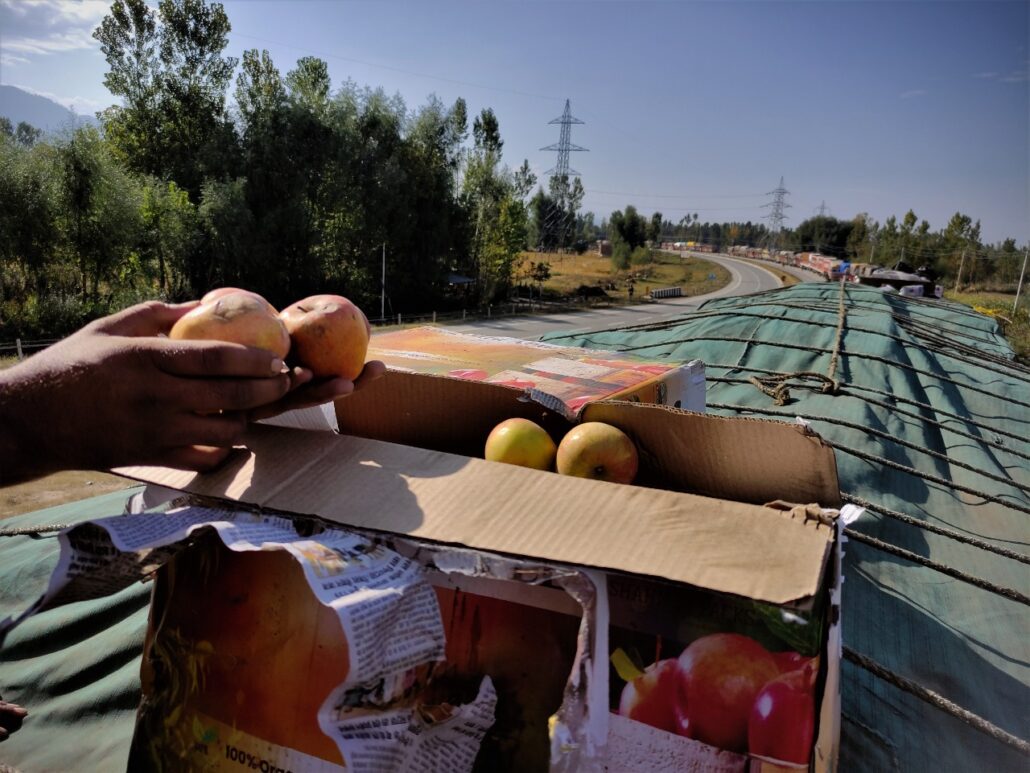
The protests were triggered by the repeated closure of the Srinagar–Jammu National Highway (NH-44), the region’s lifeline for transporting apples and other perishable fruits. Landslides, floods, shooting stones and road damage have left thousands of apple-laden trucks stranded on the route, unable to deliver produce to markets in Jammu and beyond. With delays stretching for days, large quantities of fruit are rotting in trucks, mandis and godowns. In response, fruit mandis across the Valley—including Sopore, Shopian, Handwara, Anantnag, Pulwama, Kulgam, Baramulla and Ganderbal, have shut down in protest, pressing for immediate government intervention.
Even when Kashmiri apples reach the markets, growers are forced to sell them at rock-bottom prices, further deepening their losses. “Thanks to Prime Minister Modi’s kid gesture to America and the lifting of import duties on American apples, our fruit cannot compete in the market. Consumers are buying imported apples at higher prices, while our local produce, grown with tremendous labour and care, is sold cheaply or left to rot. This is a disaster for Kashmir’s economy and for the livelihoods of hundreds of thousands of families,” Zahoor Ahmed told The Kashmiriyat. He also note that inconsistent government policies, lack of cold storage facilities, and poor supply chain management add to the crisis, leaving farmers with no bargaining power and limited options to preserve their produce.
Growers estimate that losses already run between ₹500 and ₹1,200 crore, depending on how long the highway remains blocked. They have appealed to the government to ensure smooth and guaranteed passage for fruit trucks, particularly between Qazigund and Banihal, to declare an MSP so that farmers are shielded from market crashes, and to put in place or strengthen crop insurance that covers both natural disasters and transport disruptions. Farmers have also demanded alternative transport options such as special parcel trains to reduce dependence on the highway.
In response, the administration has flagged off a parcel train service to ferry apples from Kashmir to Delhi and promised two-day windows of “traffic clearance” for fruit trucks each week to help clear the backlog. Repair work is also underway on damaged stretches of the highway, but growers insist that these measures are inadequate given the magnitude of their losses. “We are not asking for favors. We are asking for survival. MSP and insurance are the only lifelines left,” Zahoor Ahmad said.
The crisis has broader implications as more than seven lakh families in Kashmir depend directly or indirectly on horticulture, making apple growing a socio-economic lifeline. Every year, millions of metric tonnes of apples are produced, but as a perishable commodity, even slight delays translate into devastating losses. Farmers say they feel ignored in the absence of an active political government in the Union Territory, with bureaucracy responding too slowly to their appeals. Many warn that without immediate steps, growers will be forced deeper into debt and entire orchards could be at risk.
For apple farmers, this is more than just a protest, it is a fight for survival. They say the road ahead, literally and figuratively, must be cleared, and relief must be delivered before the promise of the harvest turns into irreversible loss.


- News Deskhttps://thekashmiriyat.co.uk/author/kashmiriyat/

- News Deskhttps://thekashmiriyat.co.uk/author/kashmiriyat/

- News Deskhttps://thekashmiriyat.co.uk/author/kashmiriyat/
- News Deskhttps://thekashmiriyat.co.uk/author/kashmiriyat/

