


Meer Irfan
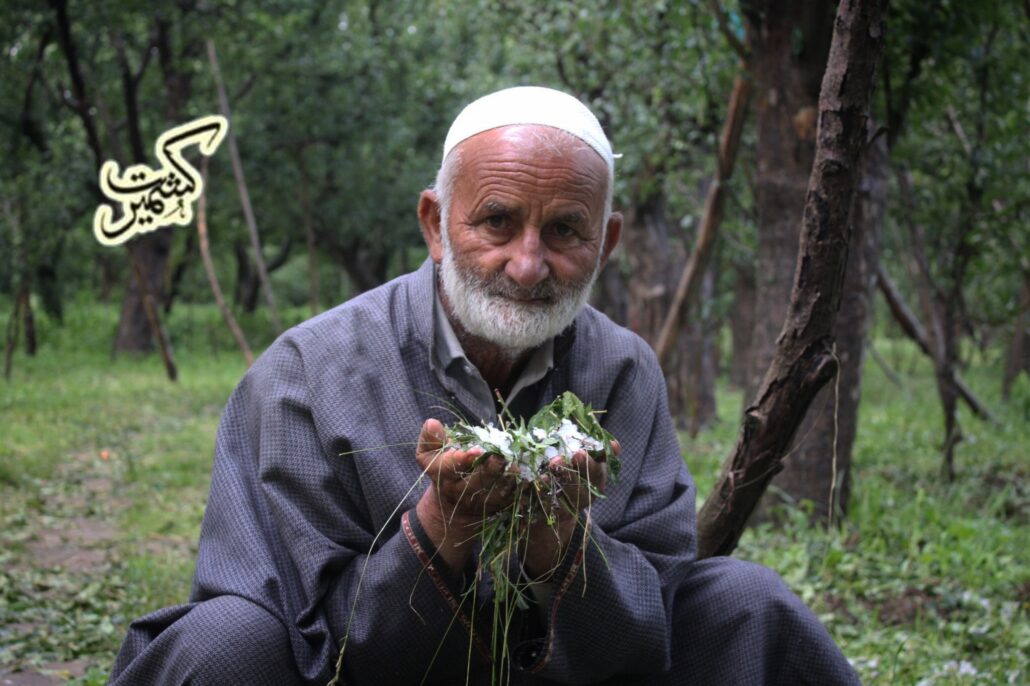
A powerful hailstorm ripped through Shopian district on Monday, inflicting massive destruction on the region’s orchards and deepening the climate crisis unfolding across Kashmir. The storm, described by residents as unusually fierce and prolonged, left entire villages counting their losses.
Villages including Gund Darvesh, Bandpawa, Dachoo, Urpora, Nagbal, Homhuna, Dhobipura, Alshipora, Handew, Chitragam, Wadipora, and Hushainpora reported near-total crop damage—up to 100% in some areas—according to preliminary assessments by horticulture officials.
“Shopian has never in history seen this sort of damage,” said Ghulam Mohammad Wani, an agricultural officer. “It’s beyond anything we’ve recorded in the past. The scale is shocking.”
The storm arrived at a critical time—just as fruit crops like apples and pears were entering vital stages of growth. Large hailstones pelted the region for nearly half an hour, stripping fruit from trees, tearing through leaves, and crushing young saplings. The result: flattened orchards and despair among thousands of growers who depend on horticulture to survive.
“Everything is gone. Our apple orchards, our pear trees – all destroyed,” said a farmer from Alshipora. “This is our only source of income. Now, we have nothing.”
Farmers across the affected villages voiced frustration over government inaction and the lack of institutional safeguards.
“We’ve been demanding Minimum Support Price for years, and asking the government to include apples under the crop insurance scheme,” said a grower from Chitragam. “With disasters like this becoming more frequent, it’s needed now more than ever.”
Beyond the immediate destruction, experts warn that such extreme weather events are part of a larger, global pattern of climate instability.
“What we’re seeing in Shopian is not isolated—it’s part of a global climate emergency,” said Dr. Irfan Yousuf, a climate researcher. “These hailstorms, once rare, are now becoming more frequent and intense. Deforestation and unsustainable land use are only accelerating the crisis.”
Locals, too, are beginning to make the connection between vanishing forests and intensifying climate shocks. “We’ve seen how tree-cutting in the hills has worsened weather patterns,” said Zahoor Ahmad, another grower from Chitragam. “Nature is reacting—and we are the first to suffer.”
State Spokesperson of Jammu Kashmir National Conference, Imran Nabi Dar, has assured full help to the farmers. Expressing grief over the losses incurred by the farmers, he said,” the crisis should be dealt with on priority basis. The Crop insurance scheme should be implemented as soon as possible and hail nets should be given to apple farmers so that the losses can be avoided. This should be done on priority basis,” he told The Kashmiriyat.
So far, no official statement has been issued regarding immediate relief or compensation. However, growers are calling for urgent intervention, financial assistance, and, most importantly, the implementation of comprehensive insurance and support systems.
As climate shocks grow more intense and frequent in Kashmir, the storm in Shopian is a painful reminder of just how vulnerable the region’s farming communities are—and how little room remains for delay.


- News Deskhttps://thekashmiriyat.co.uk/author/kashmiriyat/

- News Deskhttps://thekashmiriyat.co.uk/author/kashmiriyat/

- News Deskhttps://thekashmiriyat.co.uk/author/kashmiriyat/
- News Deskhttps://thekashmiriyat.co.uk/author/kashmiriyat/

