


Danishwar Hameed
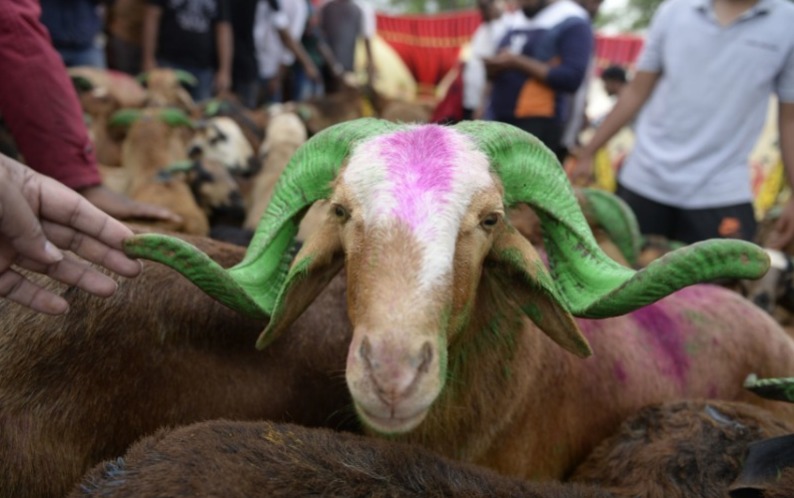
“We used to sell most of our animals by now. This year, we’ve barely sold a third,” said Mohammad Asim, a goat trader from Samba, who has been coming to Srinagar’s Eidgah market for the past 15 years. “People come, ask the price, and walk away. They just don’t have the money.”
Another livestock seller, Mohammad Akhtar from Poonch, echoed the same concern. “Last year, even if the sales were slow, they picked up by the end. This year, we’ve slashed prices and still can’t sell. It’s never been this bad.” Akthar expressed hope, “We expect that the sales would pick up by today afternoon.”
But this isn’t merely about the cost of meat—it’s about the collapse of rural spending power.
“I used to buy at least three sheep every Eid for my family,” said Nazir Ahmad, a farmer from Alshipora in Shopian. “I’d get them from Eidgah in Srinagar. But this year, our orchards were destroyed—90 percent of the crop gone. I couldn’t afford even one.”
His story is not isolated. In Handew village, another farmer, Younis Dar, said, “For five years, we’ve faced losses. First due to pests, then due to weather, and now this hailstorm just before Eid. Many of us are quitting farming and looking for labour jobs in Jammu or Delhi.”
In several areas across Shopian and south Kashmir, the pattern is the same: younger generations leaving orchards behind, families pulling children out of private schools, and old farmers selling off land to cover debt. The cumulative effect has slowed down not just agricultural output—but the entire economy.
“What we’re witnessing now is the brunt of a systemic collapse,” said an agricultural expert from Pulwama. “The crisis has been ongoing for half a decade, but its impact is finally visible in city markets, where the buzz of Eid is missing. The tragedy is, acknowledging this collapse would mean accepting the failure—and fixing it. But no one wants to fix farming,” said Abdul Rashid Khan from Arwani in south Kashmir, a retired economics teacher, now a farmer.
While social media trends promote ‘buy local, support Kashmir’, the same urban discourse continues to sidestep Kashmir’s rural backbone. “People cheer Amazon deliveries while the farmer next door bleeds. To ignore the pain of farmers is to live in a fool’s paradise,” he added.
Khan added, “Until serious policy and economic support is directed toward Kashmir’s agricultural sector—through compensation, insurance, and pricing guarantees—this decline will only deepen. This Eid, the silence in Srinagar’s markets isn’t a coincidence. It’s a consequence.”


- News Deskhttps://thekashmiriyat.co.uk/author/kashmiriyat/
- News Deskhttps://thekashmiriyat.co.uk/author/kashmiriyat/
- News Deskhttps://thekashmiriyat.co.uk/author/kashmiriyat/
- News Deskhttps://thekashmiriyat.co.uk/author/kashmiriyat/


