Javid Ahmed
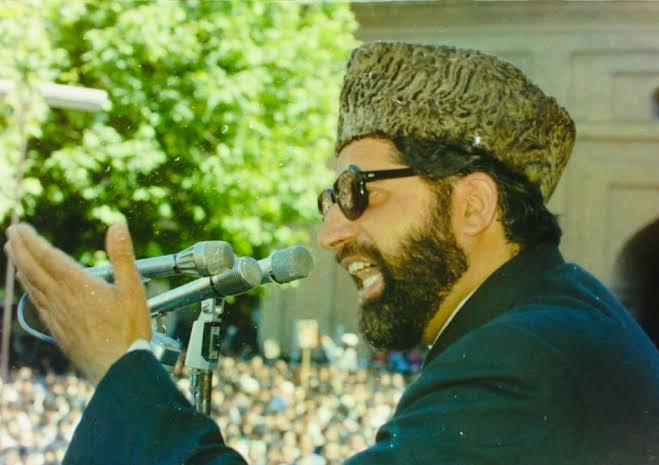
On May 21, 1990, Kashmir lost more than a leader — it lost a voice of reason in an age that demanded rage. Molvi Mohammad Farooq, the Mirwaiz of Kashmir, was gunned down inside his home in Srinagar. His killing sent shockwaves across the valley, not only because of his stature, but because of the silence that followed. A silence that was not natural, but enforced — stitched together by fear, political convenience, and selective memory.
The Mirwaiz was not a man of slogans; he was a man of sermons. Known for his commanding yet calm oratory, Molvi Farooq used his Friday sermons at Srinagar’s historic Jama Masjid not to incite but to awaken. “Truth,” he once said, “must be spoken, even when silence is safer.” And he lived by that — walking a fine line between the state and the sentiment of the people, never quite submitting to either.
In the late 1980s, when the political ground beneath Kashmir began to tremble, he called for dialogue over death, negotiation over nihilism. For this, he was marked — not just by the state, but by sections of Kashmiri power corridors, who saw his words as weakness. On the morning of May 21, 1990, unknown gunmen entered his residence in Nageen and shot him dead. But the bullets did not stop there.
As his body was being taken for burial, thousands of mourners poured into the streets. Near Hawal, paramilitary troops opened fire on the funeral procession. More than 60 people were killed in what remains one of the bloodiest massacres in Kashmir’s history — and one of its least acknowledged. That day, grief turned into collective trauma. And still, there was no closure.
The identity of Molvi Farooq’s assassins remains “unknown”, even though the valley has long whispered otherwise. Many believe he was killed by people from within the separatist fold — factions who believed that moderation was a betrayal of the cause.
In this forgetting, too, is violence.
His son, Mirwaiz Umar Farooq, was only 17 when he was thrust into leadership by tens and thousands of Kashmiris, including prominent scholars, Muftis and political voices from Kashmir. His first act was not retaliation, but restraint. In the face of provocation and personal loss, Umar called for calm. “Violence cannot build what it destroys,” he later said, echoing his father’s philosophy. In a land where vengeance is often mistaken for virtue, this was a radical act.
To understand Molvi Farooq is to understand the deeper crisis of Kashmir — the intellectual and moral void left behind when voices of reconciliation are silenced, and their killers are protected by silence. The man who tried to build a middle ground between India and Pakistan, between the street and the state, was buried not just in a grave at Martyrs graveyard of Srinagar— but under layers of political convenience and communal manipulation..
One of his most cited lines is tragically prophetic,
“If the road to peace is closed, we will keep walking until a new one opens. What we cannot do is stand still.”
But that’s exactly what happened after the killing followed by killings of more intellectuals and parallel voices- A paralysis — moral and political — took hold. His death was explained away, his politics ridiculed or ignored, and his legacy left to fade behind louder, more aggressive slogans. Many who had once stood beside him vanished from public memory.
The truth is, he was known. Too well. By those who wanted him gone.
To speak of Molvi Farooq today is not merely to honor a hero. It is to confront an entire era of betrayals. It is to remind ourselves that peace, when sought sincerely, is a dangerous act in a landscape that thrived on extremity.
As Kashmir continues its difficult path forward, the absence of voices like Molvi Farooq’s — and the silence around their erasure — remains the most painful absence of all. His killers may remain officially “unknown,” but the truth is known in every corner of the valley, whispered in graveyards and echoed in quiet prayers.
The views expressed by the author are his own.
- News Deskhttps://thekashmiriyat.co.uk/author/kashmiriyat/

- News Deskhttps://thekashmiriyat.co.uk/author/kashmiriyat/

- News Deskhttps://thekashmiriyat.co.uk/author/kashmiriyat/
- News Deskhttps://thekashmiriyat.co.uk/author/kashmiriyat/
