
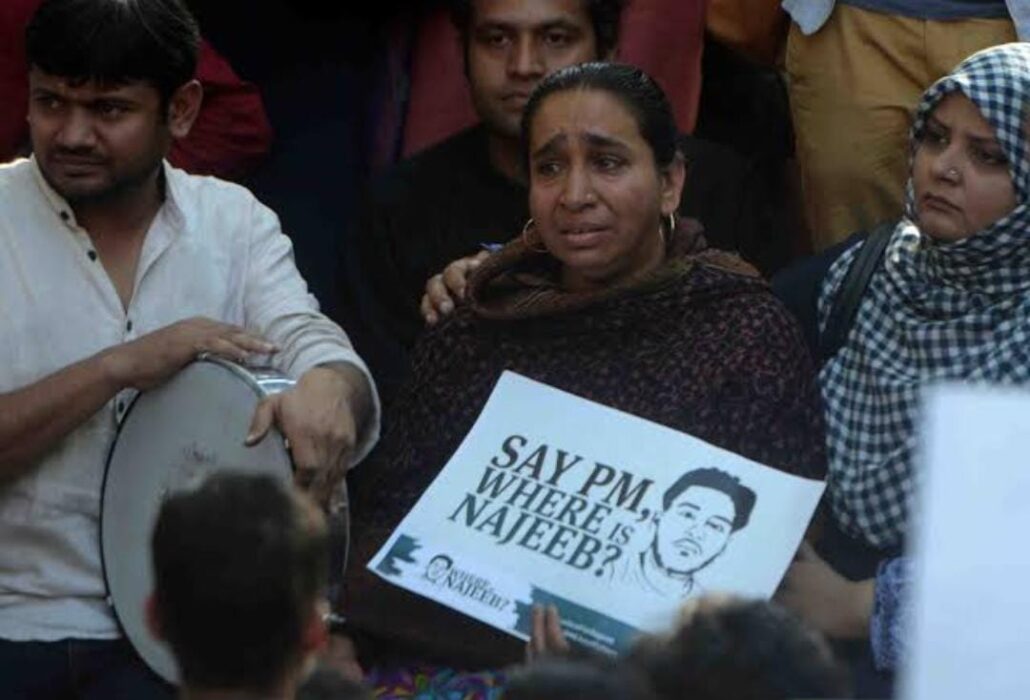
A Delhi court has formally accepted the CBI’s closure report in the disappearance case of JNU student Najeeb Ahmed, nearly nine years after he went missing.
The decision has reignited public anger and concern, especially among student groups and rights activists, many of whom view the closure as an institutional failure. Najeeb’s mother, Fatima Nafees, has denounced the decision and vowed to continue her fight for justice.
Najeeb Ahmed, a 27-year-old student from Badaun, Uttar Pradesh, was enrolled in the M.Sc. Biotechnology program at Jawaharlal Nehru University (JNU), New Delhi.
On the night of 14 October 2016, he reportedly had a violent altercation with members of the Akhil Bharatiya Vidyarthi Parishad (ABVP) inside the Mahi-Mandavi hostel. The next morning, he vanished.
Before disappearing, Najeeb had phoned his mother, Fatima Nafees, saying he had been beaten and feared for his safety. She arrived in Delhi the next day and filed a missing person’s complaint with the police. Initially investigated by the Delhi Police, the case saw little progress.
Amid mounting public pressure and a petition by Najeeb’s mother, the Delhi High Court transferred the probe to the Central Bureau of Investigation (CBI) in May 2017.
Over the years, the case gained national attention. Protests erupted across campuses demanding justice, and Fatima became a central figure in the fight. The CBI reportedly examined call records, CCTV footage, social media activity, and visited multiple states, but found no concrete leads. The agency also offered a reward and used psychological profiling, but none of it led to Najeeb’s whereabouts.
JNU, meanwhile, faced criticism for failing to take disciplinary action against students allegedly involved in the hostel altercation. Many student groups accused the university administration of shielding the ABVP members and not cooperating fully with the family.
The institution maintained that it had cooperated with police investigations, but activists and academics continued to demand internal accountability.
Case proceedings
In October 2018, the CBI moved to close the case, citing lack of evidence. After years of legal back-and-forth, a Delhi court on 30 June 2025 accepted the agency’s closure report. The court noted that the CBI had explored all possible leads and stated that the investigation could be reopened if fresh, credible evidence came to light.
The CBI submitted that no evidence had been found to indicate foul play or any involvement of individuals in Najeeb’s disappearance. The agency also mentioned that the last known sighting of Najeeb was him boarding an auto-rickshaw outside campus the morning after the altercation.
Fatima Nafees, who has relentlessly led public marches and legal battles in her son’s name, rejected the CBI’s findings and the court’s acceptance of the closure. She alleged that the agencies acted under political pressure and failed to conduct a fair and serious investigation. She has announced her intention to challenge the closure in the Supreme Court.
Reactions to the court’s decision have been swift. Student unions, human rights defenders, and civil society organizations expressed disappointment, calling it a travesty of justice. Many pointed out that the state failed to protect one of its own and feared the case would discourage other families seeking justice in cases of enforced disappearances.
Even nine years later, Najeeb Ahmed’s disappearance remains one of the most haunting mysteries in contemporary India—one that continues to reflect on the state of justice, accountability, and political impunity.

- News Deskhttps://thekashmiriyat.co.uk/author/kashmiriyat/

- News Deskhttps://thekashmiriyat.co.uk/author/kashmiriyat/

- News Deskhttps://thekashmiriyat.co.uk/author/kashmiriyat/
- News Deskhttps://thekashmiriyat.co.uk/author/kashmiriyat/
