In mid-August 2025, Israel has moved on two tracks that critics say could eliminate the possibility of a Palestinian state.
In Gaza, the Israeli military announced the first stage of an operation to capture Gaza City. Tens of thousands of reservists were called up, and fighting intensified around Jabalya and the city’s outskirts. U.N. Secretary-General António Guterres warned that an urban offensive risked “massive civilian casualties” and again urged an immediate ceasefire.
Israeli officials defended the operation, saying civilians had been warned to evacuate. “This is a necessary stage of the war,” one military spokesperson said, adding that Israel was continuing humanitarian airdrops and trucked aid.
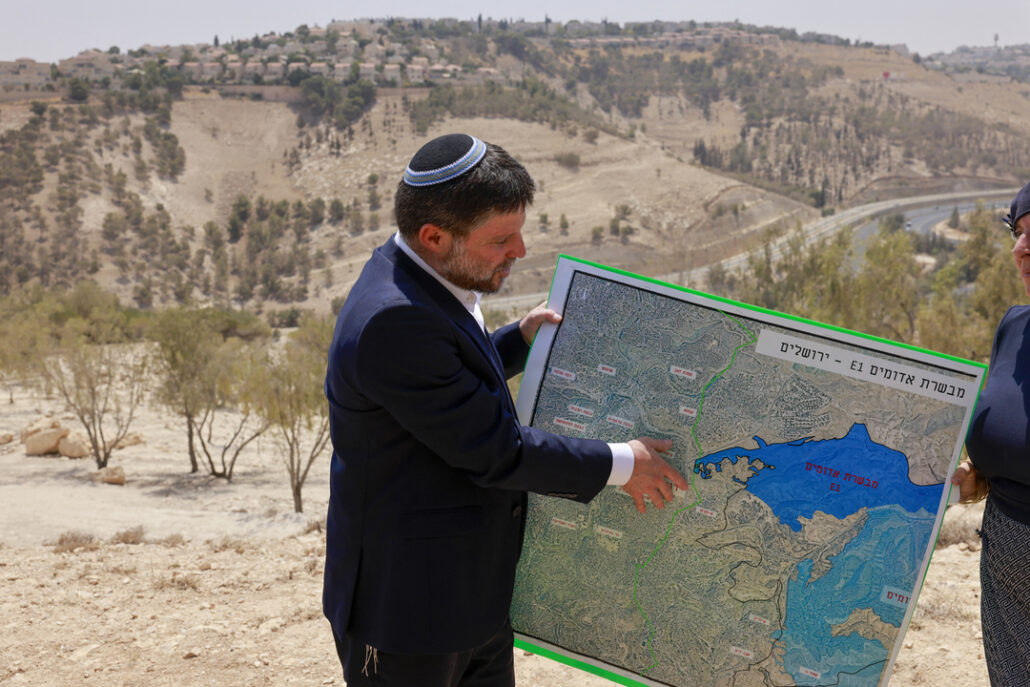
While Gaza dominated headlines, the government advanced a major settlement project in the West Bank. The E1 plan, stalled for years, received final approval from the Defense Ministry’s planning commission. It authorizes 3,400 housing units in a corridor linking Ma’ale Adumim to Jerusalem, effectively cutting the West Bank in two.
Finance Minister Bezalel Smotrich hailed the move. “The Palestinian state is being erased from the table, not with slogans but with actions,” he declared, calling it the fulfillment of “years of promises.”
The announcement drew sharp condemnation abroad. The Palestinian Authority said the project “destroys any prospect of a two-state solution.” Britain and Germany warned that the plan “severs the territorial contiguity of the West Bank” and risks isolating Israel internationally.
Many argue this is the start of a much larger project, one that extends far beyond the immediate expansion of settlements or the annexation of certain territories. Analysts and scholars have long pointed to the idea of Greater Israel, a concept rooted in certain Zionist currents and Biblical references, which envisions Israeli sovereignty stretching from the Nile to the Euphrates.
While not an official state policy, critics say actions like the E1 plan and the broader effort to cement control over the West Bank resonate with that vision, gradually erasing the possibility of a sovereign Palestinian state and redrawing the map in ways that echo the most expansive interpretations of Jewish scripture.
What is Greater Israel
The phrase Greater Israel does not belong to one single map; it is a layered idea. Its outer edges come from biblical promises, while its modern core emerges from nationalist projects after 1967.
In the Torah’s account of God’s covenant with Abram, the promised land stretches “from the river of Egypt to the great river, the Euphrates.” Exodus and Deuteronomy echo the same description, and in Joshua these boundaries are described in terms of actual conquest: from the desert and Lebanon to the Mediterranean and the Euphrates. Read literally, these verses extend far beyond Israel’s present borders.
They would encompass Sinai or the Nile’s approaches in Egypt, all of historical Palestine, southern Lebanon up to the Litani River in some readings, the Golan Heights and parts of Syria, and even territory in Jordan and Iraq.
Modern Jewish and Zionist thought, however, splinters on how to translate scripture into sovereignty. For religious-Zionist maximalists, especially the post-1967 settlement movement inspired by Rabbi Zvi Yehuda Kook and the ethos of Eretz Yisrael Ha-Shlema, Judea and Samaria are not bargaining chips but the heartland of the promise. To them, Jewish sovereignty over “every foot of the Land of Israel” is a theological imperative.
Other strands of Zionism, including many secular Israelis, have treated these biblical borders as sacred history rather than political blueprints. For them, security, defensible lines, and international diplomacy matter more than scripture. That view has at times led to support for territorial compromise, or at least the idea that borders should be limited and negotiable.
The living political version of Greater Israel in 2025 is not about stretching to the Nile and the Euphrates. Instead, it is primarily about locking in Israeli control over all of historic Palestine. For some factions, it also includes extending to “natural frontiers” like the Litani River or the Golan Heights.
In this context, the E1 plan, a settlement corridor east of Jerusalem, plays a crucial role. Its function is to tether Jerusalem to the Ma’ale Adumim bloc, effectively sealing an umbilical cord around the city. For its advocates, E1 “normalizes” irreversible Israeli contiguity across the area. For Palestinians, it fragments the West Bank, cutting off north from south and foreclosing the geographic possibility of a sovereign state.
Faith, scripture and contested claims to land
The textual authorities most often invoked in this debate cut in different directions. The Torah and the wider Hebrew Bible contain the covenantal promises that inspire the largest map of Israel, yet the same canon also ties possession of the land to ethical obedience. Rabbinic and modern Jewish scholarship is replete with debates over whether such promises are meant as binding programs for statecraft or as aspirations within a distant messianic horizon.
In Islamic sources, the Qur’an acknowledges a sanctified land and even recounts Moses calling his people to enter it. But the gift is framed within moral conditions. Surah al-Ma’idah describes the “holy land,” while Surah al-Isra narrates repeated cycles of corruption, punishment, and exile. Many Muslim exegetes therefore interpret the text to mean that no community has an eternal title irrespective of justice. For contemporary Muslim scholars, modern claims to “Greater Israel” appear theologically unfounded and politically oppressive—especially when such claims translate into the dispossession of Palestinians.
Christian readings add another layer of complexity. Dispensationalist evangelicals in the United States have long linked Jewish return and territorial expansion to eschatological prophecy, shaping American foreign policy through powerful lobbies. Yet, many Catholic and mainline Protestant theologians warn against reducing scripture to geopolitical blueprints. They argue that to conflate biblical imagery with present-day state expansion is to weaponize faith in ways that undermine peace and justice.
In 2025, these hermeneutics are not abstract. When a sitting Israeli prime minister boasts of thwarting Palestinian statehood, and when a senior minister celebrates the E1 plan as erasing Palestine “from the table,” ancient promises and modern power converge in unsettling ways. Religious texts are being marshaled not only in seminaries and mosques but also in government halls and diplomatic forums. The question, then, is no longer just about interpretation—it is about whether sacred narratives can be used to legitimize permanent control over another people.
This is why present decisions around Gaza City, E1, and broader settlement expansion provoke not only diplomatic censure under international law but also renewed scrutiny of the scriptural narratives that are being invoked, contested, and reimagined across synagogues, churches, and mosques. For many believers, the struggle over land is inseparable from the struggle over meaning itself.

- News Deskhttps://thekashmiriyat.co.uk/author/kashmiriyat/
- News Deskhttps://thekashmiriyat.co.uk/author/kashmiriyat/
- News Deskhttps://thekashmiriyat.co.uk/author/kashmiriyat/
- News Deskhttps://thekashmiriyat.co.uk/author/kashmiriyat/


