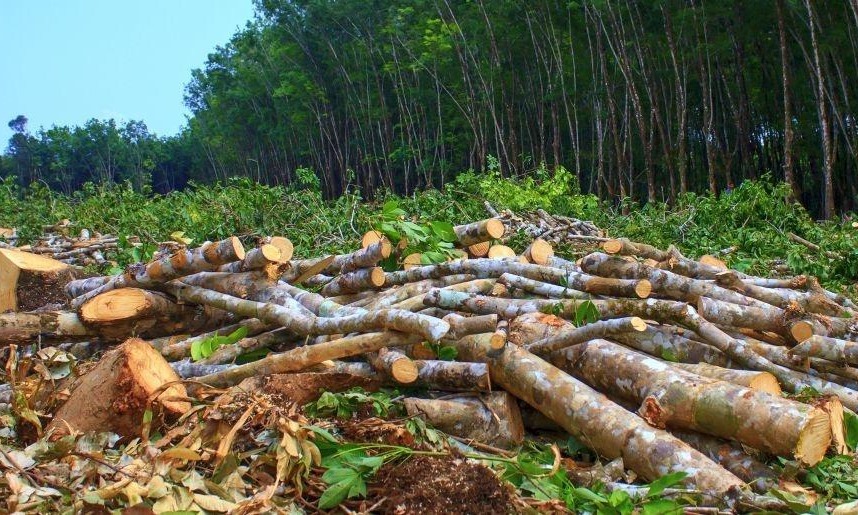
In a significant order, the National Green Tribunal (NGT) has directed the Chief Secretary of Jammu and Kashmir to submit a comprehensive affidavit explaining how more than 1,000 trees, poles and saplings were felled in Rajwar forests for the Handwara–Bangus road project without payment of mandatory compensatory charges worth ₹3.81 crore.
The Tribunal has also asked the Chief Secretary to spell out disciplinary action against officers who permitted the violations and to disclose whether such irregularities exist in other projects across the Union Territory.
The matter was heard by the Tribunal’s Principal Bench, comprising Justice Prakash Shrivastava (Chairperson), Dr. A. Senthil Vel (Expert Member), Mr. Ishwar Singh (Expert Member) and Dr. Prashant Gargava (Expert Member).
According to the sanction order dated September 24, 2019, the Jammu and Kashmir Government had permitted the Public Works Department to use 14 hectares of dense forest land for Phase I of the Handwara–Bangus road. This sanction involved the felling of 447 full-grown trees, 340 poles and 236 saplings, primarily of deodar, kail and fir species. In return, the user agency was required to pay ₹3.81 crore under the heads of Net Present Value, Compensatory Afforestation and Roadside Avenue Plantation.
However, Chief Conservator of Forests (Kashmir) Irfan Rasool Wani, appearing virtually, admitted before the Tribunal that the amount has not been deposited so far. Despite this, tree felling has already taken place on the ground. Taking strong exception, the Tribunal directed the Chief Secretary to explain how tree cutting was permitted in the absence of payment and to fix accountability on officers who allowed such violations.
The Tribunal also flagged serious irregularities in mineral use. A compliance report by the J&K Pollution Control Committee revealed that the project consumed 74,461.6 metric tonnes of material. Disposal permits were obtained only for 7,792 metric tonnes, while 63,940 metric tonnes were accounted for through road-cutting debris. A discrepancy of 2,728.82 metric tonnes remained unexplained.
The Executive Engineer, PWD Handwara, who was present virtually, failed to provide a justification. The Bench observed that this indicated illegal mineral extraction. The Secretary, Mining Department, has now been tasked to explain the discrepancy and specify action taken against officials involved.
The Tribunal also expressed concern that riverbed material had been lifted from areas dangerously close to bridges, including the Sultanpura Galgazna Bridge and Nallah Talri at Dhobi Ghat, potentially compromising their structural stability.
Records placed before the Tribunal further noted that the Rajwar forest is home to rare and endangered species such as the Himalayan black bear, leopard, jackal and Himalayan deer. The Bench has asked the J&K administration to clarify whether mandatory wildlife clearance was ever obtained before project execution.
Lawyer and RTI activist Rasikh Rasool Bhat, the applicant in the case, argued that while clearance had been granted only for Phase I, activities for Phase II have already begun without approval. “This is another blatant violation of environmental norms,” he said. “The administration cannot showcase a project as a tourism milestone by destroying the very forests that make Bangus a tourism asset.”
Locals, meanwhile, say the road has disturbed forest habitats, triggering a rise in human–animal conflicts. RTI data shows at least 128 incidents of such conflicts since 2017–18 in Rajwar, near the project site, leading to four deaths and nine injuries.
Residents blame deforestation for pushing bears and leopards into villages. “The road may bring tourists, but for us it has brought leopards into our courtyards,” said one villager from Rajwar. Kupwara district has reported a wider surge in such encounters, reflecting a growing trend across north Kashmir.
In its order, the Tribunal directed the Chief Secretary to file an affidavit within six weeks clarifying how the violations occurred, fixing responsibility on erring officers and detailing disciplinary action taken. The affidavit must also include a list of other projects where trees were cut and compensation amounts remain unpaid.
The Secretary, Mining Department, has been directed to explain the mineral discrepancies and specify action against illegal extraction. The ₹3.81 crore compensation must be recovered within two months.
The matter will be taken up again on November 11, 2025, when the Tribunal is expected to review the Chief Secretary’s affidavit and decide the matter further.

- News Deskhttps://thekashmiriyat.co.uk/author/kashmiriyat/

- News Deskhttps://thekashmiriyat.co.uk/author/kashmiriyat/

- News Deskhttps://thekashmiriyat.co.uk/author/kashmiriyat/
- News Deskhttps://thekashmiriyat.co.uk/author/kashmiriyat/
