
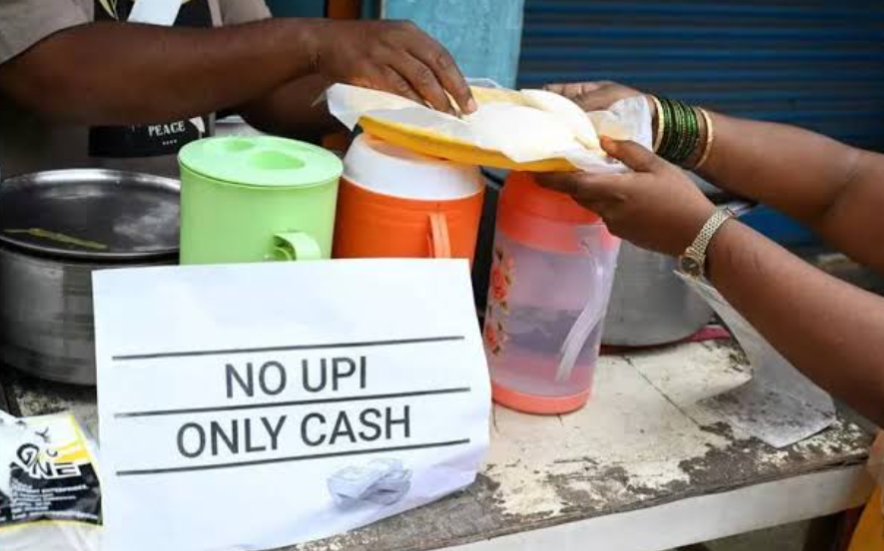
Across India’s tech capital, Bengaluru, small vendors are tearing down QR codes, switching off payment apps, and putting up signs that read: “No UPI, only cash.”
From fruit stalls and kirana shops to paanwalas and barbers, the shift marks a quiet rebellion against what many are calling a punitive turn in India’s digital payment revolution.
The trigger is a wave of tax notices sent to over 14,000 small traders in Bengaluru, many of whom say they were targeted solely based on their UPI transaction history, a history they created under government and corporate campaigns encouraging digital payments.
The backlash intensified after a viral social media post by a salaried employee, who shared that his local vegetable vendor had received a tax notice of ₹14.4 lakh. “He makes more than me and doesn’t pay tax,” the user wrote, framing it as an issue of fairness between formal and informal earners.
But traders, economists, and tax experts say the comparison is flawed. Most small traders never charged GST separately.
“They sell vegetables or soap packets at printed MRP, not services or high-margin goods that involve value-added billing. There is no profit-invoice recordkeeping like in formal businesses,” experts say.
To use transaction totals as a measure of income, they say, is misleading.
Traders argue that just because someone receives ₹5,000 a day via UPI does not mean it is profit. That money could reflect ₹5,000 worth of goods sold, with ₹4,800 spent on inventory, transport, and rent. The tax notices, they say, make no such distinction.
Unlike salaried employees, small vendors do not have fixed incomes, HR departments, or automated tax deductions. They also do not receive reimbursements for business expenses or enjoy job security and benefits. Most work without formal registration, and for many, even understanding tax slabs is a challenge.
The UPI ecosystem was widely embraced after demonetisation and during the COVID-19 pandemic. Small vendors were encouraged to go cashless not as registered tax entities but as participants in a larger digital India push. Now, those same digital trails are being used to initiate tax scrutiny, often without clear communication or support.
What began as scattered resistance has now turned into visible defiance. Posters saying “No UPI, only cash” are spreading across Bengaluru’s markets. QR codes have disappeared from counters. Some vendors say they’ve uninstalled payment apps altogether.
In Jayanagar, Kirti Devi, 52, who sells puja items, said she adopted UPI because it helped customers. “We were never told this would mean taxes and notices,” she said. “They handed us QR codes like they were offering help. Now they are treating us like criminals.”
India’s informal economy, which employs more than 90 percent of the workforce, was never systematically brought under GST or income tax nets.
While some categories were technically required to register, enforcement was uneven. Now, many vendors feel betrayed.
Bengaluru has long symbolised India’s digital ambitions. But now it is showing the tension between technological inclusion and financial policing.
Many traders say they won’t return to digital unless the government provides clearer rules, basic protections, and training. “We are not against technology,” said one vendor. “But don’t punish us for using it the way we were told to.”
For now, cash is back on the streets. Not because vendors prefer it, but because they no longer feel safe without it.

- News Deskhttps://thekashmiriyat.co.uk/author/kashmiriyat/

- News Deskhttps://thekashmiriyat.co.uk/author/kashmiriyat/

- News Deskhttps://thekashmiriyat.co.uk/author/kashmiriyat/
- News Deskhttps://thekashmiriyat.co.uk/author/kashmiriyat/
