Over the past several days, television sets across India have been inundated with what appears to be a coordinated barrage of reportage from Kashmir—framed as “ground zero” journalism, but in reality, they are defamation drills, systematically orchestrated to distort.
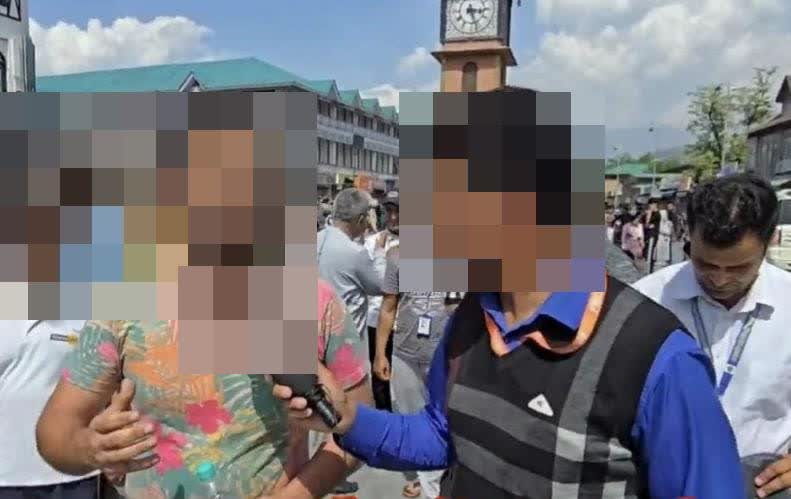
From sunrise to sundown, reporters descend upon Lal Chowk—Kashmir’s symbolic nerve center—not to listen, but to extract quotes that fit pre-scripted storylines. The interviews are carefully framed, edited with precision, and then served to the nation as evidence of a “truth” that aligns perfectly with the prime-time spectacle.
But this is not truth-seeking journalism. This is theatre.
What is most unsettling is not the presence of bias—every system of reportage carries it to some degree—but the deliberate manufacture of consent, as Noam Chomsky warned, to validate an image of Kashmir as a region perpetually hostile, ungrateful, and ‘other’. The very essence of reportage has been replaced by opinion-laced crusades, disguised as neutral observation. The goal? To stage Kashmir as a recurring character in a larger nationalist narrative.
This unrelenting media offensive has sparked visible outrage across Kashmir. The Chief Minister of the region has publicly condemned these operations for their overt bias and manipulative editing. Locals have grown weary and angry, describing the coverage as a TRP-driven distortion campaign, not journalism.
And yet, in a cruel irony, many of the very politicians raising their voices against these media outlets today are the same ones who, in times of need, run to them—offering exclusive interviews, soundbites, and press conferences in the hope of national relevance.
The relationship is co-dependent, parasitic even. While the politicians criticize the media for distortion, they remain entangled in a dynamic where validation comes not from people but from studio lights.
But amid this political and journalistic performance, something extraordinary is happening beneath the surface—a resistance is taking shape. And not in the form of protests or shutdowns, but through the slow, quiet rise of an alternative media force. It is the young Kashmiri with a mobile phone, a Facebook page, or a local news blog. It is the Instagram channel documenting kindness across Kashmir. It is the Youtube video showing a local helping a lost tourist. It is the unaccredited reporter livestreaming events that legacy media won’t touch.
George Orwell once wrote, “Journalism is printing what someone else does not want printed: everything else is public relations.” By this standard, much of what is paraded as Kashmir reportage today is not journalism, but public relations—engineered for optics. Meanwhile, those unrecognized voices on social media, often dismissed as “unprofessional” or “amateur,” are inching closer to the spirit of Orwell’s definition.
This disdain for Kashmiri social media journalists is not new. Professionals with national exposure, often urban and English-speaking, are quick to denounce them as “half-baked”, “sensationalist,” or “untrained.”
The underlying classism is unmistakable. There is a discomfort in accepting that someone without a press card or journalism degree might, in fact, be closer to the truth than the one appearing nightly on TV or in morning newspapers.
But if journalism is about bearing witness, then these so-called amateurs are doing exactly that.
Philosopher Hannah Arendt warned us against the dangers of “organized lying” in public life—a system in which the difference between truth and fiction collapses not because people are ignorant, but because they are overloaded with images and slogans that obscure reality.
Kashmir, as viewed through national television, is now such a case. The spectacle has replaced the story.
And so, what happens when the nation stops looking? When Kashmiris are left to narrate their own truth in the void left by distorted headlines? What’s emerging is not just a counter-narrative but a counter-public sphere—digital, local, unpolished, yet persistently humane.
This local media force doesn’t have the satellite vans, makeup rooms, or funding. What they do have is proximity to truth. And more importantly, they have skin in the game. Their stories are not detached—these are the stories of their own streets, neighbors, and communities.
They may be mocked as biased or emotional, but perhaps the age of emotionless neutrality has passed. James Baldwin said, “You write in order to change the world… even if you only alter a person’s point of view, or the way they see things—that’s worth something.” In Kashmir, that shift is happening one reel, one tweet, one local report at a time.
While the mainstream discourse continues to ignore the everyday acts of hospitality, decency, and solidarity that define real life in Kashmir, the digital margins are preserving those truths. Whether it’s a local explaining the origins of a rumour or a teenager documenting civic kindness, these grassroots voices are resisting the collapse into caricature.
No, they haven’t defeated the empire of “Godi media.” But they are shaking its monopoly. They are widening the aperture through which Kashmir can be seen. And in doing so, they are reclaiming the right to narrate.
Not through spectacle. But through presence.
- News Deskhttps://thekashmiriyat.co.uk/author/kashmiriyat/

- News Deskhttps://thekashmiriyat.co.uk/author/kashmiriyat/

- News Deskhttps://thekashmiriyat.co.uk/author/kashmiriyat/
- News Deskhttps://thekashmiriyat.co.uk/author/kashmiriyat/
