
Suhail Dar
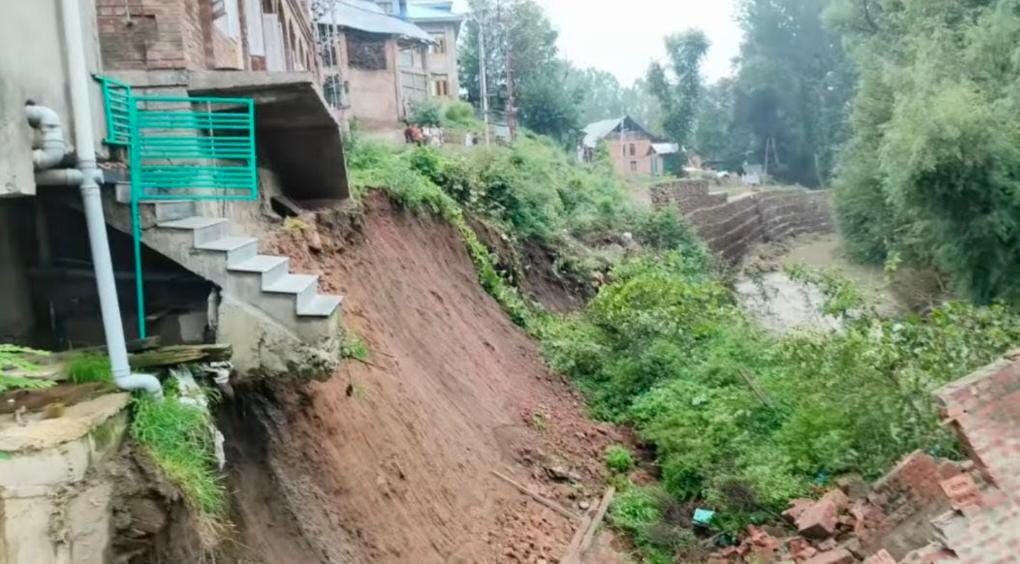
Several areas across south Kashmir have reported alarming cases of soil sinking and bund breaches after the sudden fluctuation in water levels of the Jhelum and Arpat rivers earlier this week.
The phenomenon, which residents say began after Wednesday’s flood-like swell receded, has damaged houses, extensions, and public facilities across multiple districts.
At Katriteng, Bijbehara, a massive bund breach has put a local mosque at grave risk, with its bathrooms already collapsed into the sinking earth. “The water came up suddenly and then went down just as fast. Now the bund is sliding into the river, and even the masjid is unsafe,” said Abdul Hamid, a resident of Katriteng.
Former MLA Bijbehara, Dr. Bashir Ahmad Veeri, visited the spot on Saturday to assess the damage and assured residents that the issue would be taken up with the authorities.
Elsewhere, similar incidents have been reported from Arwani in Kulgam, Naidkhai in Bandipora, Harnag behind TRC in Anantnag, Pushwara near the bridge, and other settlements along the Jhelum and Arpat rivers. In Harnag, two residential houses have been damaged while an extension block of two rooms collapsed completely.
“We were woken up by the sound of cracks in the walls. By morning, the rooms had caved in,” said Ghulam Rasool, a resident of Harnag.
Another local in Pushwara told The Kashmiriyat, “The ground is literally vanishing. With every rise and fall in the river, more land is eaten away. We are terrified to stay inside our homes.”
Officials confirmed that the affected families in Harnag were evacuated to nearby government buildings as a precautionary measure. “The safety of people is our top priority. Families from vulnerable areas have been shifted, and we are monitoring the situation closely,” an official told The Kashmiriyat.
Experts attribute the soil collapse to rapid drawdown of water levels in rivers. Dr. Masood Ali, a geologist from Pulwama, explained, “When the river rises, water seeps into the banks, making the soil heavy and saturated. But when the water recedes quickly, the external support that was holding the soil mass vanishes. The ground, still waterlogged and unstable, gives way. This is what we call slope instability due to rapid drawdown. Such conditions are very common in Kashmir because of unplanned constructions on riverbanks and weak embankments.”
Dr. Ali warned that unless the government takes immediate remedial steps, the damage could intensify in coming months. “What is urgently needed is reinforcement of riverbanks through proper embankments, retaining walls, and vegetation cover. If ignored, more houses, mosques, and public infrastructure will sink. The danger is not temporary, it is structural and long-term,” he said.
Residents across the affected areas have urged authorities to launch immediate protection works to prevent further destruction of their homes and land.

- News Deskhttps://thekashmiriyat.co.uk/author/kashmiriyat/

- News Deskhttps://thekashmiriyat.co.uk/author/kashmiriyat/

- News Deskhttps://thekashmiriyat.co.uk/author/kashmiriyat/
- News Deskhttps://thekashmiriyat.co.uk/author/kashmiriyat/
