Javed Ahmed
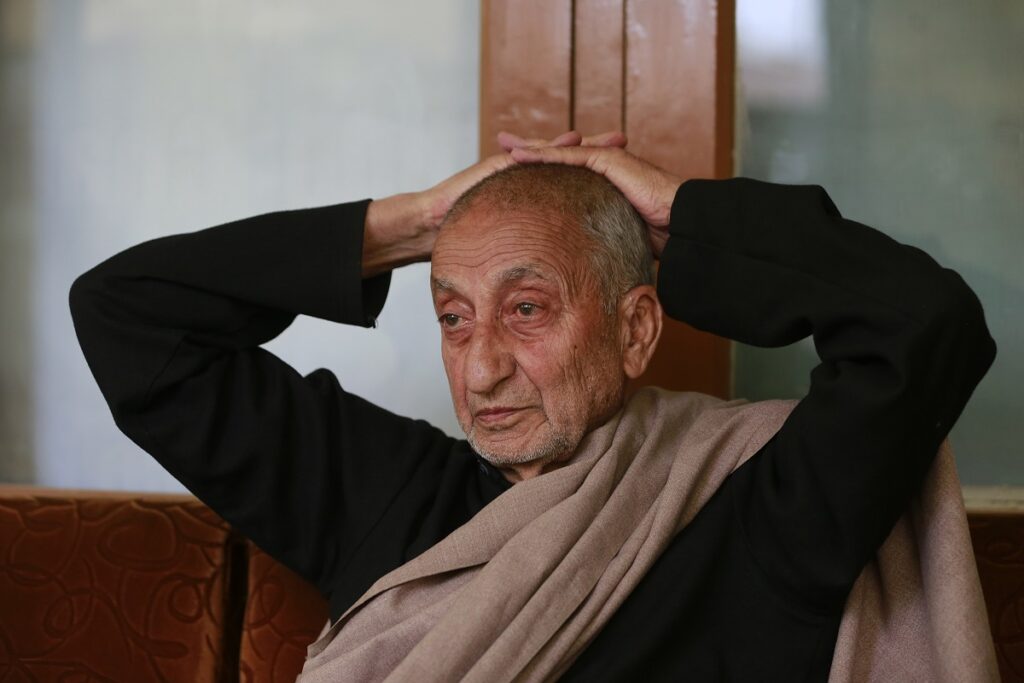
During the turbulent decade of the 1980s, after the fallout of the Indira–Sheikh accord in 1975, several new faces began to emerge in Kashmir’s political landscape. Among them was a lean, shaven man, barely five feet four inches tall. Early murmurs about him were almost dismissive, they say he is a teacher, but with an intellectual genius. That teacher was Professor Abdul Gani Bhat, a man who would go on to redefine parts of separatist politics, and at the same time, question its very foundations.
When Jagmohan was brought in as Governor of Jammu Kashmir during his first term in 1984, he imposed a string of policies that many Kashmiris believed were directed against the majority community. One decision shook Kashmir to its core: in the summer of 1986, dozens of government employees were terminated on charges of being “anti-national.” Among them was Professor Bhat, then a widely admired Persian scholar at Sopore College.
The dismissals were challenged in court, and while several employees were reinstated when the administration failed to prove its accusations, destiny had other plans for Professor Bhat. Soon after, he was summoned to a discreet meeting in Srinagar by the veteran cleric and future Hurriyat leader Molvi Abbas Ansari. What followed were a series of secret deliberations that would shape the course of Kashmir’s politics.
Within months, Professor Bhat became part of the core group of the newly formed Muslim United Front (MUF), a coalition born in opposition to Jagmohan’s policies. He played a pivotal role in drafting the MUF constitution alongside Dr. Ghulam Qadir Wani and Dr. Qazi Nisar. “Professor was the cream of the Front,” one MUF insider recalls. “He opposed contesting elections, believing it would compromise the moral position of the movement.” His fears proved prescient, when the MUF contested the 1987 assembly polls, allegations of rigging became the spark that lit the fire of the armed insurgency.
From those years onward, Bhat’s journey was marked by paradox. Though a founding figure in the Hurriyat Conference, he often resisted its politics and questioned its strategies more openly than anyone else within its ranks. While others spoke in absolutes, he preferred to prod with uncomfortable questions, sometimes angering colleagues but always reminding them that politics without introspection was blind.
The Rise of Professor Bhat
Born in 1939 in Botengo village near Sopore, Bhat studied Persian literature, political science, and law. He joined Government Degree College Sopore as a lecturer, quickly earning a reputation among students as a brilliant, if sometimes intimidating, teacher. “He would walk into the class with books tucked under his arm, never referring to notes, and weave entire lectures out of memory,” one of his former students remembers. “Even in politics, he always sounded like he was still in the classroom.”
His dismissal in 1986 abruptly ended his teaching career but pushed him onto a new path. He took charge of the Muslim Conference, an old political party, and began reorganizing it in the late 1980s. By 1993, with the insurgency at its peak, he became one of the founding members of the All Parties Hurriyat Conference (APHC), a coalition of over two dozen political, religious, and social organizations advocating Kashmir’s right to self-determination.
Bhat rose quickly within the Hurriyat, serving as its chairman in 2000 after the assassination of Abdul Gani Lone. His tenure was marked by attempts to maintain unity within the increasingly fractious alliance. “Professor was a man of words, not just slogans,” recalls a colleague from those years. “He was less interested in street power and more in shaping the intellectual core of the movement.”
He also led delegations to Pakistan and met foreign diplomats in India, especially during the brief thaw in Indo-Pak relations in the early 2000s. Yet his own politics was never straightforward. At times, he criticized Pakistan’s policies toward Kashmir. At others, he urged India to recognize the “sentiment” that, in his words, “was alive and kicking, passed from generation to generation.”
Bhat’s Uncompromising Voice in Kashmir Politics
Perhaps what defined Bhat most was his candor. In 2011, during a seminar in Srinagar, he dropped a political bombshell: the killings of prominent separatist leaders such as Mirwaiz Mohammad Farooq and Abdul Gani Lone in the 1990s were not carried out by Indian agencies, but by militants themselves. “It is time to speak the truth,” he declared. “Leaders from Mirwaiz to Lone sahib were not killed by India. They were killed by our own.”
The remarks drew fury from many in the separatist camp but also forced an uncomfortable reckoning. A year later, addressing a gathering in Sopore, he dismissed the United Nations resolutions on Kashmir as “not practicable.” “We cannot live in the past forever,” he said. “The world has changed, and we must change with it.”
Such statements isolated him within Hurriyat ranks. He was sometimes branded as inconsistent, even defeatist. Yet to others, he was simply refusing to indulge in comforting fictions. “Rigidity breaks,” he often told visitors at his Sopore home. “Flexibility survives.”
He was repudiated by many of his contemporaries for daring to articulate a view that unsettled the dominant narrative. What began as pamphlets circulated by an influential organisation soon crystallised into a systematic campaign of defamation. He was accused of transgressions he may never have imagined, let alone committed, and gradually cast in the public eye as compromised, unreliable, even suspect.
In Kashmir, such orchestrated campaigns rarely culminate in debate; they end instead in exile, in silencing, and often in death. For Bhat, it meant being pushed to the peripheries of the very movement he had helped shape, condemned by the colleagues with whom he once shared a platform, condemned to navigate politics under the twin burdens of suspicion and betrayal.
The assasination attempt, however, did not find him. In 1995, they struck his younger brother, Mohammad Sultan Bhat, a lawyer, who was shot dead outside his Sopore residence, a killing widely attributed to militants. Friends and admirers say that this tragedy deepened rather than diminished his intellectual restlessness, sharpening the philosophical streak that had always defined him. “Had he been allowed to lead this movement, we might have achieved a lot, but they did not let him,” said a former colleague at Muslim United Front.
Like many separatist leaders, he endured long spells of detention and house arrest. His Sopore home was regularly raided, his movements curtailed, his speeches monitored. Yet he maintained his routine of writing, reading Persian poetry, and receiving visitors. “He turned his home into a classroom,” a journalist who often interviewed him recalls. “He would provoke you, challenge you, argue endlessly. You left thinking, even if you disagreed with him.”
Legacy of a Thinker
In 2022, Bhat published his autobiography, Beyond Me, a dense blend of memoir, political critique, and philosophical musings. In it, he revisited his dismissal from academia, his rise in separatist politics, and his reflections on Kashmir’s unresolved conflict. “Life,” he wrote, “cannot be compartmentalized into politics, economics, or literature. It is one single, homogenous unit.”
The book was revealing in its contradictions. While defending the “sentiment of azadi,” he acknowledged the futility of maximalist positions. While critical of India’s policies, he also pointed to Pakistan’s role in complicating the conflict. For admirers, Beyond Me captured his restless intellect. For critics, it was evasive, offering more questions than answers.
Professor Abdul Gani Bhat’s death at the age of 86 closes a chapter in Kashmir’s separatist politics. He will be remembered less for mobilizing crowds than for his willingness to disrupt consensus. He was a separatist leader who urged dialogue from the start of his political career till the very end of it, unflinching
His contradictions were his essence. “He was never comfortable with easy answers,” says a former MUF colleague. “Even when you thought you had convinced him, he would return the next day with new doubts.”
In his final years, frailty slowed his public appearances but not his urge to speak. In one of his last addresses, he told a gathering: “Our wounds are deep, our tragedies many. But we cannot allow ourselves to be prisoners of despair. Hope is the only bridge that connects us to tomorrow.”
On Wednesday, as news of his death spread, tributes poured in from across Kashmir’s political spectrum. Hurriyat leaders described him as a “scholar-politician who never stopped questioning.” Journalists remembered his Sopore home as a place of “argument and poetry.” Former students recalled the teacher who never abandoned the classroom, even in politics.
Professor Bhat is survived by his family and by a legacy that defies easy categorization. To some, he was a courageous contrarian. To others, an unwavering leader. To most, he was simply “Professor”, a man who entered politics reluctantly, carried its burdens paradoxically, and left it still asking questions.
- News Deskhttps://thekashmiriyat.co.uk/author/kashmiriyat/

- News Deskhttps://thekashmiriyat.co.uk/author/kashmiriyat/

- News Deskhttps://thekashmiriyat.co.uk/author/kashmiriyat/
- News Deskhttps://thekashmiriyat.co.uk/author/kashmiriyat/
