

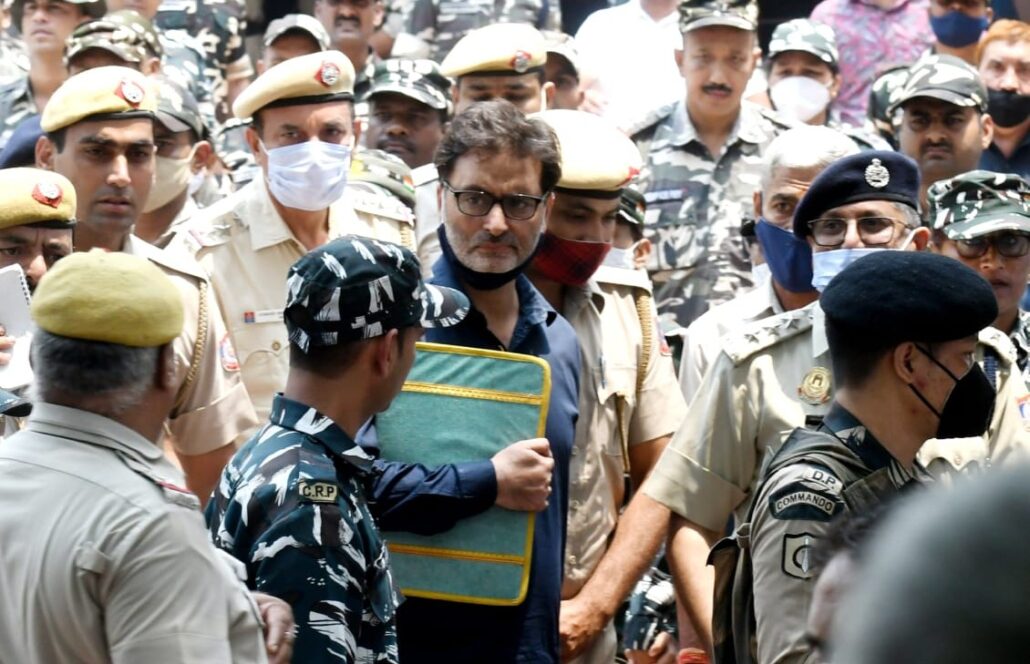
In a detailed affidavit before the Delhi High Court, jailed Kashmiri separatist leader Yasin Malik has claimed that his political journey was deeply shaped by state-sanctioned engagement, secret meetings with Indian leaders, and even international assignments, only to end in what he calls “betrayal” after the abrogation of Article 370, Kashmir Times reported.
Malik, chairman of the banned Jammu Kashmir Liberation Front (JKLF), is serving a life term after being convicted in a terror-funding case by the NIA. The agency has appealed to enhance his sentence to death. In his affidavit, Malik says he accepts his fate “gleefully,” but insists the Indian state cannot deny its long-standing engagement with him.
ALSO READ: Masarat Alam Bhat exposes Hurriyat funding network, NIA claims
Malik, in the affidavit, recounts being pulled into backchannel diplomacy in the 1990s, with then Prime Minister P.V. Narasimha Rao’s approval. From dinners at ministers’ homes to closed-door meetings with intelligence chiefs, Malik claims he was persuaded to give up arms and return to politics. In May 1994, after his release, he declared a unilateral ceasefire in Srinagar and embraced “non-violent democratic struggle.”
According to him, the state upheld its promise: 32 TADA cases against him were dropped, and successive prime ministers, Rao, Vajpayee, Gujral, Manmohan Singh and even Modi in his first term, allowed this truce to stand.
Malik narrates an unusual episode when R.K. Mishra, a close aide of Vajpayee, handed him a phone. On the other side was industrialist Dhirubhai Ambani, who encouraged him with words about “hard work” and resilience.
Ramzan ceasefire and later life
During the 2000 Ramzan ceasefire, Malik claims he was in touch with IB Director Shyamal Dutta and NSA Brajesh Mishra. A meeting hosted by journalist Prem Shankar Jha brought him face-to-face with Dr. Manmohan Singh and other Congress leaders, where he urged them to support Vajpayee’s peace efforts. The next day, Singh publicly endorsed the ceasefire.
Later, Singh allegedly told him: “I consider you the father of the non-violent movement in Kashmir.” Malik also recalls meetings with Sonia Gandhi, former prime ministers V.P. Singh and I.K. Gujral, as well as Left leaders who backed peace initiatives.
One of the most controversial episodes in Malik’s trial, his meeting with Lashkar-e-Taiba chief Hafiz Saeed in Pakistan, was, according to him, arranged by IB Special Director V.K. Joshi. Malik says he was asked to persuade militant leaders to embrace peace during Manmohan Singh’s tenure.
He claims he spoke publicly at a gathering with Saeed, urging militants to “purchase peace if it is offered.” On returning to India, he says, he debriefed the prime minister and NSA M.K. Narayanan, who thanked him. Years later, the same meeting was used as evidence to brand him a terrorist.
Malik also disputes charges of contact with a Pakistani handler named Parvaiz Ahmed. He alleges that IB Director Nehchal Sandhu himself created a Gmail account in that name for Track-II diplomacy, a fact he says could have been verified by the NIA but was ignored.
For nearly 25 years, Malik says, the state honoured its understanding with him. But after the revocation of Article 370 in August 2019, the atmosphere changed. Old cases were revived and fresh charges were pursued.
“The promise was followed by five prime ministers, including the present one in his first tenure. But after Article 370, everything changed,” he writes.
As the Delhi High Court weighs whether his life term should be converted into a death sentence, Malik ends his affidavit with fatalistic acceptance: “If the state chooses to disengage and disassociate from me as it once engaged, I will accept it, with a smile.”

- News Deskhttps://thekashmiriyat.co.uk/author/kashmiriyat/

- News Deskhttps://thekashmiriyat.co.uk/author/kashmiriyat/

- News Deskhttps://thekashmiriyat.co.uk/author/kashmiriyat/
- News Deskhttps://thekashmiriyat.co.uk/author/kashmiriyat/

