
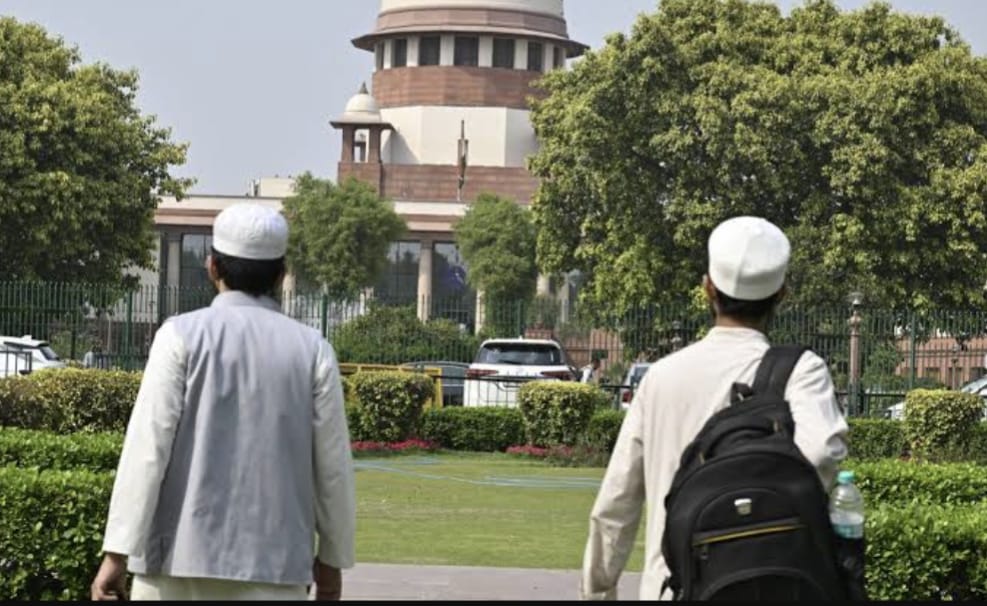
The Supreme Court on Monday passed an interim order on petitions challenging the Waqf Amendment Act, 2025, staying some provisions of the law while leaving others untouched.
The Court observed that certain clauses could operate arbitrarily and undermine constitutional principles if implemented without safeguards.
The Court stayed the requirement that a person must be a practitioner of Islam for at least five years to be eligible for positions under the Waqf law. It noted that without rules framed by state governments to determine such eligibility, the provision could lead to arbitrariness.
Another provision allowing the government to derecognize Waqf land during the pendency of encroachment disputes was also stayed. The Court said vesting such powers in the Collector violated the principle of separation of powers. It clarified that till title disputes are decided by the Waqf Tribunal or a competent court, the status of such land will not be affected. At the same time, no third-party rights are to be created on such properties.
On representation, the Court directed that the number of non-Muslim members in the Central Waqf Council shall not exceed four, and in State Waqf Boards, the number shall not exceed three.
The Court did not interfere with the provision allowing a non-Muslim to serve as CEO of a State Waqf Board. However, it said that as far as possible, the appointment should be made from within the Muslim community.
On the question of registration, the Court left the provision untouched but granted limited extensions to comply with the new timelines. The matter will now be taken up for further hearing after detailed arguments.

- News Deskhttps://thekashmiriyat.co.uk/author/kashmiriyat/

- News Deskhttps://thekashmiriyat.co.uk/author/kashmiriyat/

- News Deskhttps://thekashmiriyat.co.uk/author/kashmiriyat/
- News Deskhttps://thekashmiriyat.co.uk/author/kashmiriyat/
