

Syria’s interim president Ahmed al-Sharaa is signaling a surprising openness to normalizing relations with Israel, a development that just months ago would have seemed unthinkable, according to reports appearing in international outlets.
According to Middle East analyst Col. (res.) Dr. Moshe Elad, this shift reflects a dramatic change in regional priorities and alliances. “A handshake between Sharaa and Netanyahu at the White House is no longer unimaginable,” Elad said. “It could happen sooner than many expect.”
During the recent 12-day conflict between Israel and Iran, Sharaa refrained from interfering as Israeli aircraft used Syrian airspace to carry out strikes. When questioned, he is said to have asked, “With what exactly?” highlighting Syria’s limited military capacity. Elad argues that this stance reflects a strategic choice, one shared by several regional actors who prefer a new alignment over continued hostilities.
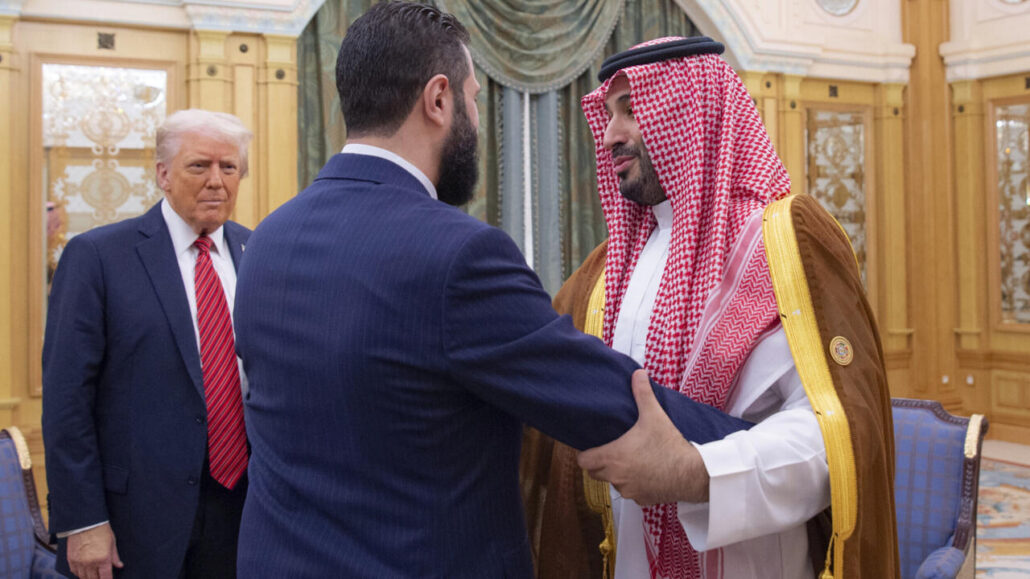
Recent meetings between Sharaa and U.S. officials have reinforced these signals. American congressmen Cory Mills and Martin Stutzman, who met the Syrian leader in Riyadh, reported that he expressed willingness to recognize Israel and even join the Abraham Accords.
According to them, Sharaa laid out three main conditions for this: halting Israeli airstrikes in Syria, ensuring Syria’s territorial unity is respected, and reaching an agreement on the Golan Heights. Former U.S. President Donald Trump, who also met with Sharaa, later announced the lifting of sanctions on Damascus and claimed that the Syrian leader had agreed in principle to normalization, though he cautioned that “there’s still work to do.”
Elad links this diplomatic outreach to a broader regional transformation. From Egypt’s peace treaty with Israel in 1979 to Jordan’s in 1994 and the more recent Abraham Accords, the momentum for normalization has grown. If Syria and Lebanon now follow, it would mark the unraveling of decades of enmity.
Elad recalls how, in 1949, Israel signed UN-mediated armistice agreements with its neighbors, including Syria and Lebanon. At the time, those agreements were seen by many in the Arab world as humiliating. But the geopolitical landscape has shifted significantly since then.
He also notes a growing willingness across the region to engage with Israel without linking it to the Palestinian issue.
“Previously, no Arab country would engage without a Palestinian solution,” Elad said. “Now, we’re seeing that change. Countries once firm in their stance—like Indonesia, Malaysia are reevaluating their positions. There’s even talk that the Palestinians themselves might eventually join the Abraham Accords without preconditions.”
However, while Sharaa attempts to reposition Syria diplomatically, his domestic policies tell a different story. Inside Syria, his government has intensified repression, particularly targeting religious leaders from the Hanafi school of thought.
Several prominent Sunni clerics have been arrested, including Mufti Ahmad Badr al-Din Hassoun, Syria’s former Grand Mufti, who has now spent over three months in prison. Other detained religious scholars include Sheikh Muhammad al-Qadri of Homs and Imam Mazin al-Hanbali from the Damascus countryside.
The Sharaa administration has also banned public religious observances long considered central to Sunni and Sufi traditions.
Mawlid celebrations, which commemorate the Prophet Muhammad’s birthday, were prohibited this year. Muharram processions, typically held across cities like Aleppo and Hama, were also blocked by authorities, prompting condemnation from religious councils and civil society groups. “These are people who taught prayer and peace,” said a Damascus resident. “Now they are treated like criminals.”
Despite these internal crackdowns, Elad remains convinced that Sharaa sees normalization with Israel as a historic opening. “Israel has become a hub for technological, agricultural, and medical cooperation across the Arab world,” he said. “The train has left the station. Syria might be preparing to board.”


- News Deskhttps://thekashmiriyat.co.uk/author/kashmiriyat/

- News Deskhttps://thekashmiriyat.co.uk/author/kashmiriyat/

- News Deskhttps://thekashmiriyat.co.uk/author/kashmiriyat/
- News Deskhttps://thekashmiriyat.co.uk/author/kashmiriyat/

