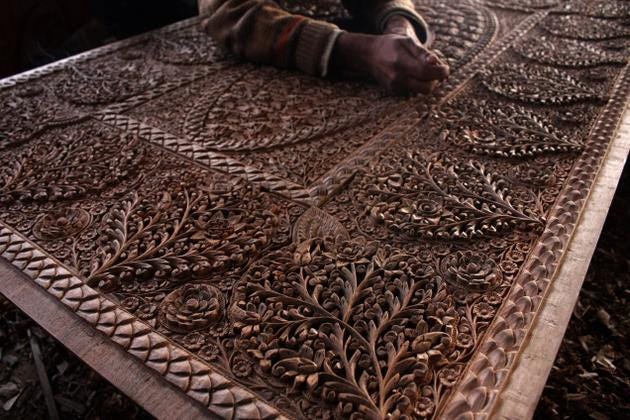
At the inaugural World Audio Visual and Entertainment Summit (WAVES 2025) held at the Jio World Convention Centre in Mumbai, Kashmiri handicrafts have emerged as an unexpected highlight. Amid the cutting-edge technology and discussions on digital futures, a dedicated exhibition of Kashmir’s centuries-old crafts—curated by SWADESH under the Reliance Foundation—has captivated international delegates, offering a tangible connection to India’s rich cultural heritage.
Over 10,000 delegates, including creators, companies, and startups from 90 countries, attended the summit, and many found themselves drawn to the intricate Kashmiri carpets and delicate embroidery. A tech executive from Singapore, who came to discuss advancements in artificial intelligence, admitted to spending nearly an hour mesmerized by the intricate craftsmanship of a Kashmiri silk carpet. Such moments underscored the enduring appeal of the region’s traditional crafts even in a high-tech environment.
The Kal Baffi carpets on display were particularly striking. These carpets, which date back to the 15th century, were introduced to Kashmir by Sultan Zain-ul-Abidin after he brought the art from Persia. The carpets’ remarkable knot density, ranging from 250 to 4600 knots per square inch, represents a level of precision and craftsmanship that has been passed down through generations. Visitors were particularly fascinated by the Talim system, a rare coded language used by master weavers to translate intricate designs into carpets with exceptional accuracy.
This rich tradition of carpet weaving is just one example of the enduring cultural legacy that Kashmir holds. The region’s handicrafts, especially carpets and Aari embroidery, have survived through centuries of cultural and political upheaval, continuously evolving while maintaining their core artistic values.
The history of these handicrafts traces back to Sultan Zain-ul-Abidin’s rule in the 15th century, when Persian weaving techniques were introduced to the region.
Over time, these skills became deeply embedded in Kashmiri culture, with the crafts influencing various aspects of life, including architecture, textiles, and trade. By the Mughal period, Kashmir had established itself as a hub for luxurious, handwoven carpets that were exported globally.
However, in recent years, the handicraft industry faced significant challenges. The introduction of Goods and Services Tax (GST) in 2017 severely impacted local artisans and traders, raising the cost of production and reducing market accessibility. Many artisans struggled to adapt, and the industry faced a decline in exports. Despite these challenges, the industry has rebounded. In 2023, Kashmiri handicrafts generated Rs 2,500 crore in exports, signaling a revival. This resurgence has been fueled by a growing international appreciation for Kashmir’s craftsmanship, and the sector has seen a renewed demand for traditional products like carpets, shawls, and embroidered textiles.
At WAVES 2025, the exhibition not only showcased the technical mastery of Kashmiri artisans but also emphasized how these traditional crafts contribute significantly to Kashmir’s socio-economic fabric. Artisans like Muhammad Amin Sheikh and Ghulam Muhammad Sheikh, whose carpets reflect a blend of Kashmiri and Persian influences, were among those whose works were featured, illustrating how these age-old techniques continue to thrive.
In addition to the carpets, the exhibition also highlighted the delicate art of Aari embroidery, where skilled artisans use a hooked needle to create elaborate patterns on textiles. The works of female artisans like Sahiba Sameer Pandit, who specializes in various embroidery styles, were prominently displayed, emphasizing the role of women in preserving and evolving these crafts.
- News Deskhttps://thekashmiriyat.co.uk/author/kashmiriyat/
- News Deskhttps://thekashmiriyat.co.uk/author/kashmiriyat/
- News Deskhttps://thekashmiriyat.co.uk/author/kashmiriyat/
- News Deskhttps://thekashmiriyat.co.uk/author/kashmiriyat/


