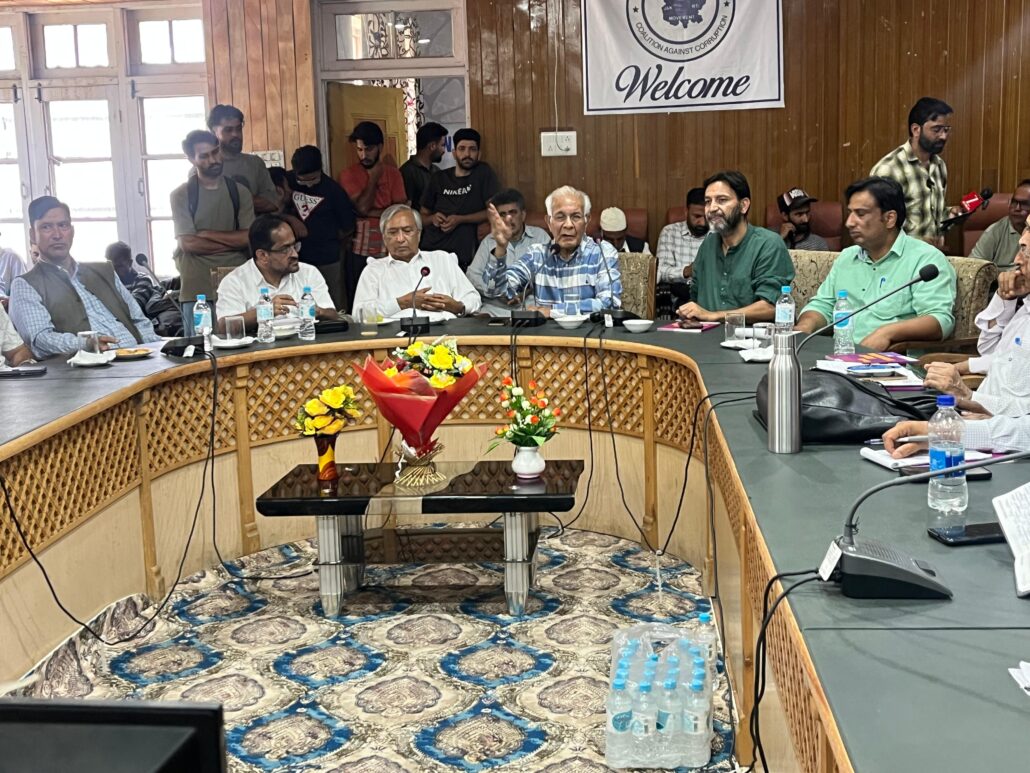
In a significant push to revive and strengthen transparency and civic participation in Jammu Kashmir, the JK RTI Movement, in collaboration with the Commonwealth Human Rights Initiative (CHRI), Uri Foundation, Kashmir Law Circle, and local civil society partners, held two impactful events — a two-day RTI capacity-building workshop in Srinagar (July 1–2) and a sensitization seminar in Kulgam (July 4).
These engagements, attended by lawmakers, administrators, journalists, lawyers, students, and civil society members, focused on the use of the Right to Information Act, 2005 as a democratic tool to strengthen citizen; government relationships, promote transparency, and address governance challenges.
Srinagar Workshop: RTI as a Tool of Empowerment
The Srinagar workshop featured prominent voices including MLA Kulgam Mohammad Yusuf Tarigami, MLA Wagoora-Kreeri Irfan Hafeez Lone, former Chief Information Commissioner Wajahat Habibullah, CHRI Director Venkatesh Nayak, and DDC Chairperson Safeena Beigh.
Tarigami emphasized the intrinsic connection between the right to life and the right to information, asserting that only an empowered public can push back against systemic dysfunction.
He critiqued the 2019 abrogation of Article 370 as an example of governance without public consultation, something, he said, that a robust RTI culture could have challenged.
Wajahat Habibullah called RTI “a tool intentionally made simple so that no citizen needs a lawyer to access information,” underscoring its potential to transform governance from the ground up.
A noteworthy highlight of the event was the launch of the first Urdu-language RTI guidebook, aiming to make the Act more accessible to people across Jammu Kashmir.
Participants also received hands-on training, drafting real RTI applications on issues of local governance, corruption, and service delivery.
Kulgam Seminar: RTI is Not Anarchy, It is Democratic Vigilance
Held on July 4 in Kulgam, the sensitization seminar echoed the urgency for greater grassroots awareness and action.
Wajahat Habibullah, addressing over 200 participants from DDCs and local civil society, urged citizens not to despair but to use RTI actively, especially with the recent introduction of online RTI portals in J-K
Presiding over the seminar, MLA Mohammad Yusuf Tarigami dismissed the notion that questioning authority is disruptive.
“Asking questions is not an act of anarchy — it is the foundation of democracy,” he said. “RTI helps repair the public’s confidence in governance and invites people into decision-making spaces.”
Tarigami cited worrying examples of bureaucratic opacity, such as delays in pension schemes and the absence of clear rules of business in the newly formed government, urging citizens to demand answers through peaceful and lawful means.
Dr. Shaikh Ghulam Rasool, Chairperson of J-K RTI Movement, reiterated that the RTI law is not merely a procedural tool but a means to reconfigure the citizen–state relationship. “In Kashmir, a land often silenced, asking questions is an act of resilience,” he said.
Venkatesh Nayak added that youth involvement has been encouraging, citing young lawyers and law students in Srinagar who identified local governance issues and used RTI to pursue answers. He reminded participants that the video conferencing appeal system now enables people in remote areas to interact directly with Central Information Commissioners from their district headquarters.
Local leaders in Kulgam, including DDC Chairperson Mohammad Afzal Parray and DDC Member Mohammad Abbas, welcomed the revival of the partnership with JK RTI Movement and CHRI, expressing hope that it will yield long-term transparency and accountability gains across the district.
Both events mark a resurgent phase for the RTI movement in JK, emphasizing youth leadership, public legal education, and grassroots empowerment.
- News Deskhttps://thekashmiriyat.co.uk/author/kashmiriyat/

- News Deskhttps://thekashmiriyat.co.uk/author/kashmiriyat/

- News Deskhttps://thekashmiriyat.co.uk/author/kashmiriyat/
- News Deskhttps://thekashmiriyat.co.uk/author/kashmiriyat/
