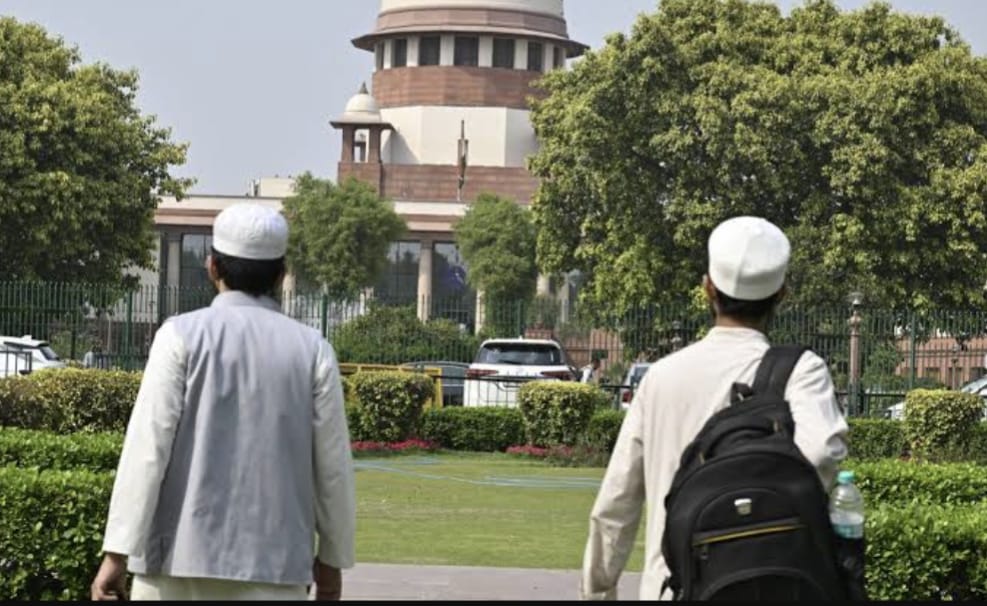
On May 22, the Supreme Court resumed hearing a batch of petitions challenging the constitutional validity of the Waqf Amendment Act, 2022 is under judicial review.
The case is being heard by a bench led by Chief Justice of India BR Gavai, along with Justice AG Masih.
The petitions question various provisions of the amended Act, with concerns ranging from alleged encroachment on religious freedoms to broader constitutional implications regarding property rights, administrative overreach, and the federal structure.
Petitioners argue that the amendments, including provisions allowing the Waqf Board to unilaterally declare properties as waqf without due process, are arbitrary and violate fundamental rights.
The Union Government, on the other hand, defends the law as a necessary step to streamline and improve the administration of waqf properties, while also maintaining constitutional compliance.
On May 21, the petitioners concluded their arguments. On May 22, the Union Government and other respondents continued their submissions before the court.
Live updates from today’s hearing:
Solicitor General Tushar Mehta: “Under the Shariah Act, if a Muslim wishes to avail personal law provisions, they must make a declaration identifying themselves as Muslim. A similar declaration is being sought under the present law. Yet, one of the petitioners is now challenging provisions from the 1995 Act.”
Chief Justice of India BR Gavai: “We will not entertain any plea that seeks to challenge the 1995 Act in the year 2025.”
Senior Advocate Guru Krishnakumar, appearing for the Waqf Board, referred to Section 32 of the Waqf Act, which requires the Board to act in accordance with the wishes of the waqif (the person who creates the waqf) while exercising its powers. He also cited Sections 96 and 97, which grant the Central Government the authority to issue directions to the Waqf Board, and empower State Governments to do so as well—though in the latter case, such directions must align with the overall objectives of the Act.
Senior Advocate Gopal Sankaranarayanan highlighted concerns over 280 monuments protected by the Archaeological Survey of India (ASI) that have reportedly been claimed as waqf properties. He also raised a constitutional issue regarding Section 25(2)(a), which allows the state to make laws related to economic, political, or other secular matters—even if they intersect with religious practices. He noted that the scope of judicial review in such matters is currently under examination by a nine-judge bench.
When Sankaranarayanan began to raise concerns regarding shrines like Shrur Mutt in the context of interim relief, Solicitor General Tushar Mehta clarified, “I am not supporting this argument.”
Sankaranarayanan responded by emphasizing that these underlying constitutional and legal questions will need to be addressed before the present matter can be conclusively decided.
CJI BR Gavai observes: “You have to satisfy that the Act is so arbitrary that it should be stayed.”
Senior Advocate Kapil Sibal responds, challenging the Union’s interpretation:
“A section cannot be interpreted based on counter affidavits or written submissions. It’s said Section 3C is just a revenue entry — that I won’t be evicted and title remains with me — but let’s read the section itself.”
Senior Advocate Gopal Sankaranarayanan states:
“When the claim is made under Article 25 and waqf is said to be an essential religious practice, that exact issue is already referred to a nine-judge bench.”
Solicitor General Tushar Mehta immediately clarifies: “No, no, no… I am not supporting the reference of this matter to a larger Bench.”
Sankaranarayanan replies: “Okay, but for interim relief, Shirur Mutt is referred, and that question—whether it qualifies as an essential religious practice—needs to be decided first.”
Kapil Sibal continued his submissions, stating, From 1954 to 2013, only one State completed the waqf survey. This happened due to whom? Communities will be deprived because of state govts not conducting surely. This is per expropriatory. “Jammu Kashmir – only 1 waqf registered… Uttar Pradesh – 0. Imagine, the Lucknow Imambara goes away. This is something drastic.”
Solicitor General Tushar Mehta responded sharply, saying, “The court is being taken for a ride.”
Sibal retorted, “You make all the statements and then accuse us of misleading the court.”
Chief Justice BR Gavai interjected, pointing out, “But see, there are other states… Tamil Nadu, Punjab, Kerala…”
Advocate A.M. Dar, appearing for a petitioner from Jammu Kashmir, began his rejoinder by emphasizing the religious significance of waqf in Islam. “I have come from Jammu Kashmir. I will show how waqf is an essential religious practice. It is there in Surah Al-Baqarah,” Dar said. He explained the etymology, saying, “‘Waqf’ comes from the Arabic word ‘waqafa,’ which means ‘to detain,’ ‘to hold,’ or ‘to tie up.’”
He further submitted: “There is a Sadqah Jariya — a continuous charity. This is the foundation stone of Islam. In 622, Hijri, waqf was introduced by the Prophet himself.” Turning to the ground situation in Jammu Kashmir, Dar noted: “In JK, there was no registration of waqf. Not under the 1970 Waqf Act, nor in 2003, nor in 2013. So many shrines in Jammu Kashmir are on waqf land.”
Senior Advocate Huzefa Ahmadi began his rejoinder by aligning with the broader challenge, stating, “I adopt the submissions of all my learned counsels.”
Addressing concerns around Section 3E, he argued that it unfairly targets tribal Muslims, “An impression was given that if a tribal wants to make a dedication in respect of a scheduled area, it cannot take place. So any dedication by a Scheduled Tribe Muslim will be void.”
He contended that rather than protecting tribal rights, the provision has the opposite effect,“It takes away rights rather than protecting them. It is said this is meant to protect tribals, but my submission is that the Act does not prohibit transfer. Therefore, transfers can still take place. It doesn’t protect tribals from illegal transfers — it only takes away his right to make a waqf.”
Arguments concluded; judgment reserved

- News Deskhttps://thekashmiriyat.co.uk/author/kashmiriyat/

- News Deskhttps://thekashmiriyat.co.uk/author/kashmiriyat/

- News Deskhttps://thekashmiriyat.co.uk/author/kashmiriyat/
- News Deskhttps://thekashmiriyat.co.uk/author/kashmiriyat/
